Mineralogy: The Science of Earth's Crystalline Materials
Mineralogy is a specialized branch of geology dedicated to the scientific study of minerals and mineralized artifacts. By integrating principles from chemistry, physics, geology, and materials science, mineralogists examine the chemical composition, crystal structure, and physical properties—including optical characteristics—of the inorganic solids that make up our world.
Beyond simple identification, the field explores the complex processes of mineral origin and formation, the systematic classification of species, their geographical distribution, and their practical utilization in industry and technology.
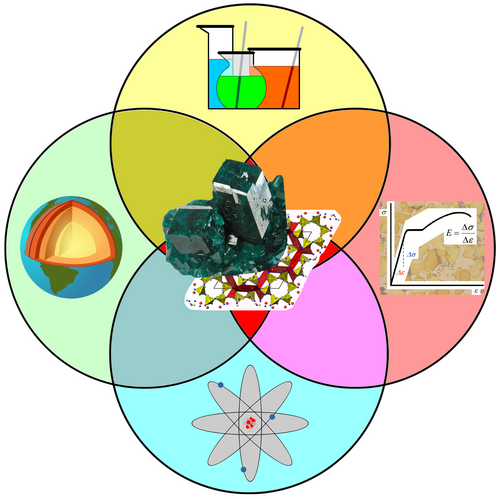
Key Facts
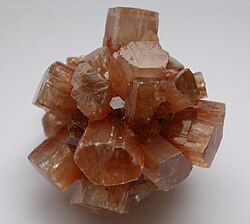
- Scope: Studies the chemistry, crystal structure, and physical properties of minerals.
- Diversity: There are over 6,000 named and unnamed minerals, with approximately 100 new species discovered annually.
- Hardness: The Mohs scale is the standard for relative hardness, ranging from 1 (talc) to 10 (diamond).
- Structure: Minerals are defined by a unit cell, a repeating basic pattern that forms a three-dimensional lattice.
- Classification: The International Mineralogical Association (IMA) regulates mineral nomenclature and classification.
The Evolution of Mineralogical Study
The roots of mineralogy stretch back to ancient Babylonia, the Greco-Roman world, ancient India, China, and the Islamic world. Early seminal works include Pliny the Elder's Natural History and Al-Biruni's Kitab al Jawahir (Book of Precious Stones). During the German Renaissance, Georgius Agricola advanced the field with De Natura Fossilium (1546) and De re metallica (1556).
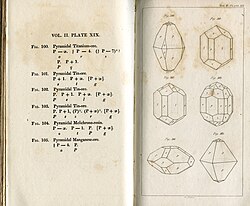
Modern mineralogy was forged through the development of crystallography (the study of crystal geometry) and the invention of the microscope in the 17th century. Key milestones include:
- 1669: Nicholas Steno observed the law of constancy of interfacial angles in quartz.
- Late 18th Century: René Just Haüy established that crystals are periodic, introducing the law of rational indices.
- 1814: Jöns Jacob Berzelius shifted classification toward chemistry rather than just structure.
- 1837: James D. Dana published A System of Mineralogy, establishing a chemical classification still used today.
- 1912: Max von Laue demonstrated X-ray diffraction, which was further refined by William Henry and William Lawrence Bragg to analyze crystal structures.
Physical and Optical Properties
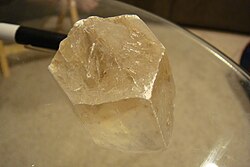
Hardness and the Mohs Scale
Hardness is typically determined by comparing a mineral's ability to scratch another. The Mohs scale provides a relative ranking from 1 (softest, talc) to 10 (hardest, diamond). While intuitive, this scale is nonlinear. For absolute measurements, scientists use a sclerometer. Some minerals, such as kyanite and calcite, exhibit hardness that varies depending on the direction of the measurement.
Crystal Structure and Symmetry
At the atomic level, a mineral's structure is a lattice of points repeating a unit cell in three dimensions. This lattice is defined by its dimensions (represented by Miller indices) and its symmetries, such as reflection, rotation, inversion, and rotary inversion. These symmetries form 32 possible crystal classes and 230 possible space groups.
![The perovskite crystal structure. The most abundant mineral in the Earth, bridgmanite, has this structure.[8] Its chemical formula is (Mg,Fe)SiO3; the red spheres are oxygen, the blue spheres silicon and the green spheres magnesium or iron.](/images/b2/1a/b21afb7a17475199270dcce8a593e6cb7117a6ccf57ced4b0f821462458ba228.jpg)
Some minerals are isomorphous, meaning they share the same crystal structure despite having different chemical compositions. For example, halite (NaCl) shares a space group (Fm3m) with sylvite (KCl) and galena (PbS).
Optical Analysis
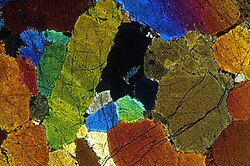
Mineralogists use polarizing microscopes to identify minerals via their optical properties. In transmitted light, isotropic crystals (which do not change the polarization of light) appear dark. By immersing these crystals in liquids with known indices of refraction, scientists can identify a Becke line—a bright perimeter line—to estimate the crystal's refractive index.
Chemical Analysis and Classification
![A color chart of some raw forms of commercially valuable metals.[30]](/images/b8/e8/b8e82ec84e7eb8eee732793b63cfdcd1382927e15aee9db5026cbd7bb2734743.jpg)
Since 1960, instrumental analysis has largely replaced wet chemistry. Modern techniques include atomic absorption spectroscopy (measuring the absorption spectrum of vaporized samples), X-ray fluorescence, electron microprobe analysis, and atom probe tomography.

Systematic Mineralogy
Systematic mineralogy focuses on the identification and classification of minerals. The International Mineralogical Association (IMA) manages the nomenclature to ensure consistency. Minerals are generally categorized into several classes:
| Class | Examples/Characteristics |
|---|---|
| Native Elements | Pure elements (e.g., Gold, Diamond) |
| Silicates | The most common rock-forming minerals |
| Carbonates | Includes Calcite and Aragonite |
| Oxides and Hydroxides | Minerals containing oxygen or hydroxyl groups |
| Sulfides and Sulfosalts | Sulfur-based compounds |
| Halides | Includes salts like Halite |
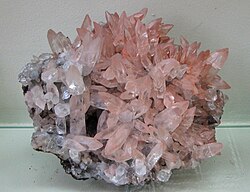
Formation and Mineral Ecology
Minerals form through various geological processes, including sublimation from volcanic gases, crystallization from magma or lava, deposition from hydrothermal brines, and recrystallization during metamorphic processes. They can also form through the weathering of rocks or during the diagenesis of sediments.
The Concept of Mineral Ecology
Recent advancements in big data, such as the Mineral Evolution Database, have led to the emergence of mineral ecology. This field examines whether mineral evolution is deterministic (driven by chemical stability and planetary composition) or the result of chance.
Research indicates a power law relationship between the abundance of elements and the number of minerals they form. While the general composition of a planet predicts common minerals, a "long tail" exists: 34% of minerals are found in only one or two locations, suggesting that rare minerals often form by chance.
![The Moon Mineralogy Mapper, a spectrometer that mapped the lunar surface[1]](/images/db/70/db7065f0c628c6b17fb4c46c7a965b6f5270380b7257e73b5e62cbbbff2234be.jpg)
Frequently Asked Questions
What is the difference between a mineral and a rock?
While the source focuses on mineralogy, minerals are the specific chemical compounds with a defined crystal structure that act as the building blocks for rocks, which are aggregates of one or more minerals.
How does the Mohs scale work?
The Mohs scale is a relative hardness scale from 1 to 10. It works on the principle that a harder mineral will scratch a softer one. For example, a mineral that scratches calcite (3) but is scratched by feldspar (6) falls between those two values.
What is a unit cell in mineralogy?
A unit cell is the smallest repeating unit of a crystal lattice. By repeating this basic pattern in three dimensions, the entire macroscopic crystal structure is formed.
How are new minerals officially recognized?
New minerals are regulated and named by the Commission on New Minerals, Nomenclature, and Classification, which is part of the International Mineralogical Association (IMA).
What is the role of X-ray diffraction in mineralogy?
X-ray diffraction is a critical tool used to analyze the internal crystal structure of minerals, allowing scientists to determine the precise arrangement of atoms within the lattice.