Mina Loy: The Avant-Garde Life of a Modernist Pioneer
Mina Loy was a formidable force in the early 20th-century avant-garde, bridging the worlds of poetry, painting, and feminist theory. Born into a complex multicultural household in London, she evolved from a classically trained artist into a central figure of the Modernist movement, navigating the intellectual hubs of Munich, Paris, Florence, and New York.
Early Life and Artistic Foundations
Born in Hampstead, London, Loy was the daughter of Julia Bryan, an English Protestant, and Sigmund Felix Löwy, a Hungarian Jewish tailor who had fled antisemitism in Budapest. Her early years were marked by a fraught family dynamic; her mother had married her father under the pressure of an unplanned pregnancy. This pattern of impulsive marriage following pregnancy would later mirror in Loy's own adult life.
Loy's formal art education began in 1897 at the St. John's Wood School, an experience she later described as a "haven of disappointment." Despite this, she developed a deep passion for the Pre-Raphaelites—artists known for their detailed, romanticized depictions of nature and mythology—specifically the works of William Morris and Edward Burne-Jones. She also studied the works of Dante and Christina Rossetti. Her creative expression often clashed with her mother's strict control, leading to instances where her artwork was destroyed for being too provocative.
European Studies and the Influence of Paris
In 1900, Loy expanded her horizons by attending the Munich Künstlerinnenverein (Society of Female Artists' School), where she mastered draughtsmanship. However, returning to London triggered a period of ill health diagnosed as neurasthenia—a common psychosomatic diagnosis for intellectual women of the era characterized by generalized weakness and respiratory issues.
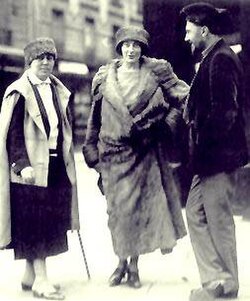
Seeking freedom, Loy moved to Montparnasse, Paris, in 1902 to study at the Académie Colarossi. Unlike her previous schooling, these classes were mixed-gender. It was here she met Stephen Haweis, an aesthete and painter. Their relationship was fraught with power imbalances; Loy later described Haweis as parasitic, noting how he exerted control over her while borrowing money he never repaid.
Marriage and Early Recognition
Loy and Haweis married in December 1903, while Loy was four months pregnant. During this time, she changed her surname from "Lowy" to "Loy," a shift her biographer Carolyn Burke suggests symbolized her attempts to resolve personal crises. While Haweis focused on photographies d'art (fine art photography) and commissions for Auguste Rodin, Loy began to establish her own reputation.
In 1905, she exhibited six watercolours at the Salon d'Automne. By 1906, her work was praised in the Gazette des Beaux-Arts for blending styles reminiscent of Guys, Rops, and Beardsley. This success led to her becoming a sociétaire, a prestigious status allowing her to exhibit without passing through a selection committee.
The Florence Years and the Futurist Movement
By 1906, Loy and Haweis lived separately, eventually relocating to Florence. This period was marked by personal tragedy and spiritual searching. After the death of her first child, Oda, and while dealing with the health struggles of her daughter Joella, Loy became a lifelong convert to Christian Science.
Between 1913 and 1916, Loy immersed herself in the Italian Futurist movement, led by Filippo Marinetti. She engaged in a complex love triangle with Marinetti and Giovanni Papini and exhibited her work at the First Free Futurist International Exhibition in Rome, serving as the sole representative for Britain. In 1914, she authored her Feminist Manifesto, a sharp polemic against the subordinate status of women, though it remained unpublished during her lifetime.
New York and the American Avant-Garde
Disillusioned by the "macho" nature of Futurism, Loy moved to New York in 1916. She quickly became a staple of the Greenwich Village bohemian scene, associating with figures such as Man Ray, Marcel Duchamp, and Marianne Moore. She contributed to Others magazine and acted in the play Lima Beans with the Provincetown Players.
In 1917, she met Arthur Cravan, a "poet-boxer." The two married in Mexico City in 1918, living in extreme poverty. Their relationship ended in mystery when Cravan disappeared at sea while testing a boat; though sightings were reported for years, he was presumed drowned.
Literary Contributions and Later Work
Loy's poetry caught the attention of Ezra Pound, who noted her "dance of the intelligence among words and ideas," describing her work as logopoeia (poetry focused on the intellectual modification of ideas rather than musicality). In 1923, she published her first volume of poetry, Lunar Baedeker.
In her later years, Loy returned to New York, living in the Bowery where she found inspiration in the city's destitute populations. She transitioned into found object assemblage art, creating constructions from discarded materials. She eventually moved to Aspen, Colorado, where she continued to write and create until her death from pneumonia in 1966.
Key Facts
- Artistic Range: Transitioned from watercolour painting to avant-garde poetry and found object assemblages.
- Feminist Pioneer: Wrote a significant Feminist Manifesto in 1914 while living in Florence.
- Futurist Connection: The only British artist to represent her country at the First Free Futurist International Exhibition in Rome.
- Literary Legacy: Published Lunar Baedeker (1923) and Lunar Baedeker & Time Tables (1958).
- Personal Life: Had four children across two marriages; two of her children died prematurely.
| Period | Location | Key Focus/Achievement |
|---|---|---|
| 1897–1902 | London & Munich | Early art education and draughtsmanship |
| 1902–1906 | Paris | Académie Colarossi; Salon d'Automne success |
| 1906–1916 | Florence | Futurism; Feminist Manifesto; Christian Science |
| 1916–1923 | New York & Mexico | Modernist poetry; Marriage to Arthur Cravan |
| 1936–1966 | New York & Aspen | Found object art; Naturalized US citizen |
Frequently Asked Questions
What was the significance of the name change from Lowy to Loy?
The shift from "Lowy" to "Loy" (and later "Lloyd") is viewed by biographers as a symbolic attempt to resolve personal crises and redefine her identity throughout her life.
What is "logopoeia" in the context of Mina Loy's poetry?
Coined by Ezra Pound, logopoeia refers to a style of poetry that prioritizes the "dance of the intelligence"—the manipulation of ideas and words—over traditional musicality or imagism.
What happened to Arthur Cravan?
Arthur Cravan disappeared without a trace while testing a boat he intended to use for escape. While some anecdotal reports suggested otherwise, he was presumed to have drowned.
What was the "Feminist Manifesto"?
Written in 1914, it was a galvanizing polemic that challenged the subordinate position of women in society, though it remained unpublished during Loy's lifetime.
What kind of art did Mina Loy create in her later years?
In her later years, particularly while living in the Bowery and Aspen, Loy focused on found object assemblage art, creating constructions from materials she encountered in her environment.