Microraptor: The Four-Winged Dinosaur of the Early Cretaceous
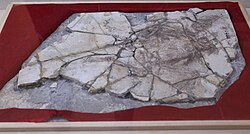
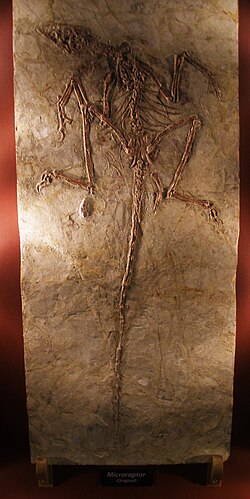
In the landscape of paleontology, few creatures challenge our understanding of flight as much as Microraptor. A small, feathered theropod from the Early Cretaceous period (approximately 120 million years ago), this dinosaur is renowned for a biological anomaly: it possessed four wings. By sporting flight feathers on both its arms and legs, Microraptor provides a critical glimpse into the experimental stages of avian evolution.
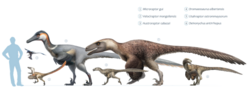
Initially discovered in China, Microraptor belongs to the family Dromaeosauridae—the same group as the famous Velociraptor—but on a much smaller scale. Its discovery has sparked intense scientific debate regarding whether the ancestors of birds were gliders, powered flyers, or ground-dwelling hunters who took to the skies later.
Key Facts
- Temporal Range: Early Cretaceous, roughly 120 million years ago.
- Unique Anatomy: Possessed long flight feathers on both forelimbs and hindlimbs.
- Size: Smallest known non-avian dinosaurs, with some specimens weighing between 0.5 and 1.88 kg.
- Coloration: Evidence suggests some individuals had iridescent black feathers.
- Classification: A member of the Dromaeosauridae family within the clade Microraptoria.
Taxonomy and Naming Controversies
The classification of Microraptor has been a subject of academic friction. In 2002, some researchers diagnosed a genus called Cryptovolans pauli, arguing it was a bird based on its primary feathers and fused sternum. However, subsequent analysis revealed that many of the features used to define Cryptovolans were also present in Microraptor, leading to the conclusion that they were the same animal.
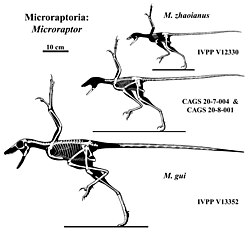
Within the genus, scientists have identified multiple species, including Microraptor zhaoianus, Microraptor gui, and Microraptor hanqingi. While some researchers suggested M. gui was a distinct species, others argued that the differences in size and proportion were simply a result of the animal's age.
Physical Description and Appearance
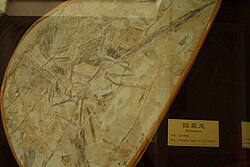
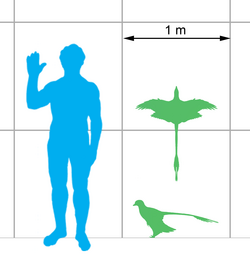
Microraptor was remarkably small. The holotype of M. gui measured 77 centimeters in length with a wingspan of 88–94 centimeters. Larger specimens reached lengths of at least 80 centimeters and wingspans exceeding 99 centimeters.
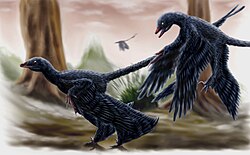
Beyond its size, its plumage was extraordinary. It featured a thick covering of feathers, including long plumes on its head—comparable to those of a modern Philippine eagle—and a diamond-shaped fan at the end of its tail, which likely provided stability during aerial maneuvers.
Coloration and Iridescence
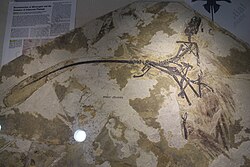
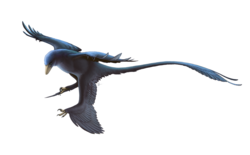
One of the most striking findings regarding Microraptor is its color. Analysis of fossilized melanosomes (pigment-containing organelles) indicates that at least some individuals possessed iridescent black coloration, similar to the glossy sheen seen on modern crows or starlings.
The Mechanics of Four-Winged Flight
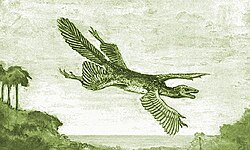
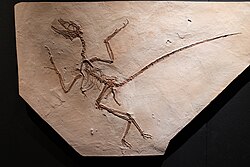
The most defining characteristic of Microraptor was its four-wing configuration. It had long, asymmetrical pennaceous feathers (vaned feathers) on both its arms and its legs. These were true flight feathers, anchored to the bone in a manner similar to modern birds, featuring both primary and secondary feathers.
The Biplane vs. Splayed-Leg Hypothesis
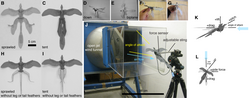
Paleontologists have long debated how Microraptor actually used these wings. One theory suggests a "biplane" arrangement, where the hindwings acted as a second set of lifting surfaces. However, wind tunnel experiments and physical models have challenged this.
A 2010 study suggested that a biplane model was structurally deficient and would require an unlikely weight distribution to glide. Instead, researchers proposed a laterally abducted configuration, where the legs splayed outward. This theory was countered by other scientists who argued that the hip anatomy of dromaeosaurs typically locks the legs in a vertical position, making a horizontal splay biologically improbable.
Paleobiology and Diet
While its flight capabilities are the primary focus, Microraptor's life on the ground was equally active. As a dromaeosaurid, it was a predator. Evidence from fossilized stomach contents suggests a generalist diet; specimens have been found with the remains of birds and lizards, indicating that Microraptor was an opportunistic hunter.
| Feature | M. gui (Holotype) | Larger Specimens |
|---|---|---|
| Body Length | 77 cm | ≥ 80 cm |
| Wingspan | 88–94 cm | > 99 cm |
| Estimated Weight | 0.5–1.4 kg | 1.25–1.88 kg |
| Wing Type | Four-winged (Fore and Hind) | Four-winged (Fore and Hind) |
Frequently Asked Questions
Was Microraptor a bird or a dinosaur?
Microraptor is classified as a non-avian dinosaur. Specifically, it was a dromaeosaurid theropod. While it shared many characteristics with birds, such as feathers and wings, it remains phylogenetically distinct from the lineage that led to modern birds.
Could Microraptor actually fly?
This is still debated. Some evidence suggests it was a glider that leaped from trees, while others argue it may have had limited powered flight. The four-wing structure was likely an evolutionary experiment in aerodynamics.
What did Microraptor eat?
Microraptor was a carnivore with a generalist diet. Fossil evidence shows it preyed upon small animals, including early birds and lizards.
Why did it have wings on its legs?
The hindwings likely increased the surface area for lift, aiding in gliding or stability. This "four-wing" stage is seen as a transitional or alternative evolutionary path toward the two-wing configuration of modern birds.
What color was Microraptor?
Based on the study of melanosomes in the fossils, scientists believe Microraptor had iridescent black feathers, giving it a shiny, metallic appearance.