Jinfengopteryx: The Feathered Troodontid of the Early Cretaceous
In the rich fossil beds of Hebei Province, China, paleontologists discovered a small but significant maniraptoran dinosaur known as Jinfengopteryx. Its name, derived from the Chinese word for "golden phoenix" (the queen of birds in folklore) and the Greek word pteryx (meaning "feather"), perfectly captures the essence of this creature: a bridge between the predatory dinosaurs of the past and the avian species of today.
Found in the Qiaotou Member of the Huajiying Formation, Jinfengopteryx dates back approximately 122 million years to the Early Cretaceous period. While its exact age is subject to some uncertainty, it likely correlates with the famous Yixian Formation, providing a glimpse into a world where feathers were becoming a defining characteristic of small theropods.
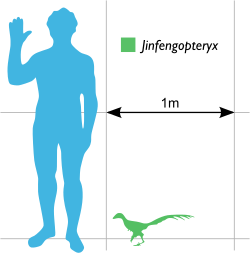
Key Facts
- Scientific Name: Jinfengopteryx elegans
- Temporal Range: Early Cretaceous (approx. 122 Ma)
- Location: Hebei Province, China
- Size: Approximately 55 cm (1.8 ft) in length
- Distinguishing Feature: First troodontid specimen to preserve evidence of feathers
- Diet: Potentially omnivorous, based on fossilized stomach contents
Physical Description and Anatomy
Jinfengopteryx is known from a single, nearly complete articulated skeleton (specimen CAGS-IG-04-0801). Measuring just 55 centimeters long, this small dinosaur possessed a body plan that blends classic theropod traits with avian-like features.
One of the most intriguing aspects of the specimen is the presence of several small, reddish-yellow oval structures. Researchers believe these may be seeds consumed by the animal before its death, which would suggest that Jinfengopteryx was an omnivore (an animal that eats both plants and meat). Alternatively, these structures could represent developing follicles or small eggs.
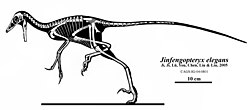
Feather Distribution
The fossil provides extensive evidence of pennaceous feathers (feathers with a central shaft and vanes). These impressions are found across the neck, body, hips, upper hindlimbs, tail, and near the manus (the end of the front limbs). While the neck and body were covered in short, simple feathers, the tail featured long, vaned feathers that increased in length toward the tip.
Interestingly, unlike some of its relatives such as Pedopenna or Anchiornis, Jinfengopteryx lacks flight feathers on its hind legs.
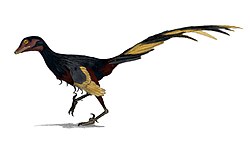
Flight Capabilities and Evolution
The question of whether Jinfengopteryx could fly has been a subject of scientific study. A 2020 analysis of paravian flight capacities suggests that Jinfengopteryx closely matches the flight potential of other non-avian flying theropods, such as Microraptor and Rahonavis, indicating that the capacity for powered flight was being approached by a wide range of avian relatives during this era.
Classification and Taxonomic History
The classification of Jinfengopteryx has evolved as more data became available. Initially, the describing authors categorized it as the most basal avialan (the clade containing birds and their closest relatives) and placed it within the family Archaeopterygidae.
However, subsequent research shifted this view. Paleontologist Luis Chiappe and others noted that Jinfengopteryx shared more characteristics with troodontids—a family of bird-like theropods—specifically an enlarged claw on its short second toe. By 2007, phylogenetic analyses confirmed its placement within Troodontidae, marking it as the first member of this group to show preserved feathers.
In 2012, a new subfamily, Jinfengopteryginae, was established to accommodate this genus. This subfamily is defined by unique anatomical traits, including a bifurcated jugal (a bone in the cheek) and large antorbital fenestrae (openings in the skull in front of the eye sockets).
| Feature | Detail |
|---|---|
| Length | 55 cm (1.8 ft) |
| Classification | Troodontidae $\rightarrow$ Jinfengopteryginae |
| Feather Types | Simple (body) and Vaned (tail) |
| Dietary Evidence | Possible seeds (Omnivorous) |
| Age | ~122 Million Years Ago |
Frequently Asked Questions
Was Jinfengopteryx a bird or a dinosaur?
While originally described as a basal bird (avialan), current scientific consensus classifies Jinfengopteryx as a troodontid dinosaur, which is a close relative of birds.
Could Jinfengopteryx fly?
Research from 2020 suggests that its flight capacities were similar to other flying non-avian theropods like Microraptor, indicating it had the potential for flight.
What did Jinfengopteryx eat?
The discovery of reddish-yellow oval structures in the fossil, which may be seeds, suggests that Jinfengopteryx was likely an omnivore.
What makes the Jinfengopteryginae subfamily unique?
This subfamily is distinguished by specific skeletal features, including a bifurcated jugal bone and large antorbital fenestrae in the skull.
Where was Jinfengopteryx discovered?
The fossil was found in the Qiaotou Member of the Huajiying Formation in Hebei Province, China.