Metro-North Railroad: Connecting the Hudson Valley, Connecticut, and New York City
The Metro-North Railroad is a vital artery of the tri-state area's transportation network, providing essential commuter rail services across the lower Hudson Valley, southwestern Connecticut, and northern New Jersey. Operated by the Metropolitan Transportation Authority (MTA), it links suburban communities to the economic heart of Manhattan, ensuring thousands of daily passengers reach their destinations efficiently.
From the scenic vistas of the Hudson River to the bustling hubs of Connecticut, Metro-North manages a complex system of five rail lines and three branches, serving 124 stations. Whether traveling for business or leisure, the railroad offers a reliable alternative to highway congestion in one of the world's most densely populated regions.
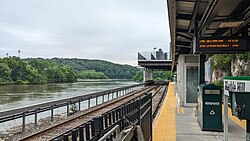
Key Facts
- Owner: Metropolitan Transportation Authority (MTA).
- Daily Ridership: 233,100 (Weekdays, Q1 2026).
- Annual Ridership: 71,758,600 (2025).
- System Reach: 787 miles total length, with 385 miles of active routes.
- Primary Hub: Grand Central Terminal in New York City.
- Infrastructure: Utilizes a mix of third rail (750 V DC) and overhead line (12.5 kV 60 Hz AC) electrification.
System Overview and Operations
Metro-North operates a diverse network designed to handle massive passenger volumes. The system is characterized by a variety of track environments, including at-grade, elevated, and underground sections. The railroad uses standard gauge tracks (4 ft 8.5 in) to maintain compatibility with other North American rail systems.
Service Areas and Lines
The network is broadly divided by the Hudson River. East of the river, the system is anchored by three primary lines: the Hudson Line, the Harlem Line, and the New Haven Line (which includes the Danbury and Waterbury branches). West of the Hudson, services are operated in conjunction with NJ Transit, including the Port Jervis and Pascack Valley lines.
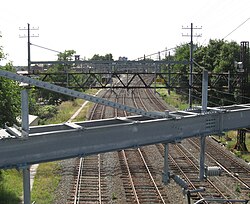
Technical Infrastructure
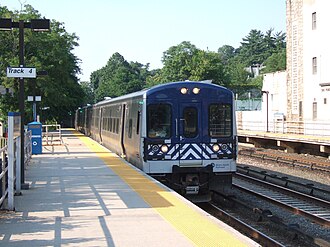
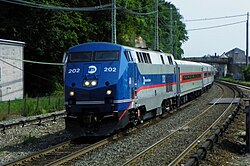
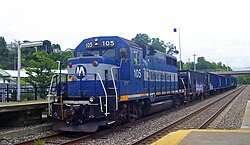
To power its fleet, Metro-North employs two different electrification methods. The third rail system is common in the inner suburbs and tunnels, while overhead catenary lines provide power for longer stretches, particularly on the New Haven Line. This dual-system approach allows for a variety of rolling stock, including the M7 electric multiple units and GE P32AC-DM dual-mode locomotives.
Historical Evolution
The roots of Metro-North lie in the legacy of the New York Central Railroad (NYC). Historically, the Harlem Line was a combination of the New York and Harlem Railroad and the Boston and Albany Railroad. In 1873, Cornelius Vanderbilt integrated these lines into his railroad empire, eventually establishing Grand Central Depot (the predecessor to the current Grand Central Terminal) as the southern terminus.
Following the decline of private rail ownership and the era of Penn Central and Conrail, the MTA took over operations in 1983, rebranding the service as Metro-North. Early investments focused on modernization, such as extending third-rail electrification to Southeast (formerly Brewster North) in 1984 and implementing modern cab signaling to replace older wayside signals.
Modern Initiatives and Future Expansion
Metro-North continues to evolve to meet the needs of a growing population. A major recent milestone was the 2010 upgrade of the Operations Control Center (OCC) at Grand Central Terminal, which modernized the hardware and software used to manage train movements.
Penn Station Access
One of the most significant upcoming projects is Penn Station Access, scheduled for 2027. This initiative will allow New Haven Line trains to access New York Penn Station via the Bronx, providing commuters with a direct link to the West Side of Manhattan and easier transfers to Amtrak and Long Island Rail Road services.
Service Adjustments
The railroad frequently adapts its routes based on state directives and partnership agreements. While there were plans to extend Hudson Line service from Poughkeepsie to Albany–Rensselaer in 2026, these were later countered by notifications from Amtrak regarding the restoration of Empire Service, leading to a reconsideration of temporary Metro-North extensions to Albany.
System Summary
| Feature | Details |
|---|---|
| Chief Executive | Justin Vonashek |
| Headquarters | Graybar Building, New York, NY |
| Number of Stations | 124 |
| Reporting Marks | MNCW |
| Electrification | Third Rail (DC) & Overhead Line (AC) |
| Primary Terminus | Grand Central Terminal |
Frequently Asked Questions
What are the main lines operated by Metro-North?
The primary lines east of the Hudson River are the Hudson Line, the Harlem Line, and the New Haven Line. West of the Hudson, the system includes the Port Jervis Line and the Pascack Valley Line.
Where is the main headquarters of Metro-North located?
The headquarters are located in the Graybar Building at 420 Lexington Avenue, New York, New York.
What is Penn Station Access?
Penn Station Access is a project expected to be completed by 2027 that will extend New Haven Line service into New York Penn Station, adding several new stops in the Bronx.
How is the Metro-North system powered?
The system uses a combination of 750 V DC third rail and 12.5 kV 60 Hz AC overhead lines to power its trains.
Who owns and operates the railroad?
The railroad is owned by the Metropolitan Transportation Authority (MTA), with certain services west of the Hudson operated in conjunction with NJ Transit.