Metal Stamping: Processes, History, and Industrial Applications
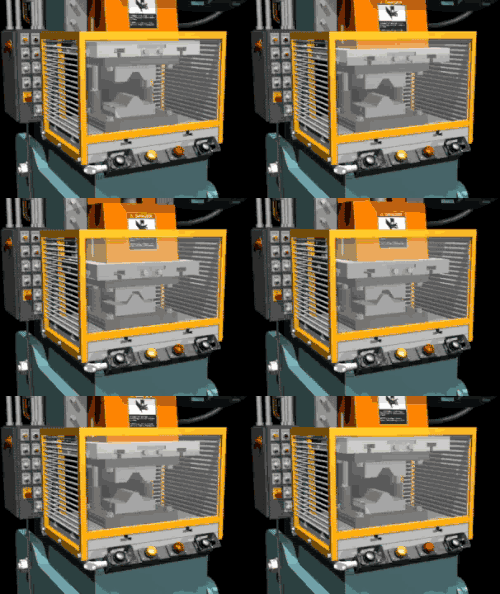
Metal stamping is a precision manufacturing process that transforms flat sheet metal—supplied either as individual blanks or in continuous coils—into specific shapes using a stamping press. By utilizing a tool and die surface, the press applies immense pressure to form the metal into a desired geometry. This versatile method encompasses various sheet-metal forming techniques, ranging from simple punching to complex multi-stage operations.
While most commonly performed on cold metal sheets, the process can also be applied to other materials, such as polystyrene. In high-volume production, progressive dies are used. These are fed from a coil reel that unwinds the material into a straightener to remove the "coilset" (the material's tendency to remain curved). A feeder then advances the material into the press at a predetermined length, moving through multiple stations to complete the part's complexity.
Key Facts
- Versatility: Includes processes like blanking, embossing, bending, and coining.
- Material Range: Primarily used for cold metal sheets, but applicable to polymers like polystyrene.
- Efficiency: Progressive stamping allows for multiple operations in a single strip of material.
- Modern Tech: Simulation software (non-linear finite element analysis) is used to predict defects before physical tooling is built.
- Miniaturization: Microstamping is an emerging field for medical and electronic components.
The Evolution of Stamping
The origins of stamping date back to the seventh century B.C., when the Lydians in modern-day Turkey are believed to have struck the first coins. For centuries, hammering remained the standard until Marx Schwab of Germany introduced a process involving a large wheel turned by up to 12 men to press coins.
The 1880s marked a turning point for industrial mass production. Stamping began replacing die forging and machining for bicycle parts, significantly reducing costs. Although stamped parts were not as strong as forged ones, their quality was sufficient for the market. By 1890, the United States began building custom stamping machines to compete with German imports, with companies like Western Wheel leading the research.
The automotive industry eventually adopted the process out of necessity. While Henry Ford initially resisted stamped parts in favor of die forging, the overwhelming demand for vehicles forced his company to adopt stamping to maintain production rates. Today, interconnected automation and advanced presses continue to increase production speeds while enhancing worker safety.
Core Stamping Operations
Depending on the desired end product, different mechanical operations are employed:
- Bending: Deforming material along a straight line.
- Flanging: Bending material along a curved line.
- Embossing: Stretching material into shallow depressions, often for decorative patterns.
- Blanking: Cutting a piece out of a sheet to create a blank for further processing.
- Coining: Squeezing a pattern into the material, traditionally used for currency.
- Drawing: Stretching a blank into an alternate shape via controlled material flow.
- Stretching: Increasing the surface area via tension without inward edge movement, common in auto body parts.
- Ironing: Reducing the thickness of a vertical wall, used for ammunition cases and beverage cans.
- Reducing/Necking: Gradually reducing the diameter of a tube or vessel's open end.
- Curling: Deforming material into a tubular profile, such as door hinges.
- Hemming: Folding an edge over itself to increase thickness, common in car doors.
Lubrication and Tribology
Because the stamping process involves significant friction—a study known as tribology—lubricants are essential. These substances protect the tool and die from galling (surface damage) and prevent the sheet metal from ripping, tearing, or wrinkling. Lubricants range from traditional plant, mineral, and animal fat-based oils to graphite and acrylic dry films. Modern industry has shifted toward polymer-based synthetic (oil-free) lubricants and water-based compounds.
Advanced Technologies in Stamping
Forming Simulation
To reduce costs and lead times, manufacturers use sheet metal forming simulation. This application of non-linear finite element analysis allows designers to predict defects such as wrinkles, splits, material thinning, and springback in a virtual environment. This eliminates the need for expensive physical tryouts and allows for rapid design optimization, a practice particularly critical in the automotive sector.
Microstamping
As technology trends toward miniaturization, microstamping has emerged as an alternative to chemical etching and machining. This process creates tiny components such as microswitches, electrical connectors, wristwatch parts, and medical devices. While promising, the industry is still addressing challenges regarding quality control and the mechanical properties of materials at such a small scale.
Industry Applications
Metal stamping is utilized across nearly every major industrial sector, utilizing materials from common base metals to rare alloys like beryllium copper for its thermal and electrical conductivity.
| Sector | Typical Applications |
|---|---|
| Automotive | Body panels, structural components |
| Aerospace & Defense | High-conductivity components, specialized alloys |
| Electronics | Connectors, microswitches, handheld device parts |
| Medical | Surgical instruments, medical device components |
| Consumer Goods | Appliances, jewelry, lock hardware |
| Industrial | HVAC, plumbing, power tools, agriculture |
Frequently Asked Questions
What is the difference between stamping and forging?
Stamping typically involves forming cold metal sheets using a press and die, whereas forging generally involves hot metal forming operations to create stronger, denser parts.
What is a progressive die?
A progressive die is a series of stations arranged in a row. A strip of material passes through these stations one step at a time, with each stroke of the press performing a different operation until the final part is completed.
Why is simulation important in the stamping process?
Simulation allows toolmakers to identify potential defects like springback or thinning virtually. This reduces the need for costly physical prototypes and accelerates the time-to-market for new products.
What are the benefits of synthetic lubricants in stamping?
Polymer-based synthetic lubricants provide an oil-free alternative that protects tool surfaces from abrasion and facilitates smoother material flow, reducing the risk of rips and tears in the finished part.
What is microstamping used for?
Microstamping is used to create miniature components for high-precision industries, including electrical connectors, micromeshes, and components for medical devices and electron guns.