Melting Pot Theory: The Evolution of Cultural Assimilation and Pluralism
The melting pot is a powerful metaphor used to describe a heterogeneous society—one composed of diverse elements—becoming more homogeneous. In this process, different nationalities, ethnicities, and cultures "melt together" to form a common culture or monoculture. Conversely, the term can describe a homogeneous society becoming more diverse through the influx of foreign elements. When this process results in a harmonious, hybridized society, it is known as cultural amalgamation.
While most famously associated with the United States and the integration of immigrants, the concept also relates to cultural additivity, where different cultural layers coexist and interact. Over time, the debate has shifted from the idea of total assimilation to models that celebrate distinct cultural identities.
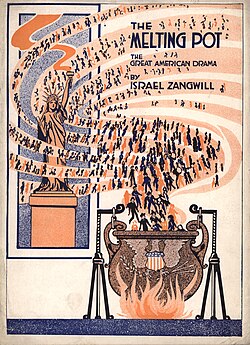
Key Facts
- Origin: While the "melting together" metaphor existed by the 1780s, the specific term "melting pot" was popularized by Israel Zangwill's 1908 play.
- Core Concept: It represents the fusion of diverse backgrounds into a single, unified national identity.
- Alternative Models: Proponents of multiculturalism prefer metaphors like the "salad bowl" or "kaleidoscope," where cultures mix but remain distinct.
- Cultural Pluralism: A counter-theory coined by Horace Kallen that rejects total assimilation in favor of maintaining diverse cultural heritages.
Historical Development in the United States
The idea of immigrants blending into a receiving culture appears early in American literature. In 1782, J. Hector St. John de Crèvecœur questioned the nature of the "new man" in Letters from an American Farmer, suggesting a fusion of ethnicities. Later, in 1845, Ralph Waldo Emerson described America as a Utopian product of a "smelting pot," though his notes were not published until 1912.
By the late 19th century, the metaphor became more explicit. In 1893, historian Frederick Jackson Turner described the American frontier as a crucible—a container used for high-temperature chemical reactions—where immigrants were "Americanized" and fused into a mixed race. Henry James also noted this phenomenon in 1905, describing New York City as a "vast hot pot" of cultural elements.
Mechanisms of Integration
Throughout history, various social activities served as catalysts for this melting process. Baseball, for instance, was viewed as a real-world crucible. In the wake of the Civil War, the sport helped integrate immigrants in New York City. Later, the breaking of the color line by Jackie Robinson in 1947 helped reduce racial segregation and improved race relations through athletic integration.
The Complexity of Racial Influence and Media
The "melting pot" has not always been an egalitarian process. Historians note that white Americans often appropriated elements of African-American culture—such as jazz and early cinema—to construct an urban popular culture. This allowed European immigrants to express themselves as "American" while African Americans continued to face second-class citizenship.
This dynamic is evident in early Hollywood films like The Jazz Singer (1927). Historian Michael Rogin describes this as a "racial masquerade," where white immigrants could adopt and discard masks of difference, unlike racially stigmatized groups.
Cinema and the "Melting Pot Platoon"
During World War II, combat films like Bataan (1943) introduced the "melting pot platoon." This cinematic convention depicted multiracial units working in solidarity, symbolizing an integrated American community that did not yet exist in reality. However, historian Richard Slotkin argues that this harmony was often predicated on a shared hatred for a dehumanized enemy.
Modern Interpretations and Global Context
The melting pot image saw a resurgence during the 2002 Winter Olympics in Salt Lake City. The success of African American, Mexican American, Asian American, and Native American athletes in traditionally European events served as a showcase of American nationalism and religious tolerance.
Despite these moments, the academic trend has moved toward cultural pluralism. This movement, led by intellectuals like Horace Kallen and Randolph Bourne in the early 20th century, argued against the pressure to assimilate. Since the 1960s, sociology and history have largely moved away from the melting pot theory in favor of models that recognize the persistence of ethnic identity.
| Model | Metaphor | Core Philosophy | Outcome |
|---|---|---|---|
| Assimilation | Melting Pot | Blending into a common culture | Homogeneity (Monoculture) |
| Multiculturalism | Salad Bowl / Kaleidoscope | Coexistence of distinct cultures | Heterogeneity (Diversity) |
| Amalgamation | Hybridization | Fusion of elements into something new | Harmonious Hybrid Society |
Frequently Asked Questions
What is the difference between a melting pot and a salad bowl?
The melting pot suggests that different cultures blend together to create a single, uniform identity. The salad bowl metaphor suggests that different cultures coexist within a society while maintaining their unique characteristics and distinctions.
Who popularized the term "melting pot"?
While the concept existed earlier, the specific term was brought into general usage by Israel Zangwill in his 1908 play titled The Melting Pot.
What is cultural pluralism?
Cultural pluralism is the belief that smaller groups within a larger society should maintain their unique cultural identities, and that their differences should be accepted and respected rather than erased through assimilation.
How did sports contribute to the melting pot effect?
Sports like baseball acted as social crucibles where people of different races and nationalities interacted, competed, and adhered to shared standards, which helped facilitate the integration of immigrants and the gradual reduction of racial segregation.
Is the melting pot theory still used in sociology?
Since the 1960s, much of the research in sociology and history has moved away from the melting pot theory, preferring models that account for cultural diversity and the complexities of interethnic relations.