Melanopareia: The Unique Crescentchests of South America
The crescentchests are a specialized genus of suboscine passerine birds—birds with a simpler vocal organ than songbirds—native to the diverse landscapes of South America. Known for their striking appearance and elusive nature, these birds occupy a unique niche in the avian world, characterized by their preference for arid scrublands and a distinctive plumage pattern that gives them their name.
Key Facts
- Family: Melanopareiidae (established formally in 2009).
- Physical Traits: Length of 14–16 cm and weight of 16–23 g.
- Defining Feature: A prominent band across the chest.
- Habitat: Arid scrub environments across South America.
- Species Count: Four distinct species within the genus Melanopareia.
Taxonomy and Classification
The genus Melanopareia was first introduced in 1853 by German naturalist Ludwig Reichenbach. The name is derived from the Ancient Greek words melas/melanos (black) and parēion (cheek). For many years, these birds were classified alongside tapaculos in the family Rhinocryptidae. However, their taxonomic placement was questioned, leading the South American Classification Committee to propose a separate family in 2007.
By 2009, the family Melanopareiidae was formally erected and subsequently accepted by major authorities, including the International Ornithological Congress Bird List and the Clements Checklist. The type species for the genus is the olive-crowned crescentchest (Synallaxis maximiliani), as selected by zoologist George Gray in 1855.
Physical Characteristics and Ecology
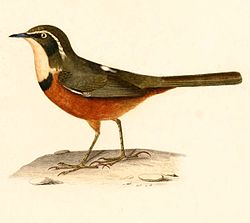
Crescentchests are small birds, typically measuring between 14 and 16 cm in length and weighing between 16 and 23 g. Compared to the tapaculos they once shared a family with, crescentchests possess relatively longer tails. Their most identifying feature is the striking band across the chest.
These birds are specialists of arid scrub habitats. While they are primarily ground-foraging birds, specific details regarding their diet have not yet been formally recorded. Their distribution varies by species: the collared and olive-crowned crescentchests are widespread across northern Argentina, Paraguay, Bolivia, and central Brazil, while the elegant and Marañón crescentchests are restricted to Ecuador and Peru.
Behavior and Breeding
Much of the behavior of the Melanopareia genus remains a mystery to science. The most detailed information available pertains to the olive-crowned crescentchest, which is a seasonal breeder. This species constructs a cup-shaped nest approximately 15 cm high, utilizing palm fronds and vegetable fibers. These nests are typically hidden in low shrubs or grasses close to the ground.
The olive-crowned crescentchest typically lays a clutch of two to three eggs. These eggs are white and characterized by black spots or blotches.
Species Overview
There are currently four recognized species within the genus. While most are listed as Least Concern (LC) by the IUCN, the Marañón crescentchest is categorized as Near Threatened due to its very small global range and uncommon status within that range.
| Common Name | Scientific Name | Primary Range | IUCN Status |
|---|---|---|---|
| Collared Crescentchest | M. torquata | Central Brazil, NE Bolivia, N Paraguay | Least Concern |
| Olive-crowned Crescentchest | M. maximiliani | Argentina, Bolivia, Paraguay | Least Concern |
| Marañón Crescentchest | M. maranonica | S Ecuador, N Peru | Near Threatened |
| Elegant Crescentchest | M. elegans | Ecuador, Peru | Least Concern |
Frequently Asked Questions
Why are they called crescentchests?
They are named for the distinctive, striking band of plumage that runs across their chest, resembling a crescent.
How does their classification differ from tapaculos?
Although previously placed in the family Rhinocryptidae with tapaculos, they were moved to their own family, Melanopareiidae, in 2009 after their taxonomic placement was questioned.
Where can crescentchests be found in the wild?
They are native to South America, specifically inhabiting arid scrublands in countries such as Brazil, Bolivia, Paraguay, Argentina, Peru, and Ecuador.
Which species is most at risk?
The Marañón crescentchest is the most vulnerable, listed as Near Threatened because it has a very restricted global range and is uncommon even within its habitat.
What is known about their nesting habits?
Based on the olive-crowned crescentchest, they build 15 cm high cup nests from vegetable fibers and palm fronds, hidden in low vegetation near the ground.