Medium-Density Fibreboard (MDF): Properties, Manufacturing, and Applications
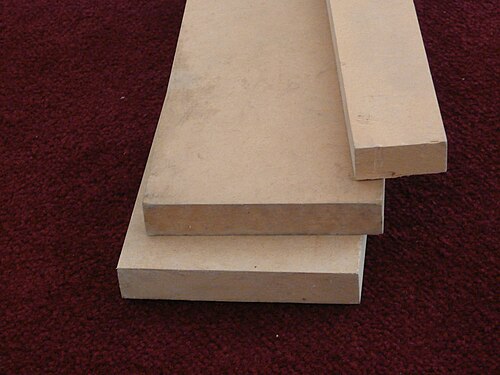
Medium-density fibreboard (MDF) is a versatile engineered wood product created by breaking down hardwood or softwood residuals into wood fibres. These fibres are combined with wax and a resin binder, then formed into dense panels using high temperature and pressure. While it is composed of separated fibres, it serves as a building material similar to plywood, though it is generally denser than plywood and stronger than particle board.
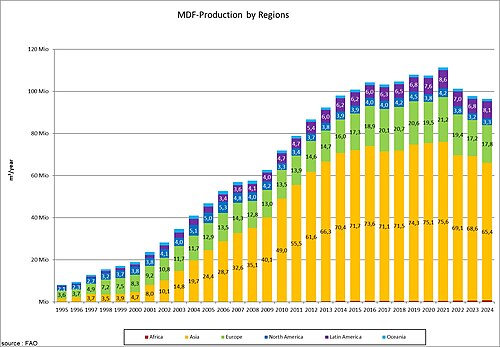
Large-scale production of MDF began in the 1980s across North America and Europe. Over time, the term has evolved into a generic name for any dry-process fibreboard.
Key Facts
- Composition: Typically consists of 82% wood fibre, 9% urea-formaldehyde resin, 8% water, and 1% paraffin wax.
- Density: Generally ranges between 500 and 1,000 kg/m³.
- Uniformity: Lacks the knots and rings found in natural wood, providing a smooth surface for veneers and paint.
- Primary Use: Ideal for indoor applications such as furniture, cabinetry, and interior trim.
- Health Note: May release formaldehyde, a known human carcinogen, necessitating proper sealing and ventilation.
Physical Properties and Classifications
The density of MDF is a critical factor in its application. While boards are often categorized as light, standard, or high-density, these labels can be misleading. For example, a softwood fibre panel with a density of 700–720 kg/m³ might be considered high-density, whereas a hardwood panel of the same density would not be. Typically, MDF has a Modulus of Rupture (MOR) of 40 MPa and a Modulus of Elasticity (MOE) of 3 GPa.
Types of MDF
MDF is often color-coded to indicate its specific properties:
- Ultralight MDF (ULDF): A lower-density variant.
- Moisture-resistant: Typically identified by a green color.
- Fire retardant: Typically identified by red or blue colors.
In Europe, the EN 622-5 standard classifies MDF based on its intended use, ranging from general-purpose boards for dry or humid conditions to load-bearing boards.
| Classification | Intended Use |
|---|---|
| MDF | General purpose board for dry conditions |
| MDF.H | General purpose board for humid conditions |
| MDF.LA | Load-bearing boards for dry conditions |
| MDF.HLS | Load-bearing boards for humid conditions |
| MDF.RWH | Board for rigid underlays in roofs and walls |
The Manufacturing Process
The production of MDF involves several precise stages to transform raw timber into a stable panel.
Chip and Fibre Production
The process begins with debarking logs. The bark is often repurposed as biomass fuel or landscaping material. The logs are then processed through a disk chipper. These chips are washed and then compacted into plugs using a screw feeder, where they are heated for 30–120 seconds to soften the lignin (the organic polymer that binds wood cells together).
The softened chips enter a defibrator—two counter-rotating discs with grooves—which separates the wood into individual, intact fibres. These fibres then enter a blowline, an expanding pipeline where paraffin wax (for moisture resistance) and urea-formaldehyde resin (the bonding agent) are injected. The material dries and expands into a fine, fluffy fibre.
Sheet Forming and Pressing
The dry fibre is distributed by a "pendistor" into a uniform mat, typically 230–610 mm thick. This mat is precompressed and then sent to a hot press. The pressing cycle occurs in stages, creating a board with higher density near the faces and a less dense core, which optimizes mechanical strength.
Finally, the boards are cooled in a star dryer or cooling carousel, trimmed, and sanded. Some boards are further laminated for added strength.
Comparison with Natural Wood
MDF offers several advantages over natural timber, primarily its uniformity. Because it lacks grain, knots, and rings, it does not "telegraph" through veneers and is highly stable, exhibiting less expansion and contraction than solid wood.
However, MDF is not entirely isotropic (having the same properties in all directions) because fibres are pressed tightly through the sheet. This affects how it handles fasteners. While it has high screw pull-out strength in the face grain, screwing into the edge without pilot holes can cause the board to split or delaminate.
Advantages and Disadvantages
Pros
- Consistent strength, size, and dimensions.
- Excellent surface for paint and wood glue.
- High flexibility and ease of shaping.
- Denser than chipboard and plywood.
Cons
- Moisture Sensitivity: Low-grade MDF can swell or break when saturated.
- Tool Wear: Dulls blades quickly; tungsten carbide-edged tools are recommended.
- Health Risks: Potential release of formaldehyde.
- Edge Fragility: Prone to splitting when fastened at the edges.
Applications and Safety
MDF is widely used for indoor applications, including:
- Interior Trim: Skirting boards, architraves, and window boards.
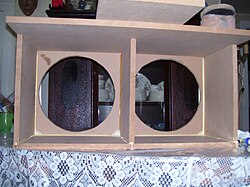
- Furniture: Cabinets and shelving due to its strong, smooth surface.
- Specialized Use: Pipe-organ chambers, where its density helps reflect bass sound.
- Retail: Slatwall panels for shop fitting.
Veneered MDF is a popular alternative to expensive hardwoods. A thin slice of hardwood (1–2 mm) is wrapped around a profiled MDF board under high pressure, though this is generally limited to simple profiles to prevent the veneer from breaking.
Safety and Environmental Concerns
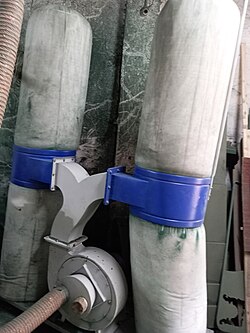
Cutting MDF releases significant dust and formaldehyde. The International Agency for Research on Cancer (IARC) classifies formaldehyde as a known human carcinogen. To mitigate this, manufacturers use different emission classes (E0, E1, and E2), with E0 being the lowest. It is recommended to coat all sides of a finished piece with paint or sealant to trap free formaldehyde.
Frequently Asked Questions
Is MDF waterproof?
No, standard MDF has poor moisture resistance and can swell or warp in humid environments. However, moisture-resistant MDF (typically green) is available for areas with higher humidity.
Why does MDF dull my saw blades so quickly?
The combination of high density and the adhesives (resins) used in the manufacturing process is abrasive. Tungsten carbide-edged tools are recommended over high-speed steel to maintain a sharp edge.
Is MDF safe for home use?
Yes, provided it is used correctly. To reduce exposure to formaldehyde, it is best practice to seal all surfaces of the MDF with paint or a suitable coating and ensure proper ventilation during cutting and sanding.
How do I prevent MDF from splitting when screwing into the edge?
Because of the fibre alignment, you should always drill pilot holes before installing screws into the edge of an MDF board to prevent it from splitting or delaminating.
What is the difference between MDF and particle board?
MDF is made from broken-down wood fibres, whereas particle board is made from larger wood chips. This makes MDF denser, stronger, and easier to machine and paint than particle board.