Particle Board: Properties, Manufacturing, and Uses in Modern Design
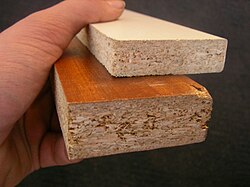
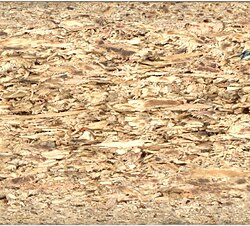
Particle board, frequently referred to as chipboard, is a widely used engineered wood product. As a member of the wood-based panel family, it is manufactured by combining wood chips with a synthetic binder—most commonly a formaldehyde-based resin—and pressing the mixture under intense heat. While it is often confused with oriented strand board (OSB), particle board is a distinct type of fiberboard that utilizes smaller wood chips rather than larger, machined flakes.
Because it is denser and more uniform than conventional solid wood, particle board serves as a cost-effective alternative in many applications. While it lacks the structural strength of plywood, its affordability and stability make it a staple in modern manufacturing.
Key Facts
- Composition: Made from wood chips or jute-stick mixed with synthetic resins.
- Cost-Effectiveness: Generally cheaper and more uniform than solid wood or plywood.
- Moisture Sensitivity: Highly susceptible to expansion and discoloration if exposed to moisture.
- Common Uses: Widely used in budget-friendly furniture and as underlayment in kitchens or laundries.
- Safety Note: Can release formaldehyde; "no added formaldehyde" (NAF) versions are available.
Characteristics and Limitations
Particle board is characterized by its density and uniformity. While it is the lightest and weakest type of fiberboard (excluding insulation board), it is significantly denser than many conventional woods. Manufacturers can enhance its aesthetic appeal by applying paint or wood veneers—thin layers of decorative wood—to visible surfaces.
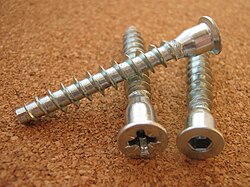
The strength of the board is often tied to its density. Higher-density grades offer greater resistance to failure when using screw fasteners. However, a primary disadvantage is its vulnerability to moisture. Without a protective sealer or paint, the material can absorb water, leading to swelling and discoloration. Consequently, it is rarely used outdoors and is typically reserved for dry indoor environments or shielded by moisture-resistant flooring in areas like kitchens.
Comparison of Wood-Based Panels
| Material Type | Relative Strength | Relative Density | Primary Characteristic |
|---|---|---|---|
| Particle Board | Lower | Medium | Highly cost-effective and uniform |
| MDF (Medium-Density Fibreboard) | Higher | Higher | Stronger and denser than chipboard |
| OSB (Oriented Strand Board) | Higher | Variable | Uses larger machined wood flakes |
| Hardboard | High | High | Also known as high-density fiberboard |
The Evolution of Particle Board
The origins of particle board are somewhat obscure, though attempts to utilize sawmill by-products like sawdust and chips date back to the 19th century. A major breakthrough occurred in 1932 when inventor Max Himmelheber patented a process that did not require full impregnation of wood fibers with adhesive. This allowed for the use of waste products like planer shavings and sawdust, which were hammer-milled—a process of smashing material into smaller pieces—and bound with phenolic resin.
As the industry matured, producers discovered that using uniform, manufactured chips improved strength and appearance. This led to the development of three-layer particle board, which features a core of coarse, inexpensive chips sandwiched between finer, high-quality layers of birch, beech, pine, or spruce.
The Manufacturing Process
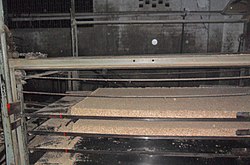
The production of particle board is a precise engineering feat. It begins by feeding raw materials, such as wood or jute-stick, into a disc chipper. These chippers use between four and sixteen blades to produce chips that are more uniform in size than those from standard wood chippers. Once dried and screened to remove irregular sizes, the particles are sprayed with a fine mist of resin.
Resin Types and Additives
The choice of resin impacts the board's performance:
- Amino-formaldehyde resins: Best for cost-efficiency and ease of use.
- Urea melamine resins: Provide water resistance; higher melamine content increases durability for external use.
- Resorcinol and Phenolic resins: Often used to enhance properties for specialized applications.
Other additives, including wax, dyes, and wetting agents, may be included to provide resistance to fire, insects, or water.
Compression and Finishing
After being coated, the particles are spread into a continuous "carpet" and then into rectangular "blankets." These blankets undergo a two-stage compression process. First, they are cold-compressed to reduce thickness for transport. Second, they are subjected to a hot press at temperatures between 140 and 220 °C (284 to 428 °F) and pressures of 2 to 3 megapascals to harden the glue. Finally, the boards are cooled, trimmed, and sanded.
Impact on Furniture Design
Particle board has revolutionized the furniture industry. In the early 1950s, particle-board kitchens were a luxury available only to the wealthy. As technology improved and production costs dropped, it became a primary material for mass-market furniture. Many large companies now utilize particle board, MDF, or similar engineered woods to maintain low price points while managing quality through higher-density grades or superior resins.
Safety and Environmental Considerations
Working with particle board involves certain safety precautions. Machining the material—such as sawing or routing—releases fine dust and chemicals. Depending on the resin used, cutting can release formaldehyde, carbon monoxide, hydrogen cyanide, or phenol. Formaldehyde is classified by the WHO as a known human carcinogen.
To address concerns regarding indoor air quality and formaldehyde emissions, the industry has developed "no added formaldehyde" (NAF) versions of particle board and MDF. While these were not in widespread common use as of 2015, they represent a significant response to consumer and regulatory pressure.
Frequently Asked Questions
How does particle board differ from OSB?
While both are engineered wood products, particle board is made from small wood chips, whereas Oriented Strand Board (OSB) uses larger, machined wood flakes, offering greater strength.
Can particle board be used in bathrooms?
Yes, but it must be protected. In high-moisture areas like bathrooms or kitchens, it is typically used as an underlayment that is shielded by a continuous, moisture-resistant sheet of vinyl flooring.
Why is particle board so much cheaper than solid wood?
It is manufactured using sawmill by-products like sawdust and chips, making it a highly efficient way to utilize wood waste that would otherwise be discarded.
What are the risks of cutting particle board?
Cutting particle board can release fine wood dust and chemical vapors, including formaldehyde, which can pose respiratory and health risks if not managed with proper safety protocols.
What is three-layer particle board?
This is a high-quality version of the board where the core is made of coarse, inexpensive chips, while the outer surfaces consist of finer, more uniform chips to improve appearance and strength.