Medal Bars and Clasps: The History and Meaning of Military Award Devices
In the world of military and civil honors, a medal is rarely just a single piece of metal. To provide a detailed record of a recipient's service, authorities use medal bars (also known as medal clasps). These are thin metal strips attached to the ribbon of a decoration to signify specific campaigns, operations, or repeated acts of bravery.
While the terms are often used interchangeably, they technically refer to different components: the "bar" is the indicator of achievement, while the "clasp" is the part of the medal that connects it to the ribbon.
Key Facts
- Purpose: Bars indicate specific battles, campaigns, or the number of times an award was received.
- Terminology: In British convention, "and bar" signifies a repeat award (e.g., DSO and two bars means the award was given three times).
- Evolution: The system evolved from engraving names directly on medals to using detachable bars for greater flexibility.
- Variety: Devices range from simple horizontal bars to ornate clasps, rosettes, and stars.
The Evolution of Medal Bars
Before the early 19th century, medals were primarily reserved for high-ranking officers. While enlisted soldiers and seamen occasionally received medals, these were typically private gestures rather than official state honors. An early exception was the Army Gold Medal from the Peninsular War, which used clasps for each battle fought. Once a recipient earned four clasps, the medal was exchanged for a cross, with further clasps added to the arms. The Duke of Wellington achieved the maximum possible honor with a cross and nine clasps.
By the mid-19th century, governments began issuing medals to all participants in a campaign. Initially, battle names were engraved directly onto the medal. However, this was inefficient, as it required new medals for every conflict and made it difficult to distinguish between general participants and those involved in specific major actions.
The Sutlej Medal (1845–1846) marked a turning point as the first medal to utilize bars. For soldiers in the First Anglo-Sikh War, the first battle was engraved on the medal, while subsequent engagements were denoted by silver bars on the ribbon. This system was further refined during the Punjab Campaign, where a standard medal was issued to all, with specific bars for the Battle of Chillianwala, the Siege of Multan, and the Battle of Gujarat.
This innovation led to the "General Service" medal, a single award that could be used across different regions and timeframes. The 1854 India General Service Medal featured 23 different clasps over 41 years, while the 1847 British Naval General Service Medal featured approximately 231 clasps for actions between 1793 and 1840.
Types of Medal Bars and Devices
Campaign and Battle Bars
These are the most common types of bars, used to denote the specific region or battle where the recipient served. In the UK, these are typically called clasps. When only the ribbon is worn, these may sometimes be represented by rosettes. Examples include the "under enemy fire" clasp on the 1914 Star and the Battle of Britain clasp on the 1939-45 Star.
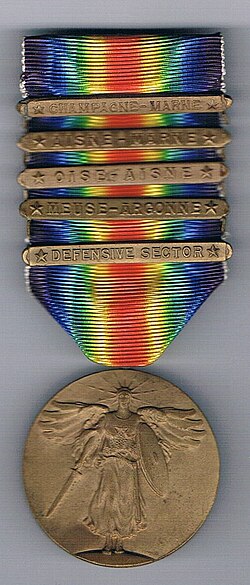
The United States military utilizes different devices. While the World War I Victory Medal used an extensive bar system, later awards shifted toward Service stars to indicate multiple campaigns. During World War II, the Arrowhead device was introduced for assault landings, and the "W" Wake Island Device was created for the Navy and Marine Corps Expeditionary Medals.
Achievement Bars
Achievement bars signify a specific feat associated with the medal rather than a location. A notable example is the Wintered Over Device on the United States Antarctica Service Medal, which proves the recipient completed a tour of duty during the Antarctic winter.

Service and Multiple Award Bars
Service bars are primarily found on long-service medals for military and emergency services, indicating the total length of time served. Multiple award bars indicate that a decoration for merit or gallantry has been earned more than once.
In the US, repeat awards are denoted by Oak Leaf Clusters (Army and Air Force) or Stars (Navy and Marine Corps). In the UK, repeat awards are often shown by rosettes on the ribbon, though the Victoria Cross and George Cross use miniature models of the cross itself.
Summary of Medal Device Types
| Type | Purpose | Examples |
|---|---|---|
| Campaign/Battle | Denotes specific operations or regions | Battle of Britain clasp, Service stars |
| Achievement | Denotes a specific feat or condition | Wintered Over Device |
| Service | Indicates length of time in service | Long service medal bars |
| Multiple Award | Indicates the award was earned multiple times | Oak Leaf Clusters, Rosettes |
Frequently Asked Questions
What is the difference between a medal bar and a medal clasp?
While often used interchangeably, the bar is the specific device that indicates an achievement or campaign, whereas the clasp is the physical component that attaches the medal to the ribbon.
How do you read "DSO and two bars" in British military honors?
This phrasing indicates that the recipient was awarded the Distinguished Service Order (DSO) on three separate occasions: the original medal plus two additional bars.
What does an Oak Leaf Cluster represent in the US military?
An Oak Leaf Cluster is used by the US Army and Air Force to indicate that the recipient has received the same decoration multiple times.
Why did the military move away from engraving battle names on medals?
Engraving was inefficient because it required creating new medals for every campaign and made it difficult to tell at a glance whether a soldier participated in the entire campaign or only specific major battles.
What is the purpose of the Wintered Over Device?
The Wintered Over Device is an achievement bar attached to the United States Antarctica Service Medal to show that the recipient served during the Antarctic winter.