Mechanical Equivalent of Heat: The History and Priority Dispute
The transition from the 18th to the 19th century marked a revolutionary shift in how scientists understood energy. For years, the prevailing caloric theory suggested that heat was a fluid-like substance. However, a series of experiments and theoretical breakthroughs eventually proved that heat is not a substance, but a form of motion—establishing the concept of the mechanical equivalent of heat.
The Early Observations of Count Rumford
The challenge to established heat theories began around 1797 with Benjamin Thompson, known as Count Rumford. While observing the boring of cannons at the Munich arsenal in Bavaria, Rumford noticed the immense amount of heat generated by friction. To test this, he immersed a cannon barrel in water and used a specially blunted boring tool.
Rumford discovered that the frictional heat was seemingly inexhaustible and could boil the water within approximately two and a half hours. In his 1798 paper, "An Inquiry Concerning the Source of the Heat Which Is Excited by Friction," he argued against the idea of heat as a stored substance, sparking a revolution in thermodynamics that would inspire future researchers.
The Race for the Mechanical Equivalent
By the 1840s, several scientists independently arrived at the conclusion that heat and mechanical work are interchangeable. Julius Robert von Mayer proposed this equivalence in a leading German physics journal in 1842, while James Prescott Joule independently proposed the same idea in a leading British journal in 1843. Simultaneously, Ludwig A. Colding conducted similar work between 1840 and 1843, though his findings remained largely unknown outside of Denmark.
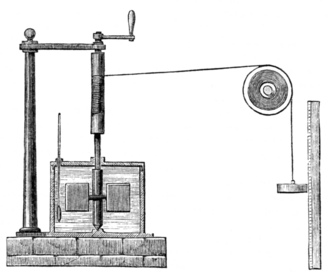
In 1845, Joule published "The Mechanical Equivalent of Heat," providing a specific numerical value for the work required to produce a unit of heat. By measuring the friction needed to raise the temperature of one pound of water by one degree Fahrenheit, Joule calculated a consistent value of 778.24 foot pound force (4.1550 J · cal). He contended that a specific amount of work would always generate the same amount of heat, regardless of the method used.
The Path to Scientific Acceptance
Despite their breakthroughs, both Joule and von Mayer initially faced resistance. The tide began to turn in 1847 when Hermann Helmholtz published a definitive declaration on the conservation of energy. Helmholtz had studied Joule's work and eventually credited both Joule and von Mayer for their contributions.
That same year, Joule presented his findings to the British Association for the Advancement of Science. Among the audience was William Thomson (later Lord Kelvin). While initially skeptical, Thomson became a convinced supporter by 1851. From 1852 to 1856, Thomson and Joule collaborated closely; Joule performed the experiments while Thomson analyzed the data. This partnership was instrumental in the general acceptance of the kinetic theory—the theory that heat is the result of the motion of particles.
The Priority Dispute and Legacy
The discovery of the mechanical equivalent of heat led to a bitter dispute over who deserved primary credit. In 1848, after seeing Joule's papers, von Mayer asserted his priority through the French Académie des Sciences. Joule, supported by Thomson and a circle of influential scientists including James Clerk Maxwell and William John Macquorn Rankine, argued that while von Mayer may have had the idea first, Joule provided the essential experimental verification.
The conflict escalated in 1862 when John Tyndall gave a lecture crediting von Mayer with both the conception and measurement of the equivalent. This led to a public and often undignified exchange of letters in the Philosophical Magazine and Good Words. Despite continued efforts by Tyndall and Henry Enfield Roscoe to champion von Mayer, Joule's reputation remained dominant, while von Mayer faded into obscurity.
Key Facts
- Count Rumford first challenged caloric theory by observing heat generated from boring cannons.
- James Prescott Joule calculated the mechanical equivalent of heat as 778.24 foot pound force per pound of water per degree Fahrenheit.
- Julius Robert von Mayer independently proposed the equivalence of heat and work in 1842.
- Hermann Helmholtz provided the definitive declaration of the conservation of energy in 1847.
- The modern standardized value of 4.1860 J·cal was established in the early 20th century.
| Scientist | Key Contribution | Approximate Date |
|---|---|---|
| Count Rumford | Observed inexhaustible frictional heat in cannon boring | 1797–1798 |
| Julius Robert von Mayer | Proposed heat and work equivalence in German journals | 1842 |
| James Prescott Joule | Provided precise experimental numerical values for equivalence | 1843–1845 |
| Hermann Helmholtz | Declared the law of conservation of energy | 1847 |
| William Thomson | Analyzed Joule's data, aiding general scientific acceptance | 1852–1856 |
Frequently Asked Questions
What is the mechanical equivalent of heat?
It is the numerical relationship between mechanical work and the amount of heat produced. It establishes that a specific amount of mechanical work will always generate a consistent amount of heat.
How did Count Rumford's experiments change science?
Rumford showed that heat could be generated indefinitely through friction, which contradicted the caloric theory that heat was a finite fluid stored within materials.
Who actually discovered the mechanical equivalent of heat?
It was discovered independently by several people. Julius Robert von Mayer proposed the idea first (1842), but James Prescott Joule provided the rigorous experimental evidence and precise measurements (1843–1845).
Why did the value of the constant change over time?
While a value of 4.1860 J·cal was standardized, it was later realized that this constant is close to the specific heat of water, which varies between 4.17 and 4.22 J·g·°C depending on the temperature.
What was the role of William Thomson in this discovery?
Thomson initially doubted Joule's findings but eventually became his collaborator. He provided the mathematical analysis and theoretical framework that helped the scientific community accept the kinetic theory of heat.