Mauritius Banknotes: A History of Currency and Design
The evolution of currency in Mauritius reflects the nation's journey from a colonial administration to a sovereign state. From the early government-issued notes of the 19th century to the sophisticated polymer security features of today, the Mauritian Rupee has undergone significant transformations in both value and aesthetic design.
The Early Era of Government Issues
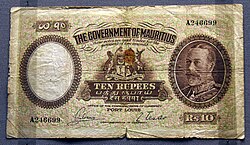
The first official banknotes were issued by the government in 1876, available in denominations of Rs. 5/-, Rs. 10/-, and Rs. 50/-. As the economy grew, the currency expanded; Re. 1/- notes were introduced in 1919. During the turmoil of 1940, the government released emergency issues in denominations of 25c, 50c, and Re. 1/-. By 1954, higher denominations of Rs. 25/- and Rs. 1,000/- were added to the circulating currency.
The Establishment of the Bank of Mauritius
A pivotal shift occurred in September 1967 with the establishment of the Bank of Mauritius, the nation's central bank. From this point forward, the Bank assumed full responsibility for the issuance of all coins and banknotes.
The Bank's inaugural series in 1967 featured four undated denominations: Rs. 5/-, Rs. 10/-, Rs. 25/-, and Rs. 50/-. These notes were characterized by a portrait of Queen Elizabeth II on the obverse (the front side). While the signatures of the Governor and managing director were updated over time, the core designs remained consistent for several years.
1967 Series Design Details
- Rs. 5/-: Featured the monument marking the Dutch landing at Grand Port bay (1598) and a sailing boat on the reverse.
- Rs. 10/-: Featured Government House in Port Louis on the reverse.
- Rs. 25/-: Featured a bullock cart on the reverse.
- Rs. 50/-: Featured Port Louis Harbour on the reverse.
The Transition Years: 1985 to 1998
In 1985, a comprehensive new set of banknotes was introduced, spanning denominations from Rs. 5/- up to Rs. 1,000/-. This era was marked by a lack of design uniformity, as the notes were printed by two different companies: Bradbury Wilkinson and Thomas de La Rue.
Because these notes were designed across different time periods, they exhibited various inconsistencies. These included differing numbering systems, security threads, typesets, and variations in the size and design of the Mauritian Coat of Arms. Even the ultraviolet light latent printing and the size increments between denominations varied across the series.
The 1998 Issue and Linguistic Controversy
In November 1998, the Bank of Mauritius released a standardized set of seven denominations (Rs. 25/-, 50/-, 100/-, 200/-, 500/-, 1,000/-, and 2,000/-), all printed by Thomas de la Rue Limited in England. However, this series was short-lived. By June 1999, the notes were withdrawn due to controversies regarding the ordering of the text in English, Sanskrit, and Tamil. The dispute centered on the historical arrival of the Tamil population in Mauritius prior to the North Indian community associated with Hindi.
Current Circulating Banknotes
The current series, introduced after June 1999, represents the modern face of Mauritian currency. These notes have seen a gradual transition from traditional paper to polymer (a durable plastic substrate) to increase longevity and security.
| Value | Dimensions (mm) | Main Colour | Obverse Portrait | Reverse Image | Polymer Transition |
|---|---|---|---|---|---|
| Rs 25 | 135 × 66 | Violet | Sir Moilin Jean Ah-Chuen | Rodrigues | 22 Aug 2013 |
| Rs 50 | 140 × 68 | Blue | Joseph Maurice Paturau | Le Caudan | 22 Aug 2013 |
| Rs 100 | 145 × 70 | Orange | Renganaden Seeneevassen | Supreme Court | 20 Jun 2025 |
| Rs 200 | 150 × 72 | Green | Sir Abdool Razack Mohamed | Market | 18 Jul 2025 |
| Rs 500 | 155 × 74 | Brown | Sookdeo Bissoondoyal | University of Mauritius | 22 Aug 2013 |
| Rs 1000 | 160 × 76 | Cyan | Sir Gaëtan Duval | State House | 2 Dec 2024 |
| Rs 2000 | 165 × 78 | Red | Sir Seewoosagur Ramgoolam | Ox cart | 4 Dec 2018 |
Detailed Design Elements
Obverse (Front) Features
The front of the current notes is highly detailed. The "Bank of Mauritius" title sits at the top, with a central-left portrait of a prominent figure, including their name and lifespan. The Mauritian Coat of Arms is located at the bottom-left, while the background features the Bank of Mauritius building and the statue of justice.
For accessibility, the notes include features to aid the visually impaired, complemented by distinct size differences for each denomination. The value is displayed in the top-right corner and written out in English, Tamil, and Bhojpuri. Signatures of the Governor and managing director (or deputy governors) are present above the printing year.
Reverse (Back) Features
The reverse side maintains the "Bank of Mauritius" title and the numerical value in the top-right and left-side (sideways). Each note features a unique vignette—a decorative illustration—depicting various aspects of Mauritian life and geography. The value is also printed in Devanagari script (with the "ru" abbreviation), Tamil, and Gujarati.
Key Facts
- First Issue: Government banknotes first appeared in 1876 (Rs. 5, 10, and 50).
- Central Bank: The Bank of Mauritius was established in September 1967.
- Material Shift: Currency has transitioned from paper to polymer, with the Rs 25, 50, and 500 notes moving to polymer in August 2013.
- Multilingualism: Current notes feature text in English, Tamil, Bhojpuri, Devanagari, and Gujarati.
- Highest Denomination: The current highest value note is Rs 2,000.
Frequently Asked Questions
When did the Bank of Mauritius start issuing its own notes?
The Bank of Mauritius began issuing its own banknotes in 1967, following its establishment as the nation's central bank in September of that year.
Why were the 1998 banknotes withdrawn so quickly?
The 1998 series was withdrawn in June 1999 due to controversies regarding the linguistic ordering of English, Sanskrit, and Tamil, specifically concerning the historical arrival of the Tamil population.
What materials are used for current Mauritian banknotes?
Current banknotes are issued in both paper and polymer substrates, with polymer being introduced for various denominations between 2011 and 2025 to improve durability.
What security and accessibility features are on the notes?
Notes include specific features to aid the visually impaired, varying physical sizes for each denomination, and complex background imagery including the statue of justice and the Bank of Mauritius building.
Which languages appear on the current banknotes?
The banknotes feature English, Tamil, Bhojpuri, Devanagari, and Gujarati scripts to reflect the diverse cultural heritage of Mauritius.