Martin Creed: Redefining Art Through Minimalism and Audacity
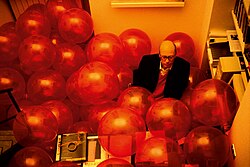
Martin Creed is a multidisciplinary artist whose work spans films, installations, paintings, theatre, and live-action sculptures. Known for his versatility, Creed utilizes whatever medium best suits his conceptual goals, often challenging the boundaries of what constitutes "art." Since 1987, he has adopted a systematic approach to his portfolio, numbering each piece and typically using descriptive titles that strip away mystery in favor of literalism.
His approach often blends minimalism—an art movement that reduces forms to their most essential elements—with the concept of the readymade, where ordinary manufactured objects are repositioned as art. This is evident in works like Work No. 79 (kneaded Blu-tack on a wall) and Work No. 88 (a crumpled sheet of A4 paper).
Key Facts
- Systematic Cataloging: Every work since 1987 is assigned a unique number and a descriptive title.
- Turner Prize Winner: Won the prestigious 2001 Turner Prize for his minimalist exhibitions.
- Global Presence: Works are held in major institutions, including the Museum of Modern Art (MoMA) in New York and the Colleccion Jumex in Mexico City.
- Public Impact: Created large-scale neon installations and architectural interventions across the globe.
- Diverse Media: His practice includes music, choreography, painting, and public infrastructure.
Challenging Authenticity and Reproducibility
A recurring theme in Creed's work is the interrogation of authenticity. In 1989, he exhibited Work No. 19: An Intrusion And A Protrusion From A Wall at the Slade School of Fine Art. A year later, he "replaced" it with Work No. 21, which bore an almost identical name and appearance but featured slightly different content, forcing the viewer to question the nature of the original versus the copy.
This exploration continues in Work No. 916, a pyramid constructed from empty retail boxes with original postage labels. While reminiscent of Andy Warhol's Brillo Boxes, Creed's version uses different boxes for each iteration. This creates a metaposition where multiple unique works look identical in disposition but are composed of different materials, further commenting on the nature of modern art.
The Turner Prize and the Debate Over Minimalism
Creed achieved significant critical attention when he won the 2001 Turner Prize. His submission, Work No. 227: The lights going on and off, consisted of an empty room where the lights cycled on and off every five seconds. The work sparked intense public debate, with some critics questioning if such a minimalist gesture could be considered art.
Despite the controversy—which included a visitor throwing eggs at the gallery walls in protest—the jury praised the work for its rigour, wit, and audacity. This tension between the "extinct skill" of traditional painting and conceptual minimalism remains a hallmark of the discourse surrounding Creed's career, though he has integrated painting into nearly every recent exhibition, such as Work No. 1768.
Public Works and Permanent Installations
Creed's influence extends far beyond the gallery. He has created numerous public installations that integrate art into the fabric of daily life. One of his most recognizable motifs is the phrase "Everything is Going to be Alright." While Work No. 975 is a unique sculpture on the Scottish National Gallery of Modern Art, the phrase has appeared in various forms: a red neon sign in New York's Times Square (Work No. 225), a 30-metre version in Detroit (Work No. 790), and a white neon version in Vancouver (Work No. 851).
![Martin Creed, Work No. 2314, Everything is Going to be Alright, 2015, Neon, 146.8 x 4600 cm at Christchurch Art Gallery, New Zealand[15]](/images/2f/ad/2fad0ea9b25c6ed6a6aceb794cb0ee09e5d31cefda20ff99ee7c15ba426571a2.jpg)
Other notable public contributions include:
- The Scotsman Steps (Edinburgh): Work No. 1059, where 104 steps and landings are clad in different types of marble.
- Sketch (London): Work No. 1343, featuring a mismatched collection of global cutlery and furniture, and Work No. 1347, a herringbone floor made of 96 different marbles.
- Auckland, New Zealand: Work No. 2950: WHATEVER, a large multicoloured neon roof sign.
- Fort Worth, Texas: A massive spinning "MOTHERS" sign.
Summary of Notable Works
| Work Number | Title/Description | Key Feature |
|---|---|---|
| No. 227 | The lights going on and off | Lights cycling every 5 seconds; Turner Prize winner |
| No. 975 | Everything is Going to be Alright | Neon text installation (various versions worldwide) |
| No. 1059 | The Scotsman Steps | 104 steps clad in different marbles |
| No. 1197 | All the bells in the country... | Commission for the 2012 Summer Olympics |
| No. 1000 | 1,000 hand prints | Created using broccoli |
Performance and Multimedia
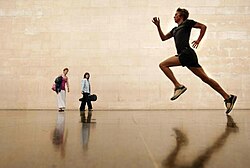
Beyond static objects, Creed engages in live performance. In 2009, he wrote and choreographed Work No. 1020: Ballet, a multidisciplinary piece combining music, words, and film. This work was performed at venues including Sadler's Wells in London, the Traverse Theatre in Edinburgh, and The Kitchen in New York. His playful, often child-like approach is further exemplified by his live band performances and public talks.
Frequently Asked Questions
Why does Martin Creed number his artworks?
Since 1987, Creed has numbered his works and used descriptive titles to remove subjective interpretation and emphasize the literal nature of the object or action.
What is the significance of "The lights going on and off"?
Work No. 227 challenged traditional definitions of art by presenting a minimalist experience of light and time, eventually winning the 2001 Turner Prize for its audacity and sensitivity to the site.
How does Creed use the phrase "Everything is Going to be Alright"?
The phrase is used across multiple distinct works (each with its own number), appearing as neon installations in cities like New York, Detroit, Vancouver, and Christchurch.
What is the "readymade" element in Creed's work?
Creed uses everyday objects—such as retail boxes, Blu-tack, or A4 paper—and presents them as art, similar to the approach pioneered by Andy Warhol and Marcel Duchamp.
Where can I see Martin Creed's public art?
His works are located globally, including the singing lifts at the Royal Festival Hall in London, the Scotsman Steps in Edinburgh, and neon signs in Auckland and Fort Worth.