Marta Minujín: The Argentine Pioneer of Conceptual and Action Art
Marta Minujín is a visionary Argentine artist whose career has spanned over six decades, challenging the boundaries between art and life. Born in 1943 in the San Telmo neighborhood of Buenos Aires, Minujín has become a global icon of conceptual art—art where the idea or concept takes precedence over the traditional aesthetic or material object. From her early days in Paris to her massive public installations in Germany and England, her work is defined by a belief that "everything is art."
Key Facts
- Born: January 30, 1943, in Buenos Aires, Argentina.
- Primary Movements: Action art, Conceptual art, Pop art, Psychedelic art, and Informalism.
- Signature Style: Known for "Happenings"—spontaneous, interactive events that serve as the artwork itself.
- Major Awards: Recipient of the Platinum Konex Award in 1982 and 2002.
- Notable Works: The Parthenon of Books, La Menesunda, and the Minuphone.
Early Career and the Influence of Paris
Minujín's artistic journey began at the National University Art Institute, with her first exhibition in 1959 at the Teatro Agón. A scholarship from the National Arts Foundation soon took her to Paris, where she was exposed to the Nouveaux Realistes, a group of artists who sought to integrate art into the fabric of daily existence.
Inspired by this philosophy, Minujín began creating "livable sculptures." In 1962, she staged a provocative exhibition where she publicly burned her own paintings. This was followed in 1963 by La Destrucción, an installation of mattresses along the Impasse Roussin that she invited fellow avant-garde artists, including Christo, to destroy. This marked her entry into the world of Happenings, transforming the act of creation and destruction into a performance.

The Era of Happenings and Pop Art
Upon returning to Buenos Aires, Minujín became a central figure at the Torcuato di Tella Institute. In 1964, she produced several high-energy works, including Eróticos en technicolor and the interactive Revuélquese y viva (Roll Around in Bed and Live). She also brought her art to the public via television with Cabalgata (Cavalcade), featuring horses with paint buckets tied to their tails.
In 1965, she collaborated with Rubén Santantonín to create La Menesunda (Mayhem). This immersive installation led visitors through sixteen distinct chambers, including a walk-in freezer, a dental office, and a mirrored room with the scent of frying food. The work heavily utilized advertising elements, signaling the influence of Pop art—an art movement that incorporates imagery from popular and commercial culture.
New York and Psychedelic Exploration
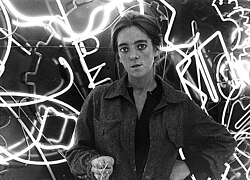
A 1966 Guggenheim Fellowship brought Minujín to New York City, a move that proved fortuitous as a military coup in Argentina led to increased censorship of irreverent art. In the United States, she pivoted toward psychedelic art, characterized by vivid colors and mind-altering sensory experiences.
Her most famous New York creation was the "Minuphone," developed with engineer Per Biorn. This interactive telephone booth surprised users with projected colors, sounds, and a television screen in the floor. During this period, she befriended Andy Warhol and was featured in Mary Beth Edelson's 1972 poster, Some Living American Women Artists.
Political Monuments and the Parthenon of Books
Returning to Argentina in 1976, Minujín began exploring metaphors of fragility and loss, creating sculptures from unconventional materials like panettone and cheese. However, her most profound work emerged after the return of democracy in 1983.
To honor the freedom of expression lost during the military dictatorship, she created the Parthenon of Books [Homage to Democracy]. This structure was built from 30,000 books that had been banned between 1976 and 1983, including works by Freud, Marx, and Sartre. After three weeks, the monument was dismantled, and the books were distributed to the public, symbolizing the return of knowledge to the people.
Minujín continued this theme globally, creating a second Parthenon in Kassel, Germany, in 2017 using 100,000 books censored by the Nazis. In 2021, she designed Big Ben Lying Down in Manchester, England, a half-size replica of the Elizabeth Tower made of books representing British politics.
Summary of Major Works
| Work | Year | Key Feature/Material | Concept |
|---|---|---|---|
| La Destrucción | 1963 | Mattresses | Collaborative destruction |
| La Menesunda | 1965 | 16 immersive chambers | Sensory mayhem and Pop art |
| Minuphone | 1967 | Telephone booth/Electronics | Psychedelic interaction |
| Parthenon of Books | 1983 | 30,000 banned books | Homage to democracy |
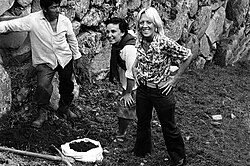
| The Debt | 1985 | Maize (Corn) | Latin American debt crisis |
| Big Ben Lying Down | 2021 | Political books | British political commentary |
Frequently Asked Questions
What is a "Happening" in the context of Marta Minujín's art?
A Happening is a performance-based work of art that is spontaneous and interactive. Rather than creating a static object, Minujín creates an event where the experience and the participation of the audience are the actual artwork.
What was the purpose of the Parthenon of Books?
The Parthenon of Books served as a monument to freedom of expression. By using books that were banned by oppressive regimes, Minujín highlighted the tragedy of censorship and celebrated the restoration of intellectual liberty by giving the books back to the public.
How did Andy Warhol influence Minujín's work?
Minujín befriended Warhol in New York, and their conversations regarding the Latin American debt crisis inspired her 1985 work The Debt, in which she symbolically "paid" the debt using a shipment of maize.
What is the significance of the Minuphone?
The Minuphone represents Minujín's exploration of psychedelic art and technology. It transformed a mundane object—a telephone booth—into a multisensory experience using light, sound, and video to surprise the user.
Why does Minujín often destroy her installations?
Destruction is a key part of her conceptual process. By dismantling works like the Parthenon of Books or Big Ben Lying Down and distributing the materials to the public, she ensures the art is not a commodity for a museum, but a shared social experience.