Mars Sample Return: The History and Future of Bringing Martian Soil to Earth
For decades, the dream of bringing physical pieces of Mars back to Earth has captivated scientists and engineers. Known as Mars Sample Return (MSR), this ambitious goal represents one of the most complex challenges in space exploration. Unlike orbiting a planet or landing a rover, MSR requires a complete round trip: landing on the Martian surface, collecting geological materials, launching a rocket from another planet, and safely returning those samples to Earth laboratories.
The journey toward this goal has evolved from early conceptual sketches during the Apollo era to the sophisticated operations currently being conducted by the Perseverance rover.
Key Facts
- Primary Goal: To collect and return Martian rock, regolith (soil), and atmospheric samples to Earth.
- Current Progress: The Perseverance rover has filled 33 of 43 available sample tubes as of July 2025.
- Landing Site: Jezero Crater, an ancient lakebed ideal for ground sampling.
- Major Partners: A collaborative effort primarily between NASA and the European Space Agency (ESA).
- Current Status: The project was paused in November 2023 due to cost and complexity, with NASA seeking more fiscally feasible mission profiles.
Early Concepts and Cold War Ambitions (Before 1990)
The idea of returning samples from Mars appeared in technical literature while the Apollo program was still in development. Early analyses by Lockheed focused on trajectory options for a 15-ton launch vehicle, though the density of the Martian atmosphere was still unknown at the time.
In the 1970s, NASA's Langley Research Center and the Jet Propulsion Laboratory (JPL) studied the requirements for a "Mars surface-to-orbit launch vehicle." They noted that the mass of this vehicle would significantly impact the entire mission's requirements. During this era, the Sample Collection for Investigation of Mars (SCIM) proposal suggested a simpler approach: a spacecraft performing a grazing pass through the upper atmosphere to collect dust and air without landing.
The Soviet Union also pursued MSR. The Mars 5NM mission was considered in 1975 but cancelled due to failures of the N1 rocket. A subsequent plan, Mars 5M (Mars-79), was also cancelled due to technical complexity.
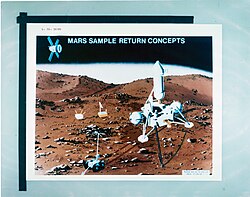
By the mid-to-late 1980s, JPL and other NASA centers proposed more detailed architectures. One concept involved a 12-ton package featuring a 700-kg rover and a 2.7-ton Mars Ascent Vehicle (MAV)—the rocket designed to launch samples from the surface into orbit. These plans aimed to return approximately 5 kg of scientific-quality cores.
Refining the Architecture (1990–2010)
Interest in MSR surged in 1996 following the discovery of apparent microfossils in the Martian meteorite ALH84001. Although the hypothesis was eventually rejected, it renewed the drive to obtain pristine samples directly from the planet.
Throughout the 1990s, NASA and JPL explored "small-scale" architectures to reduce costs. This included studying MAVs as light as 100 to 600 kg. Engineers debated between using pressure-fed liquid bipropellants or pump-fed propulsion to save mass. By 1999, a plan existed to launch missions in 2003 and 2005, utilizing a French-supplied orbiter to capture sample containers and return them to Earth. However, this specific concept was cancelled after a program review.
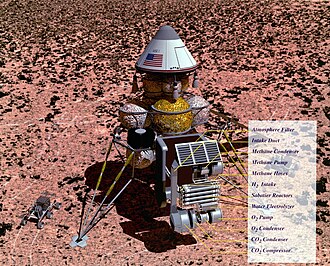
In 2006, the International Mars Architecture for the Return of Samples (iMARS) Working Group was formed to coordinate international requirements for a 2018–2023 timeframe. This led to the ExoMars program, a joint initiative between NASA and ESA. Unfortunately, budget limitations led to the cancellation of the MAX-C caching rover in 2011 and NASA's eventual withdrawal from the ExoMars program.
The Mars 2020 Mission and Current Status
The current phase of MSR began with the Mars 2020 mission. The Perseverance rover landed in Jezero Crater on February 18, 2021, with the explicit goal of preparing for future sample return.
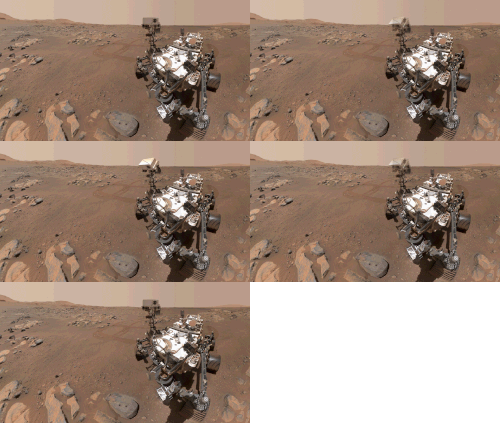
Perseverance has been caching samples in 43 cylindrical tubes. These tubes are designed to preserve the integrity of the samples for the long journey back to Earth.
![Image of one of the sample tubes. Its appearance has been noted to have similarities with a Lightsaber from the Star Wars movies.[42]](/images/31/00/31002c9476017f3428c0c6da22cd4d7cdb2c7f815cb0f25a02cc9ca4f78f01e3.png)
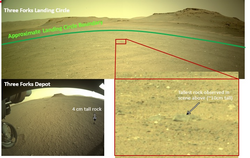
As of July 2025, the rover has filled 33 tubes, including a diverse array of igneous and sedimentary rocks, regolith, and atmosphere samples. To ensure mission success, Perseverance began depositing 10 of these samples at a backup location called the Three Forks Sample Depot in December 2022.
Sample Inventory Summary
| Sample Type | Number of Tubes Filled |
|---|---|
| Sedimentary Rock | 13 |
| Igneous Rock | 8 |
| Igneous/Impactite Rock | 3 |
| Regolith (Soil) | 2 |
| Serpentinite Rock | 1 |
| Silica-cemented Carbonate Rock | 1 |
| Atmosphere | 1 |
| Witness Tubes (filled at launch) | 5 |
Despite this progress, the MSR project faced a critical review in late 2023. NASA announced a "pause" on November 13, 2023, citing an infeasible cost of $11 billion and extreme complexity. While the NASA Administrator reaffirmed the commitment to retrieve the samples in April 2024, the agency is now working with JPL and private industry to develop a more affordable mission profile.
Frequently Asked Questions
What is a Mars Ascent Vehicle (MAV)?
The MAV is a specialized rocket designed to launch from the surface of Mars, carrying collected samples into orbit where they can be rendezvoused with an Earth-return orbiter.
Why was the Perseverance rover sent to Jezero Crater?
Jezero Crater was selected because it appears to be an ancient lakebed, making it a prime location for collecting geological samples that might contain evidence of past life.
What are "witness tubes"?
Witness tubes are sample containers filled with materials before launch. They are used to capture particulates from the Martian environment to serve as a baseline for comparison with collected samples.
Why was the Mars Sample Return project paused in 2023?
The project was paused due to its high complexity and an estimated cost of $11 billion, which NASA deemed fiscally infeasible. The agency is currently seeking a more cost-effective way to complete the mission.
How many samples are actually being returned to Earth?
While 43 tubes exist, the sample canister only has 30 slots. Consequently, some tubes, including three witness tubes, will remain on Mars.