Marche: Italy's Hidden Gem of Art, Industry, and Landscapes
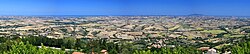
Nestled along the central Adriatic coast, Marche (often referred to in English as the Marches) is one of Italy's twenty regions. With a population of nearly 1.5 million people, it serves as a bridge between the rugged peaks of the Apennines and the shimmering waters of the Adriatic Sea. From its capital, Ancona, to the Renaissance halls of Urbino, the region is a blend of deep historical roots and a modern, dynamic economy.
The region's name is derived from the medieval word marca, meaning a border zone or "march," referring to its history as a frontier territory of the Holy Roman Empire.
Key Facts
- Capital: Ancona
- Population: 1,479,832 (as of 2026)
- GDP: €50.510 billion (2024)
- Highest Point: Monte Vettore (2,476 metres)
- HDI: 0.903 (Very High)
- Key Industries: Footwear, furniture, and household appliances
Geography and Climate
Marche covers an area of approximately 9,344.49 square kilometres. The landscape is predominantly hilly, with the Apennine range running longitudinally along the border and descending toward the sea. While most mountains stay below 2,400 metres, Monte Vettore stands as the region's highest peak at 2,476 metres.
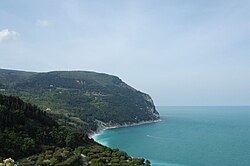
The coastline stretches for 173 kilometres, characterized by flat terrain except for the northern hills near Pesaro and the slopes of Monte Conero.
The climate is temperate, shifting from a Mediterranean feel along the coast to a more continental climate inland, where winters are cold and often snowy. Precipitation is significantly higher in the mountains (up to 1,500 mm annually) compared to the coast (600 to 800 mm).
A Journey Through History
In ancient times, the region was known as the Picenum territory, inhabited by the Picentes during the Iron Age. By the fourth century BC, the northern areas saw the arrival of the Senones, a Gallic tribe. Following the Battle of Sentinum in 295 BC, the Romans established several colonies, linking the region to Rome via the Via Flaminia and Via Salaria.
After the fall of the Western Roman Empire, the region transitioned through various rulers, including the Goths, the Byzantine Exarchate of Ravenna, and the Lombards. By the ninth century, the creation of the marches of Ancona, Fermo, and Camerino gave the region its modern name.
The Renaissance and Beyond
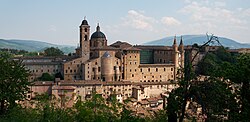
During the Middle Ages and the Renaissance, cities like Ancona, Pesaro, and Urbino became pivotal cultural and commercial hubs. Urbino, in particular, was a beacon of Renaissance art and the birthplace of the master painter and architect Raphael.
The region was later absorbed into the Papal States, though it experienced various shifts during the Napoleonic era before finally being annexed to the unified Kingdom of Italy in 1860 via a plebiscite.
Economy and Industry
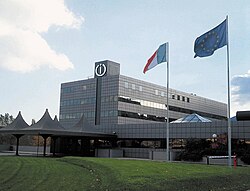
Once considered a poor agricultural region, Marche has undergone a radical economic transformation since the 1980s. While agriculture remains present—producing cereals, vegetables, grapes, and olives—the region is now a powerhouse of specialized small-to-medium enterprises.
The economy is characterized by "industrial districts":
- Footwear and Leather: Concentrated in Macerata and Fermo, renowned for luxury Italian shoes.
- Furniture: Centered primarily in the Pesaro area.
- Appliances and Textiles: Based in the province of Ancona, which also hosts shipbuilding and petrochemical industries.
Tourism and Culture
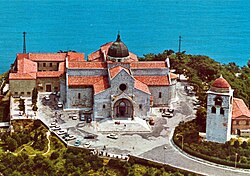
Marche is a destination for those seeking "hidden Italy." It is famous for its picturesque villages, with 31 towns recognized by I Borghi più belli d'Italia (The most beautiful Villages of Italy). Visitors are drawn to the region's rich heritage, from the Cathedral of Ancona to the serene landscapes of the interior.
| Province | Population (2025) | Area (km²) | Density (inh./km²) | Municipalities |
|---|---|---|---|---|
| Ancona | 461,613 | 1,963.22 | 235.1 | 47 |
| Ascoli Piceno | 200,202 | 1,228.27 | 163.0 | 33 |
| Fermo | 166,772 | 862.77 | 193.3 | 40 |
| Macerata | 301,689 | 2,779.34 | 108.5 | 55 |
| Pesaro and Urbino | 349,556 | 2,510.89 | 139.2 | 50 |
Frequently Asked Questions
Why is the region called "The Marches"?
The name comes from the medieval term marca, which refers to a borderland or frontier territory. Historically, the region consisted of several such "marches," such as the March of Ancona.
Who are some famous people from Marche?
The region is the birthplace of several luminaries, including the painter Raphael, the writer Giacomo Leopardi, the composer Gioachino Rossini, and the educator Maria Montessori.
What is the main economic driver of the region today?
While agriculture is still present, the economy is driven by specialized industrial sectors, most notably luxury footwear and leather goods, furniture manufacturing, and household appliances.
What is the geography of the region like?
Marche is primarily hilly and mountainous, with the Apennines running along the interior and a relatively straight, flat coastline along the Adriatic Sea.
How do I travel to Marche?
The region is served by Marche Airport, and travelers also frequently use nearby hubs such as Bologna Guglielmo Marconi Airport and Rimini Fellini Airport.