Marble Production: Extraction, Global Trade, and Industry Standards
Marble has long been prized for its aesthetic appeal and durability, serving as a cornerstone for architecture and art across millennia. While often used interchangeably with limestone in commercial and historical contexts, marble is geologically distinct. Today, the production of this stone involves sophisticated quarrying techniques and a complex global supply chain that spans several continents.
The Process of Marble Extraction
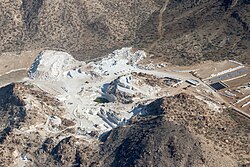
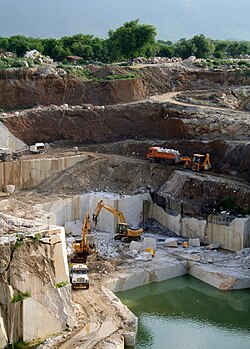
The primary method of obtaining marble is through quarrying, where large blocks of stone are extracted from the earth. These blocks are preferred for most industrial and artistic purposes. To isolate these blocks, producers employ various techniques, including drilling and blasting, water jetting, and the use of wedges.
Global Production and Trade Dynamics
The production of marble and decorative stone is concentrated in a few key nations. Four countries alone account for nearly half of the world's total output. China leads the industry with a 34% share of global production, followed by Italy at 19%, India at 16%, and Spain at 13%.
Trade patterns often differ from production volumes. In 2018, Turkey emerged as the world leader in marble exports, commanding a 42% share of the global trade market. Italy and Greece followed with 18% and 10% shares, respectively. Conversely, China was the largest importer in 2018, holding a dominant 64% market share, with India (11%) and Italy (5%) also serving as significant importers.
Historical Context: The Roman Era
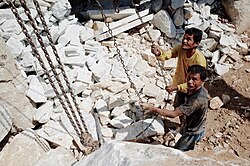
The utilization of white marbles was widespread throughout the Mediterranean basin during the Roman period. However, extraction centers were not evenly distributed; they were concentrated in the Italian Peninsula, mainland Greece, the Aegean Islands, and Asia Minor, with smaller hubs located in the Iberian Peninsula.
This geographical imbalance necessitated an extensive trade network. Building elements, sculptures, and sarcophagi were exchanged across the empire. This distribution of white marble peaked between the late 1st century BC and the end of the 2nd century AD, before beginning a gradual decline in the 3rd century AD.
Marble Industry in the United States
In the U.S., marble production is categorized into dimension marble and crushed marble. Dimension marble, primarily used for tiles, saw a demand of approximately 1.3 million tons. According to the DSAN World Demand for (finished) Marble Index, this sector grew by 12% annually between 2000 and 2006.
Crushed marble is used for industrial purposes and as aggregate. In 2006, the U.S. produced 11.8 million tons of crushed marble valued at $116 million, consisting of 6.5 million tons of finely ground calcium carbonate (a chemical compound found in limestone and marble) and the remainder as construction aggregate. This was an increase from 2005, where production stood at 7.76 million tons valued at $58.7 million.
For domestic dimension marble, 2006 production was 46,400 tons valued at $18.1 million, a decrease from the 72,300 tons valued at $18.9 million produced in 2005.
Key Facts
- Top Producers: China (34%) and Italy (19%) are the world's leading marble producers.
- Export Leader: Turkey held a 42% share of the global marble trade in 2018.
- Primary Importer: China dominated imports in 2018 with a 64% market share.
- U.S. Usage: Tile is the largest application for dimension marble in the United States.
- Health Risks: Marble dust exposure can lead to silicosis and impaired lung function.
| Category | Country | Market Share / Value |
|---|---|---|
| Production | China | 34% |
| Production | Italy | 19% |
| Export | Turkey | 42% |
| Import | China | 64% |
Occupational Safety and Health
The marble industry presents several health hazards, primarily due to particulate air pollution. Workers cutting marble are exposed to dust that can cause skin and eye irritation or severe lung diseases, such as silicosis (a lung disease caused by inhaling silica dust). To mitigate these risks, the use of dust filters and suppression systems is recommended.
In the United States, regulatory bodies have established strict exposure limits over an 8-hour workday:
- OSHA (Occupational Safety and Health Administration): Legal limit of 15 mg/m³ total exposure and 5 mg/m³ respiratory exposure.
- NIOSH (National Institute for Occupational Safety and Health): Recommended limit of 10 mg/m³ total exposure and 5 mg/m³ respiratory exposure.
Beyond respiratory health, workers face risks from debris and temperature fluctuations, making eye protection equipment and comprehensive health education essential for all staff involved in processing.
Frequently Asked Questions
What is the difference between commercial and geological marble?
Geologically, marble is a specific metamorphic rock, but commercially and historically, many types of limestone are referred to as marble.
Which countries dominate the global marble market?
China and Italy are the leading producers, while Turkey is a dominant force in exports and China is the leading importer.
What are the primary health risks for marble workers?
The most significant risks include lung diseases like silicosis caused by inhaling marble dust, as well as potential skin and eye irritation.
How is marble extracted from the ground?
Marble is extracted via quarrying, using methods such as drilling and blasting, water jets, and wedges to create large blocks.
What is the most common use for dimension marble in the U.S.?
The largest application for dimension marble in the United States is the production of tiles.