Exoskeletons: The Biology and Evolution of External Skeletons
In the natural world, structural support comes in many forms. While humans rely on an internal framework of bone, countless other species utilize an exoskeleton—a hardened external layer of integument (the outer covering of an organism) that serves as both a structural scaffold and a protective shield for internal organs. Depending on the species, these structures can range from flexible cuticles to rigid armor or heavy shells.
Exoskeletons are found across a diverse array of animals. Arthropods, including insects, crustaceans, myriapods, and chelicerates, as well as tardigrades, possess cuticle skeletons. Other examples include the stony secretions of corals, the tests (hard shells) of sea urchins and sea squirts, and the shells of molluscs like snails and clams. Interestingly, some vertebrates, such as turtles, possess a hybrid system featuring both an endoskeleton and a protective exoskeleton.
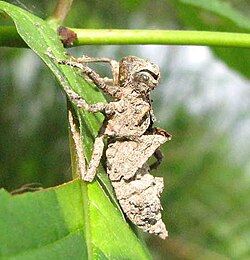
Key Facts
- Primary Functions: Provides structural support, protects internal organs, aids in respiration and excretion, and acts as a barrier against desiccation (drying out) for land animals.
- Composition: Common materials include chitin, calcium carbonate, silica, and in rare cases, iron sulfides.
- Growth Method: Many animals must undergo ecdysis (moulting) to grow, as the rigid exterior does not expand.
- Evolutionary Impact: The rise of mineralized exoskeletons is linked to the Cambrian explosion, driving a diversification of predator and prey tactics.
- Fossil Record: Hard exoskeletons are far more likely to be preserved as fossils than soft tissues.
Composition and Functional Roles
An exoskeleton is far more than a simple suit of armor. It serves critical biological roles, including sensation, feeding, and courtship displays. For terrestrial organisms, it acts as an essential osmotic barrier to prevent water loss. Additionally, it provides vital attachment points for muscles.
Material Science of Nature
The materials used to build these skeletons vary by lineage:
- Chitin: The primary component of arthropod exoskeletons. When reinforced with calcium carbonate, it becomes harder and stronger, though heavier.
- Apodemes: These are chitinous ingrowths that serve as muscle attachment sites. They are approximately twice as stiff and six times stronger than vertebrate tendons and can store elastic energy for movements like jumping in locusts.
- Calcium Carbonate: The main building block for molluscs, brachiopods, and certain tube-building worms.
- Silica: Used by microscopic organisms such as radiolaria and diatoms.
- Iron Sulfides: The scaly-foot gastropod uniquely incorporates greigite and pyrite into its structure.
Some organisms, such as certain foraminifera, create agglutinated exoskeletons by cementing grains of sand and shell fragments to their exterior. It is important to note that echinoderms do not have a true exoskeleton; their test is always covered by a layer of living tissue.
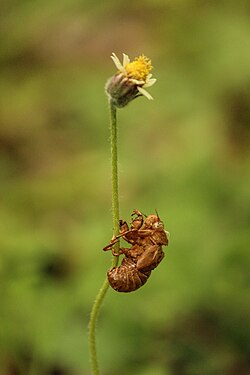
Growth and the Process of Moulting
Because exoskeletons are rigid, they impose strict limits on growth. Animals with open shells, such as bivalves and gastropods, can grow by adding new material to the shell's aperture (opening). However, panarthropods must undergo ecdysis, or moulting.
During ecdysis, the animal produces a new, soft exoskeleton beneath the old one. Once the old shell is shed, the animal is highly vulnerable to predators and trauma, often hiding in burrows during this transition. The organism plumps itself up to expand the new skeleton before it fully hardens. If an arthropod fails to moult, it may die or fail to reach reproductive maturity. This biological vulnerability is exploited by certain pesticides, such as Azadirachtin.
In contrast, moulting reptiles only shed the outer layer of skin and often exhibit indeterminate growth, replacing integuments throughout their lives.
Paleontological Significance
Exoskeletons are invaluable to paleontologists because they resist decay far better than soft tissues. Mineralized skeletons can be preserved as fragments or as moulds, where the hard shell protects the space beneath it from compaction during fossilization. In rare cases, such as in the Burgess Shale, chitin can be mineralized or transformed into keratin.
While these hard parts provide a window into the past, they also create a bias in the fossil record. Since two-thirds of animal phyla are soft-bodied, they are rarely preserved. However, "muscle scars" on fossilized exoskeletons often allow scientists to reconstruct the internal anatomy of extinct species.
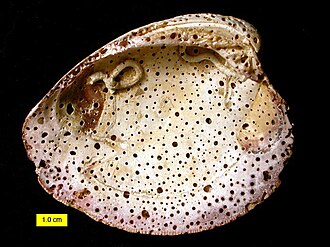
The Cambrian Explosion
Mineralized skeletons became prominent roughly 550 million years ago, just before the Cambrian period. This development is thought to have fueled the Cambrian explosion, as animals evolved new defensive and predatory strategies. While some Ediacaran organisms like Cloudina had calcified shells—some showing evidence of predation via borings—mineralized skeletons became widespread with the rise of "small shelly fauna." This shift may have been influenced by changes in ocean chemistry that made calcium compounds more stable.
Evolutionary Adaptations
Exoskeletons have evolved independently across many lineages. While most adopted calcium carbonate, the specific form (calcite or aragonite) often depended on the magnesium-to-calcium ratio of the seawater at the time the lineage first evolved. Once a lineage adopted a specific mineral form, it generally remained unchanged regardless of subsequent chemical shifts in the ocean.
Beyond mineralized shells, other animals evolved analogous protective coatings. Armadillos use bone, pangolins use hair, and crocodiles utilize a combination of bony scutes and horny scales.
| Material | Common Organisms | Key Characteristic |
|---|---|---|
| Chitin | Insects, Crustaceans | Flexible; can be hardened with calcium |
| Calcium Carbonate | Snails, Clams, Corals | Rigid and heavy; common in marine life |
| Silica | Diatoms, Radiolaria | Glass-like; found in microscopic organisms |
| Iron Sulfides | Scaly-foot gastropod | Rare; found near hydrothermal vents |
| Bone/Keratin | Turtles, Armadillos | Vertebrate-based protective armor |
Frequently Asked Questions
What is the difference between an exoskeleton and an endoskeleton?
An exoskeleton is a hard outer shell located on the exterior of the animal, providing both support and protection. An endoskeleton, like that of a human, is an internal framework enclosed by soft tissues.
Why do arthropods have to moult?
Because their exoskeletons are rigid and cannot expand, arthropods must shed their old shell (ecdysis) and grow a new, larger one to accommodate their increasing body size.
How do exoskeletons help in the study of evolution?
Hard exoskeletons fossilize much more easily than soft tissues, providing a physical record of ancient species. Muscle scars on these fossils also help scientists reconstruct the internal anatomy of extinct animals.
Can vertebrates have exoskeletons?
Yes, some vertebrates have exoskeleton-like structures. Turtles have a protective shell, armadillos have bony plates, and crocodiles have bony scutes and scales.
What is the role of chitin in an exoskeleton?
Chitin is a primary structural component in arthropod exoskeletons. It provides a balance of strength and flexibility, and can be further hardened by the addition of calcium carbonate.