Magnolia campbellii
Magnolia campbellii, commonly known as Campbell's magnolia, is a breathtaking deciduous tree celebrated for its massive, vibrant blooms. Native to the sheltered valleys of the Himalayas and surrounding regions, this species is a standout in the botanical world, combining impressive scale with delicate floral beauty. Named after Archibald Campbell, the former Superintendent of Darjeeling, it remains a prized specimen for collectors and gardeners worldwide.
Key Facts
- Conservation Status: Least Concern (IUCN 3.1).
- Maximum Height: Typically 30 meters, rarely reaching 45 meters.
- Flower Size: Large blooms ranging from 15 to 25 cm, occasionally up to 35 cm in diameter.
- Native Range: Eastern Nepal, Sikkim, Assam (India), northern Myanmar, and southwestern China.
- Bloom Time: Late winter to early spring, appearing before the foliage.
Botanical Description
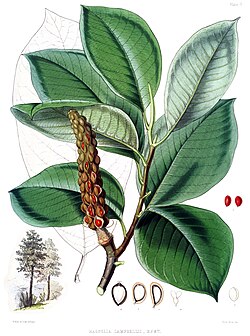
Magnolia campbellii is a medium to large deciduous tree characterized by its smooth grey bark. Its foliage consists of leaves measuring 10–23 cm in length (rarely up to 33 cm) and 4.5–10 cm in width (rarely up to 14 cm). These leaves feature an acute apex and a distinct fuzzy texture on the underside.
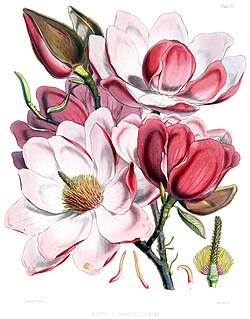
The most striking feature of the tree is its flowers. With 12 to 16 tepals (a term used when petals and sepals are indistinguishable), the blooms vary in color from pure white to deep pink. A unique biological adaptation occurs during flowering: while the outer tepals spread wide, the innermost ones remain erect. This structure is believed to protect the stamens and stigmas from the rain and snow common during the early spring season.
Varieties and Cultivars
Botanists recognize two primary varieties of Magnolia campbellii based on their geographic distribution and physical characteristics:
- Magnolia campbellii var. campbellii: Found in the western part of the species' range in the Himalaya; characterized by thinly hairy shoots and flower stalks.
- Magnolia campbellii var. mollicomata: Found in the eastern range, including Yunnan; distinguished by more densely hairy shoots and thickly felted flower stalks.
Beyond these natural varieties, several cultivars have been developed for ornamental use. These include 'Alba' and 'Strybing White', both featuring white flowers, and 'Charles Raffil', which produces bright purple-pink flowers and begins blooming on younger trees. Additionally, various hybrids have been created by crossing this species with other Magnolias.
Cultivation and Growth
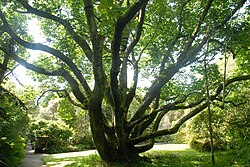
Growing Magnolia campbellii requires patience and specific environmental conditions. Young trees are slow to reach flowering age and demand deep, moist soil and a mild, sheltered site to thrive. Because the flowers emerge so early, they are highly susceptible to late spring frosts.
For gardeners in cooler climates, Magnolia campbellii var. mollicomata is often the preferred choice, as it flowers slightly later and is more resistant to frost damage.
| Feature | Details |
|---|---|
| Scientific Name | Magnolia campbellii |
| Family | Magnoliaceae |
| Flower Diameter | 15–25 cm (up to 35 cm) |
| Bark Color | Smooth grey |
| Native Habitat | Himalayan sheltered valleys |
| Leaf Texture | Fuzzy underneath |
Frequently Asked Questions
What is the difference between the two main varieties of Magnolia campbellii?
The primary difference lies in their hairiness and location. Var. campbellii is found in the western Himalaya and has thinly hairy shoots, while var. mollicomata is found in the east (Yunnan) and has densely hairy shoots and felted flower stalks.
Why do the inner petals of the flower stay upright?
The innermost tepals remain erect to act as a shield, protecting the reproductive organs (stamens and stigmas) from harsh environmental conditions like snow and rain during the early flowering period.
Which cultivar is best for younger gardens?
The 'Charles Raffil' cultivar is often recommended because it begins flowering on younger trees compared to the standard species.
Can Magnolia campbellii grow in cold climates?
While it can be grown ornamentally, successful flowering is limited to mild areas. In regions prone to late spring frosts, the flowers may be damaged; however, var. mollicomata is slightly more frost-tolerant due to its later blooming time.
What are the soil and site requirements for this tree?
Young trees require a mild, sheltered site and deep, moist soil to establish themselves and eventually reach flowering age.