Archibald Campbell: The Physician Who Shaped Darjeeling
Archibald Campbell was far more than a medical officer; he was a pioneer of economic botany, a dedicated ethnologist, and the primary architect of the early development of Darjeeling. Serving as the first superintendent of the sanatorium town from 1840 to 1862, Campbell transformed a remote Himalayan outpost into a thriving commercial and agricultural center.
His legacy is most visible today in the world-renowned tea industry of the region, but his contributions extended deep into the scientific study of the Himalayas, from the classification of rare flora to the documentation of indigenous tribes.
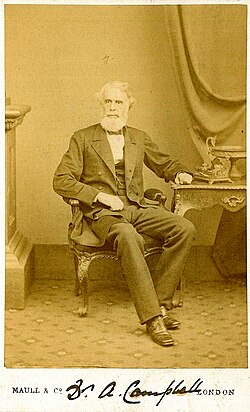
Key Facts
- Role: First Superintendent of Darjeeling (1840–1862).
- Major Achievement: Credited with introducing tea cultivation to Darjeeling.
- Scientific Contribution: Extensive research on Himalayan ethnology and economic botany.
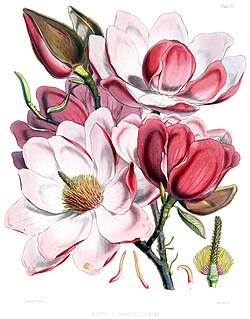
- Botanical Legacy: The species Magnolia campbellii is named in his honor.
- Medical Career: Member of the Bengal Medical Service (later the Indian Medical Service).
Early Life and Medical Career
Born on April 20, 1805, in Kilciarain, Islay, Archibald Campbell was the son of Lieutenant Archibald Campbell of Ardmore and Helen. He pursued his medical education at Glasgow and Edinburgh University, graduating with an M.D. in 1827.
Campbell joined the East India Company's Bengal medical establishment on May 8, 1827. His early career saw him posted to the horse artillery at Meerut and the European Convalescent Depot at Landour. By 1832, he was serving as a surgeon in Kathmandu, Nepal, where he worked under Brian Hodgson, a figure who profoundly influenced his interest in the natural world and local cultures.
The Transformation of Darjeeling
In 1840, Campbell was appointed Superintendent of Darjeeling. At the time, the region was inhabited by five primary tribes: the Lepchas, Moormis, Tibetans, Limboos, and Mechis. Under the direction of Lord Auckland, Campbell sought to reconcile these groups and establish Sikkim as a British commercial hub.
His administrative success was rapid. Between 1839 and 1849, the population grew from fewer than 100 people to approximately 10,000, driven by immigrants from Bhutan, Sikkim, and Nepal. By 1852, Campbell had overseen the construction of a bazaar, a jail, roads, and 70 European-style houses. He also abolished forced labor and generated over Rs. 50,000 in revenue.
Pioneering Economic Botany
Campbell's passion for economic botany—the study of plants for financial or medicinal gain—led to several landmark experiments. In 1841, he introduced tea seeds from the Kumaun region, planting them experimentally at his home, Beechwood. This initiative laid the foundation for what is now known globally as Darjeeling tea.
Beyond tea, Campbell experimented with Tassar silk and sea-island cotton in the Terai. He also attempted to cultivate Cinchona (the source of quinine used to treat malaria) using samples brought from Kew in 1834 by Robert Fortune, though these initial plants failed to survive the winter.
Diplomacy, Captivity, and Conflict
Campbell maintained a close professional relationship with the renowned botanist Sir Joseph Hooker. In November 1849, while exploring Sikkim with Hooker and a guide named Chibu Lama, the party was taken prisoner by Namgyal, a minister to the Raja of Sikkim. They were held at Tumlung until December 9.
Although Hooker was initially allowed to leave, he chose to remain with Campbell until both were released. This diplomatic incident had significant geopolitical consequences: the British Government of India subsequently annexed part of the Sikkim Terai region and ceased the annual rent payment of Rs 3,000 to the Sikkim Raja for the use of Darjeeling.
Later Life and Academic Legacy
Campbell retired on February 8, 1862, eventually returning to Slough in 1872. He remained active in his community, working with local institutions and the Orphan Asylum. He attended the International Congress of Orientalists in 1874 shortly before his death on November 5, 1874. He was buried at Upton.
Throughout his career, Campbell was a prolific writer for the Journal of the Asiatic Society of Bengal. Because he often signed his work as "Dr Campbell" or "Dr A. Campbell," he was frequently misidentified in historical texts as Arthur or Andrew. His writings covered a vast array of subjects, including the anatomy of wild dogs, the languages of the Limboo and Lepcha people, and the geography of Tibet.
| Category | Key Contribution / Detail |
|---|---|
| Agriculture | Introduced tea cultivation to Darjeeling (1841). |
| Infrastructure | Built roads, a bazaar, and 70 European houses in Darjeeling. |
| Botany | Collaborated with Sir Joseph Hooker; namesake of Magnolia campbellii. |
| Ethnology | Documented the languages and cultures of the Lepcha, Limboo, and Moormi tribes. |
| Medicine | Served in the Bengal Medical Service; experimented with Cinchona. |
Frequently Asked Questions
Did Archibald Campbell start the tea industry in Darjeeling?
Yes, he is credited with the introduction of tea cultivation in the region, beginning with experimental plantings near his home at Beechwood in 1841 using seeds from Kumaun.
Why was Archibald Campbell sometimes called Arthur or Andrew?
This confusion arose because he published many of his scientific papers under the names "Dr Campbell" or "Dr A. Campbell," leading later authors to assume his first name was Arthur or Andrew.
What was the result of Campbell's imprisonment in Sikkim?
The imprisonment of Campbell and Sir Joseph Hooker by the minister of the Raja of Sikkim led the British Government of India to annex part of the Sikkim Terai and stop paying rent for Darjeeling.
What botanical species are named after him?
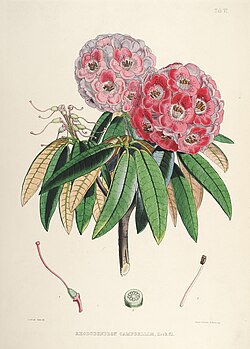
The magnolia species Magnolia campbellii was named after him by the botanist Sir Joseph Hooker. Additionally, Rhododendron campbelliae was named after his wife, Mrs. Campbell.
What other crops did Campbell experiment with?
In addition to tea, Campbell worked with Tassar silk, sea-island cotton in the Terai, and early samples of Cinchona brought from Kew.