Machinery Row: The Architectural and Commercial Legacy of East Madison
While Madison's early growth centered on the capitol square, the mid-19th century saw a shift toward the east. By the 1850s, a vibrant business district began to emerge around Williamson Street, setting the stage for one of the city's most significant commercial landmarks: Machinery Row.
The catalyst for this growth was the arrival of the railroads. The Chicago & Northwestern Railroad arrived in 1864, placing its depot at the intersection of Blair and E. Wilson, followed by the Chicago, Milwaukee and St. Paul Railroad in 1869. These connections transformed Madison into a critical logistics hub, bridging the gap between eastern manufacturers and the expanding agricultural frontier to the west.
The Rise of "Implement Row"
By the 1860s, Madison had become a major distributing center for agricultural implements—the machinery used in farming. The scale of this trade was immense; in 1866, reports indicated that shipments from Madison reached 70,760 pounds eastward and a staggering 2,686,330 pounds westward. Because it was more cost-effective for manufacturers to maintain branch locations than to ship directly from factories, many established offices near the east Madison depots, creating a district known as "Implement Row."
Before the permanent brick structures were erected, the site consisted of wooden buildings owned by Daggett and Gill, which served as ice houses, tobacco warehouses, and produce storage. As the implement trade grew, these structures were converted. In 1889, the Advance Thresher Company became one of the first major distributors to occupy these wooden spaces.
Architectural Transformation and Design
In 1898, Frank and Frederick Brown purchased the Daggett and Gill property. Leveraging a family fortune built on banking and utilities, the Browns commissioned the architectural firm Conover and Porter to replace the fragmented wooden buildings with a unified brick block. This ambitious project began in 1898, coinciding with railroad improvements to the spur track behind the site.
The first section (601-607 Williamson) was completed in 1899, housing the Advance Thresher Company in a facility described as the finest implement branch house in the country, capable of holding ten times the stock of an ordinary house. The transition to brick continued incrementally until the final wooden structure burned down in 1912, completing the unified block.
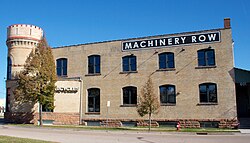
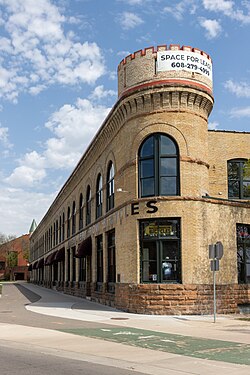
The building was designed in the Romanesque Revival style, characterized by several distinct features:
- Rusticated Sandstone: The base is clad in rough-hewn sandstone blocks to provide a sense of stability and groundedness.
- Round-Topped Windows: A hallmark of the Romanesque style, these appear on the second story.
- Materials: The walls feature white brick trimmed with Abelman stone and tile, topped by a brick corbelled cornice (a decorative projection).
- Towers: A round tower with battlements rises from the northwest corner, reminiscent of a castle watchtower and similar to the UW's Red Gym. A smaller turret with a conical roof sits at the far end of the block.
A Diverse Commercial Hub
Despite its name, Machinery Row was not limited to farming equipment. It served as a diverse commercial center housing businesses ranging from plumbing, heating, and electrical supplies to chemicals, paint, and printing. It even hosted retailers of ladies' underwear and candy; the Madison Candy Company operated here before building its own facility. The agricultural legacy persisted for decades, with Allis-Chalmers remaining as the last implement business until 1954.
In 1980, the property was acquired by John Coatta, a former Wisconsin Badgers player and head coach, and his wife, Jean, the daughter of former Mayor Henry Edward Reynolds.
Key Facts
- Location: Williamson Street, East Madison.
- Architects: Conover and Porter.
- Style: Romanesque Revival.
- Key Dates: Construction began in 1898; completed in 1912.
- NRHP Status: Added to the National Register of Historic Places (NRHP) in 1982.
- Primary Purpose: Distribution hub for agricultural implements.
| Era | Primary Characteristics | Key Developments |
|---|---|---|
| 1850s - 1880s | Early Development | Wooden warehouses; arrival of railroads in 1864 and 1869. |
| 1898 - 1912 | Brick Reconstruction | Brown brothers commission Conover and Porter for a unified brick block. |
| Early 20th Century | Commercial Peak | Diverse tenants from candy shops to Allis-Chalmers. |
| 1980 - Present | Preservation | Purchased by the Coattas; listed on the NRHP in 1982. |
Frequently Asked Questions
Why was Machinery Row significant to Madison's economy?
It served as a major distributing center for agricultural implements, utilizing Madison's central location and railroad connections to ship massive quantities of farming equipment to the American agricultural frontier in the west.
What architectural style defines the building?
The building is designed in the Romanesque Revival style, featuring rusticated sandstone bases, round-topped second-story windows, and a castle-like round tower with battlements.
Who were the architects of Machinery Row?
The block was designed by Conover and Porter, the same architectural firm responsible for the University of Wisconsin's Red Gym.
When was Machinery Row added to the National Register of Historic Places?
It was added to the NRHP in 1982 in recognition of its commercial history, its architectural value, and its role as a remnant of the 19th-century agricultural implement trade.
Did the building only house farming machinery?
No. While it was a hub for implement distributors, it also housed businesses selling building materials, plumbing, electrical supplies, chemicals, paint, and even candy and ladies' underwear.