Macclesfield Canal: A History of Ambition, Engineering, and Survival
The Macclesfield Canal stands as a testament to the industrial ambition of the early 19th century. Connecting the Peak Forest Canal to the Trent and Mersey Canal, this waterway was the result of decades of failed proposals, financial hurdles, and eventually, a triumph of civil engineering. From its origins as a strategic link for trade to its modern role as a leisure destination, the canal reflects the broader evolution of British transport.
The Long Road to Realization
The desire to link Macclesfield to the wider canal network began as early as 1765. For several decades, various schemes were proposed, including links to Congleton, Northwich, and Leek. In 1796, a more formal effort emerged when a group of investors hired Benjamin Outram, an engineer then working on the Peak Forest Canal, to survey potential routes. Outram proposed a route from the Peak Forest via Rudyard to the Caldon Branch, but the project stalled due to a lack of financial support following the end of "Canal Mania"—the period of speculative investment in waterways.
Throughout the early 1800s, the idea was revived multiple times. Proposals in 1805, 1810, and 1818 all failed to materialize. Even a potential branch of the Cromford and High Peak Railway in 1824 was deferred. It was not until September 1824 that a public meeting at the Macclesfield Arms finally galvanized local support, leading to the formation of a committee and the pledging of £100,000 in subscriptions.
Construction and Engineering
The Macclesfield Canal Act 1826 provided the legal framework for construction, with an estimated cost of £295,000. While Benjamin Outram handled the initial survey and legislation, the actual construction was managed by William Crosley. Crosley, who had previously worked on the Lancaster Canal, is credited with high-standard workmanship and efficiency, even reducing the canal's overall length by approximately 2 miles (3.2 km) through skillful management.
Construction began at Bollington on December 4, 1826. One of the most significant engineering challenges was the creation of the Bosley Locks and the aqueduct over the River Dane. The latter, completed in October 1830, utilized 10,212 cubic feet of stone with a main arch spanning 42 feet.
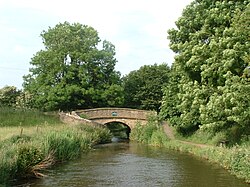
The canal officially opened on November 9, 1831, following a ceremonial procession of boats from Congleton and Marple. The final construction cost was approximately £320,000. To prevent water loss to the Trent and Mersey Canal, a stop lock (a lock used to separate two different waterways) was installed at the junction, featuring a fall of just 1 foot.
Key Facts
- Opening Date: November 9, 1831.
- Chief Engineer: William Crosley (Construction).
- Total Cost: Approximately £320,000.
- Summit Level: 518 feet (158 m), matching the Peak Forest Canal.
- Key Infrastructure: 12 locks at Bosley and two reservoirs at Bosley and Sutton.
- First Year Traffic: 98,201.5 tons of cargo (1832-1833).
The Impact of the Railways
The mid-19th century brought the inevitable challenge of railway competition. By 1845, the canal company faced declining dividends and rising costs. In a desperate bid to retain passengers, they introduced "swift packet boats" for leisure traffic between Dukinfield Central and Macclesfield, though this service ended by 1846.
To survive, the canal company initially threatened to build its own railway. However, they eventually negotiated a perpetual lease with the Sheffield, Ashton-under-Lyne and Manchester Railway in 1846. This agreement provided an annual rent of £6,605 and a £60,000 payment to clear debts. Ownership subsequently passed through the Manchester, Sheffield and Lincolnshire Railway, the Great Central Railway, and finally the London and North Eastern Railway (LNER) in 1922.
Commercial Decline and Incidents
While the canal continued to carry cotton, coal, and grain into the early 20th century, volumes dwindled. A major setback occurred on February 29, 1912, when a culvert failure at Kerridge caused the canal to burst its banks, flooding nearby streets and draining the upper pound. It took 100 men and 160 boat loads of clay puddle to repair the breach.
Transition to Leisure and Conservation
Commercial carrying officially ended in 1954. However, the canal found a new purpose in recreation. In 1943, the North Cheshire Cruising Club was formed at the High Lane Arm, recognized as the first such cruising club in Britain.
Following the nationalization of railways in 1948, the canal came under the British Transport Commission. Despite threats of closure in the 1950s, vigorous campaigning and the Transport Act 1968 secured the waterway's future. In June 1975, Macclesfield Borough Council designated the entire canal as a Conservation Area.
| Feature | Detail |
|---|---|
| Construction Period | 1826–1831 |
| Primary Purpose | Industrial transport (Coal, Cotton, Grain, Stone) |
| Key Connection | Peak Forest Canal to Trent and Mersey Canal |
| Current Status | Conservation Area / Leisure Waterway |
| Notable Feature | Bosley Locks (12 locks) |
Frequently Asked Questions
Who was responsible for the construction of the Macclesfield Canal?
While Benjamin Outram conducted the initial surveys and handled the parliamentary bill, the actual civil engineering and construction were managed by William Crosley.
Why was a stop lock installed at the junction with the Trent and Mersey Canal?
The stop lock was designed to ensure that the Trent and Mersey Canal did not lose water to the Macclesfield Canal, while also allowing both companies to collect tolls.
How did the arrival of railways affect the canal?
Railways led to a sharp decline in commercial traffic and dividends. This forced the canal company to lease the waterway to the Sheffield, Ashton-under-Lyne and Manchester Railway in 1846 to ensure financial survival.
What is the significance of the North Cheshire Cruising Club?
Formed in 1943, it is acknowledged as the first cruising club of its kind to be established in Britain, marking the shift from commercial use to leisure boating.
When did commercial traffic on the canal officially end?
Commercial carrying ceased in 1954, specifically with the end of coal transport between Stoke and Marple.