M2-F2 Lifting Body: The High-Stakes History of NASA's Heavyweight Test Vehicle
In the mid-1960s, NASA embarked on a pioneering journey to master lifting body technology—a method of flight where the aircraft's body itself generates lift, rather than relying on traditional wings. One of the most significant participants in this research was the Northrop M2-F2, a heavyweight lifting body designed to push the boundaries of aerodynamic stability and control.
Built by the Northrop Corporation in 1966, the M2-F2 was the result of intensive studies conducted at NASA's Ames and Langley research centers. As a "manned flight" (M-F) version of the lifting body concept, it served as a critical stepping stone for future spacecraft designs.
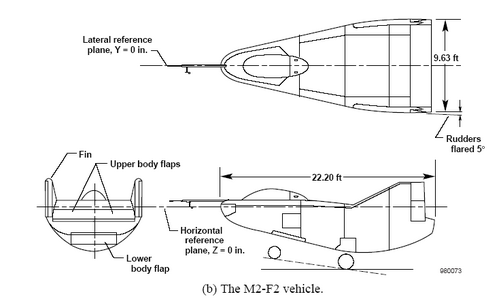
Development and Flight Testing
The M2-F2 was developed following the success of the M2-F1 program. It was part of a dual-track effort alongside the HL-10 (Horizontal Landing model 10), which was being investigated by Langley. While the HL-10 focused on different parameters, the M2-F2 was designed as a heavyweight entry-configuration vehicle.
The testing program began with captive flights on March 23, 1966, where the vehicle remained attached to a B-52 carrier aircraft. The transition to true flight occurred on July 12, 1966, when pilot Milton O. Thompson performed the first free gliding flight. Dropped from a B-52 wing pylon at 45,000 feet, the vehicle reached speeds of approximately 450 mph (720 km/h).
The Flight Profile
Before any powered flight attempts were made, NASA conducted a series of 16 unpowered glide flights to gather essential data on stability, control, and performance. These flights were carried out by four primary pilots:
- Milton O. Thompson (5 flights)
- Jerry Gentry (5 flights)
- Bruce Peterson (3 flights)
- Don Sorlie (3 flights)
The 1967 Crash and Operational Challenges
Despite the rigorous testing, the M2-F2 faced significant aerodynamic hurdles. The vehicle suffered from limited roll authority—the ability of the pilot to control the aircraft's rotation around its longitudinal axis—because the body itself produced very little roll force compared to conventional aircraft.
On May 10, 1967, during the sixteenth and final glide flight, pilot Bruce Peterson experienced a pilot-induced oscillation (PIO). This occurs when a pilot's corrective inputs inadvertently reinforce the aircraft's oscillations, leading to increasingly violent movements. As Peterson struggled to manage the roll, he became momentarily distracted by a rescue helicopter. This distraction, combined with a crosswind and a lack of visible ground markers, caused the vehicle to drift into an unmarked area of the lake bed.
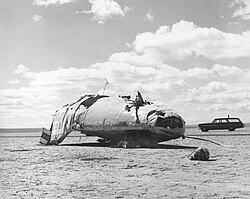
Although Peterson deployed landing rockets to increase lift, the M2-F2 struck the lake bed before the landing gear could fully lock. The vehicle rolled six times, ending up upside down. While Peterson was rescued and survived, he suffered a staphylococcal infection that resulted in the loss of vision in his right eye.
Legacy and the M2-F3 Evolution
The lessons learned from the M2-F2's lateral control issues led to a significant redesign. The vehicle was rebuilt at Dryden and redesignated as the M2-F3. To solve the stability problems, engineers added a third vertical fin centered between the existing tip fins, greatly improving control characteristics.
The M2-F2/F3 program successfully answered fundamental questions regarding heavyweight lifting bodies, paving the way for future aerospace technology. Interestingly, footage of the M2-F2, including the crash landing, was later used in the 1973 television series The Six Million Dollar Man.
Key Facts
- Manufacturer: Northrop Corporation
- Primary User: NASA
- First Flight: July 12, 1966
- Total Glide Flights: 16
- Redesignation: Rebuilt as the M2-F3 with an additional vertical fin
- Core Technology: Lifting body (generating lift via the fuselage)
Technical Specifications
| Feature | Specification |
|---|---|
| Crew | 1 |
| Length | 22 ft 2 in (6.76 m) |
| Wingspan | 9 ft 8 in (2.95 m) |
| Empty Weight | 4,620 lb (2,096 kg) |
| Gross Weight | 6,000 lb (2,722 kg) |
| Max Speed | Mach 0.707 (466 mph) |
| Service Ceiling | 45,000 ft (14,000 m) |
Frequently Asked Questions
What is a lifting body?
A lifting body is an aircraft design where the shape of the vehicle's main body is used to generate lift, reducing or eliminating the need for traditional wings.
Why was the M2-F2 redesigned as the M2-F3?
The M2-F2 had poor lateral control (roll authority). It was rebuilt as the M2-F3 with a third vertical fin added to the center to improve stability and control.
What caused the M2-F2 crash in 1967?
The crash was caused by a combination of pilot-induced oscillation (PIO), limited roll authority, a momentary distraction by a helicopter, and difficulty judging altitude over an unmarked lake bed.
How was the M2-F2 launched?
The M2-F2 was carried to an altitude of 45,000 feet by a B-52 carrier aircraft and then released to perform unpowered glide flights.
Did the M2-F2 have an engine?
The M2-F2 was equipped with a Reaction Motors XLR-11 liquid-fueled rocket motor, though the primary research flights conducted were unpowered glides.