Understanding Lythrum salicaria: The Story of Purple Loosestrife
Commonly known as purple loosestrife, Lythrum salicaria is a striking flowering perennial that commands attention in wetland environments. While it is celebrated in gardens for its vibrant hues, it is also a subject of significant ecological debate due to its ability to spread rapidly in non-native regions. Whether viewed as a beautiful ornamental or a challenging invasive species, this plant plays a complex role in the ecosystems it inhabits.
Key Facts
- Scientific Name: Lythrum salicaria
- Family: Lythraceae
- Native Range: Europe, temperate Asia, northern Africa, and eastern Australia.
- Height: Typically grows between 1–2 meters (3 ft 3 in – 6 ft 7 in).
- Pollination: Uses a unique cross-pollination system involving three different flower types.
- Conservation Status: Listed as Least Concern (IUCN 3.1).
Botanical Description and Characteristics
Lythrum salicaria is an herbaceous perennial that often forms extensive clonal colonies—groups of plants that grow from a single, shared woody root mass. The plant is characterized by its erect, reddish-purple stems which feature a distinct square cross-section.
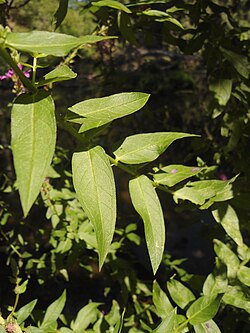
The leaves are lanceolate (shaped like a lance head), measuring 3–10 cm in length and 5–15 mm in width. They are typically downy to the touch and are arranged either in opposite pairs or in whorls of three along the stem.
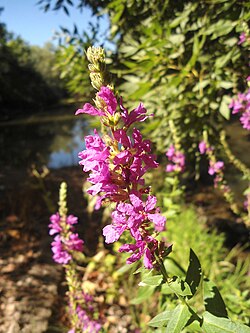
The most recognizable feature of the plant is its showy flowers. These reddish-purple blooms, roughly 10–20 mm in diameter, consist of six petals (and occasionally five) and 12 stamens. The flowers are tightly clustered in structures called verticillasters—dense, false whorls located in the axils of the leaves or bracts.
A Unique Pollination Strategy
One of the most fascinating aspects of purple loosestrife is its reproductive biology. The species possesses three different flower types, each with stamens and styles of varying lengths: short, medium, or long. To ensure cross-pollination (the transfer of pollen between different plants to increase genetic diversity), a flower can only be successfully pollinated by a different flower type. For example, if a flower has a medium-length pistil, its stamens will be either long or short, but never medium.
This "generalised pollination syndrome" attracts a wide variety of long-tongued insects, including many species of bees and butterflies.
Distribution and Habitat
Naturally, this plant thrives in temperate regions across Europe, Asia, northern Africa, and Australia. It is highly adapted to moist environments, commonly found in ditches, marshes, wet meadows, and along the edges of lakes.
While it is native to these areas, it has become naturalized in many other parts of the world, including North and South America and parts of southern Africa. In Australia, while once thought to be a recent introduction, pollen samples suggest it may have colonized the region naturally before modern human intervention.
Ecological Impact and the Invasive Debate
In North America and New Zealand, purple loosestrife is recognized as an invasive species. It has the capacity to invade sedge meadows and, in rare instances, disrupt water flow in rivers and canals. Because a single plant can produce up to 2.7 million tiny seeds annually, it spreads rapidly via wind and water.
However, modern scientific perspectives suggest a more nuanced view. Some researchers argue that the perceived threat of the plant is often amplified by media attention. They suggest that while the plant does impact environments, resources might be more effectively used to prevent general wetland disturbance rather than focusing solely on the removal of L. salicaria.
Biological Control Success
The management of purple loosestrife has become a landmark model for biological control—the use of natural enemies to manage a pest population. Since research began in 1985, several insect species have been used to control its spread:
- Leaf Beetles: Galerucella calmariensis and Galerucella pusilla can defoliate entire stands of the plant.
- Weevils: Species such as Hylobius transversovittatus, Nanophyes breves, and Nanophyes marmoratus target the roots and flowers, hindering the plant's ability to grow and produce seeds.
Cultivation and Uses
Beyond the wild, purple loosestrife is a popular ornamental plant. Gardeners value its bright colors and its ability to thrive in damp, poorly drained soils. Several cultivars have been developed for specific aesthetic effects, such as:
- 'Atropurpureum': Features dark purple flowers.
- 'Brightness': Produces deep pink flowers.
- 'Happy': A shorter variety (60 cm) with red flowers.
- 'Roseum Superbum': Known for large pink flowers.
The cultivars 'Blush' and 'Feuerkerze' have both received the Award of Garden Merit from the Royal Horticultural Society. Historically, the plant has also been used as an astringent medicinal herb to treat conditions like diarrhea and dysentery.
Summary of Species Data
| Feature | Details |
|---|---|
| Growth Habit | Herbaceous perennial; clonal colonies |
| Stem Shape | Square in cross-section; reddish-purple |
| Flower Color | Reddish-purple to pink or red (cultivars) |
| Seed Production | Up to 2.7 million seeds per plant annually |
| Preferred Habitat | Wetlands, marshes, and damp meadows |
Frequently Asked Questions
How can I tell purple loosestrife apart from other "loosestrifes"?
It is important not to confuse Lythrum salicaria with plants in the genus Lysimachia (family Primulaceae), which also share the name "loosestrife." You can distinguish L. salicaria by its square stems and its specific leaf arrangement.
Is purple loosestrife dangerous to the environment?
In its native range, it is a natural part of the ecosystem. In areas where it is invasive, such as North America, it can outcompete native vegetation in wetlands. However, scientific literature suggests its impact is often more modest than media reports might imply.
What insects feed on this plant?
While many pollinators like bees and butterflies visit the flowers, several insects specifically target the plant as a food source, including the black-margined loosestrife beetle, the golden loosestrife beetle, and various weevils.
Can I grow purple loosestrife in my garden?
Yes, it is widely cultivated as an ornamental, especially in damp or boggy areas. If you are concerned about its spreading nature, look for sterile cultivars or ensure it is planted in a contained environment.
Why do the leaves turn red in the autumn?
In early autumn, the leaves often turn a bright crimson color due to dehydration, a process that can last for nearly two weeks before the plant enters its dormant phase.