Lymantria dispar: The Impact and Biology of the Spongy Moth
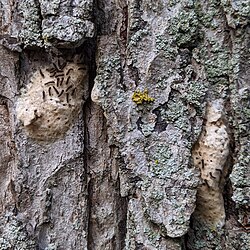
Lymantria dispar, a species of moth belonging to the family Erebidae, is one of the most significant invasive species in the world. Known historically as the gypsy moth, the Entomological Society of America officially transitioned to the name spongy moth in 2022. This change reflects the spongy texture of the moth's egg casings and addresses the fact that the previous common name was considered an ethnic slur toward the Romani people.
Native to Europe and Asia, this moth has successfully established itself across several continents, including Africa, North America, and South America. Because its larvae are polyphagous—meaning they can feed on a wide variety of both deciduous and coniferous trees—they have the potential to cause massive ecological disruption during years of mass reproduction.
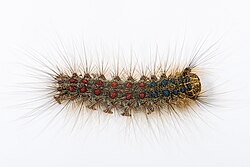
Key Facts
- Scientific Name: Lymantria dispar
- Common Names: Spongy moth (formerly gypsy moth)
- Status: Listed among the world's 100 worst invasive alien species
- Primary Threat: Severe forest defoliation caused by hungry larvae
- Control Methods: Microbial pathogens like LdmNPV and the fungus Entomophaga maimaiga
Taxonomy and Subspecies
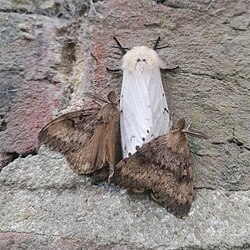
The classification of L. dispar involves several distinct subspecies, which can vary significantly in their physical traits and flight capabilities. The name Lymantria is derived from the Latin word for "destroyer," while the species epithet dispar refers to the sexual dimorphism—the distinct physical differences between males and females—observed in the species.
Subspecies Comparison
| Subspecies | Distribution | Identifying Characteristics |
|---|---|---|
| L. d. dispar | Europe, western Asia, north Africa, Eastern North America | Females are winged but flightless |
| L. d. asiatica | Eastern Asia, western North America, Europe | Females are winged and capable of flight; attracted to lights |
| L. d. japonica | Japan | Large males, very dark brown |
The European subspecies, L. d. dispar, was introduced to the United States in 1869 by Étienne Léopold Trouvelot. He sought a silk source to mitigate the cotton shortages caused by the American Civil War. Since then, the moth has expanded its range at an average rate of 21 km (13 mi) per year.
Ecological Impact and Outbreaks
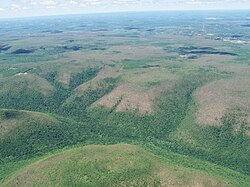
The most destructive stage of the moth's life cycle is the larval stage. These caterpillars can reach massive densities; in some parts of the northeastern and midwestern United States, densities have exceeded 2,500,000 caterpillars per hectare. Such outbreaks lead to widespread defoliation, where the leaves are stripped from trees, weakening or killing them.
Between 1970 and 2013, the cumulative defoliation caused by this species reached 33,000,000 hectares (82,000,000 acres). Beyond direct tree mortality, the moth affects other species. For example, defoliation by L. dispar triggers chemical defenses in quaking aspen, making them unsuitable hosts for the Polyphemus moth, thereby threatening that species' conservation.
Biological Control Efforts
To manage these populations, scientists have utilized various biological control agents. While some early attempts involved generalist predators that inadvertently harmed native insects, modern management focuses on more specific tools. The most effective agents are microbial pathogens, specifically the Lymantria dispar multicapsid nuclear polyhedrosis virus (LdmNPV) and the fungus Entomophaga maimaiga.
Frequently Asked Questions
Why was the name changed from gypsy moth to spongy moth?
The Entomological Society of America changed the name because "gypsy" is considered an ethnic slur by some Romani people. The new name, "spongy moth," refers to the spongy texture of the moth's egg masses.
How does the spongy moth affect forests?
The larvae are highly polyphagous and consume large quantities of leaves from various deciduous and coniferous trees. This mass defoliation can weaken forests and lead to significant ecological damage.
What are the main subspecies of Lymantria dispar?
The three main subspecies are L. d. dispar (European/North American), L. d. asiatica (Asian), and L. d. japonica (Japanese).
Are there natural ways to control the spongy moth population?
Yes, biological control agents such as specific viruses (LdmNPV) and fungi (Entomophaga maimaiga) are used to manage outbreaks effectively.
What is sexual dimorphism in these moths?
Sexual dimorphism refers to the physical differences between the sexes. In L. dispar, this is notably seen in the wings; for instance, in the L. d. dispar subspecies, females are winged but unable to fly.