Lyft: The Evolution of a Ride-Hailing Giant
Lyft, Inc. has established itself as a cornerstone of the modern urban transport landscape. As the second-largest ridesharing company in the United States, Lyft provides a comprehensive ecosystem of mobility services, including ride-hailing (the process of requesting a ride via a digital platform), e-scooters, and bicycle-sharing systems. Operating primarily across the United States and Canada, and expanding into Europe via the Freenow app, the company currently coordinates 9 million rides per day for 25 million active riders.
Key Facts
- Founded: June 9, 2012, as Zimride.
- Headquarters: San Francisco, California.
- Key Leadership: David Risher (CEO), Logan Green (Chairman), and John Zimmer (President).
- Market Presence: Publicly traded on Nasdaq as LYFT.
- Financials (2025): US$6.32 billion in revenue and US$9.03 billion in total assets.
- Global Reach: Services in the US, Canada, and Europe.
From Zimride to a Global Brand
The origins of Lyft date back to 2007, when computer programmers Logan Green and John Zimmer founded Zimride. Originally a long-distance intercity carpooling service focused on college transport, the idea was born from Green's own experience seeking easier ways to share rides between the University of California, Santa Barbara, and Los Angeles.
By May 2013, the company rebranded as Lyft. Shortly after, in July 2013, the original Zimride service was sold to Enterprise Holdings. This pivot allowed Lyft to focus on the burgeoning urban ridesharing market, supported by early growth funding from Andreessen Horowitz.
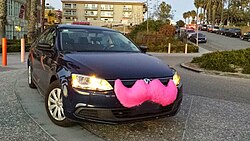
Lyft initially gained notoriety for its quirky marketing. Drivers famously attached large pink furry mustaches to their cars, and riders were encouraged to fist bump their drivers. However, as the company matured, it shifted toward a more professional image. In January 2015, the "glowstache"—a small, glowing plastic dashboard light—replaced the large exterior mustaches to better accommodate business travelers.
Strategic Expansion and Diversification
Lyft has consistently expanded its service offerings to move beyond simple car rides. In August 2014, the company introduced shared transport, allowing passengers to split fares. International expansion followed in December 2017 with a launch in Canada's Toronto, Hamilton, and Ottawa areas.
Healthcare and Micromobility
In March 2018, Lyft entered the healthcare sector by partnering with Allscripts, creating a platform for healthcare providers to arrange transportation for patients. The company also aggressively pursued micromobility (short-distance transport solutions) by acquiring Motivate in November 2018, the operator of Citi Bike and Capital Bikeshare, and later acquiring PBSC Urban Solutions in April 2022.
The Shift Toward Autonomous Technology
Lyft's relationship with self-driving technology has been a journey of partnership and divestment. While the company once owned a self-driving division with partners like General Motors and Ford, it sold that unit to Toyota for $550 million in April 2021. More recently, Lyft has returned to the autonomous space through partnerships, collaborating with Waymo in Nashville and May Mobility in Atlanta as of September 2025.
Corporate Growth and Financial Performance
Lyft transitioned to a public company in March 2019 through an initial public offering (IPO) that raised $2.34 billion. While the company faced significant challenges during the COVID-19 pandemic—including layoffs in 2020 and subsequent corporate restructuring in 2022 and 2023—it has shown resilience. In the second quarter of 2024, Lyft achieved its first GAAP (Generally Accepted Accounting Principles) profit in company history.
Recent acquisitions have further solidified its global footprint, including the €175 million purchase of Freenow in July 2025 and the £83 million acquisition of TBR Global Chauffeuring in October 2025.
| Metric | Value |
|---|---|
| Annual Revenue | US$ 6.32 Billion |
| Net Income | US$ 2.84 Billion |
| Total Assets | US$ 9.03 Billion |
| Total Equity | US$ 3.27 Billion |
| Employee Count | 3,913 |
Frequently Asked Questions
Who are the founders of Lyft?
Lyft was founded by computer programmers Logan Green and John Zimmer, who originally started the company as Zimride in 2007.
What is the "glowstache"?
The glowstache is a small, glowing plastic mustache that sits on a driver's dashboard. It was introduced in 2015 to replace the large pink furry mustaches on the front of cars to provide a more professional appearance for riders.
Does Lyft operate outside of North America?
Yes. While primarily serving the US and Canada, Lyft expanded into Europe through the acquisition of Freenow in July 2025.
Is Lyft currently using self-driving cars?
Yes, through strategic partnerships. As of September 2025, Lyft has partnered with Waymo for services in Nashville and May Mobility for services in Atlanta.
When did Lyft become a public company?
Lyft went public in March 2019, raising $2.34 billion with a valuation of $24.3 billion.