Uber: The Evolution of a Global Mobility Giant
From its humble beginnings as a niche service in San Francisco to becoming a global powerhouse in Mobility as a Service (MaaS)—a shift toward providing transportation as a flexible, on-demand service—Uber has fundamentally changed how the world moves. Today, the company operates across 70 countries and 10,500 cities, diversifying its portfolio from simple taxi rides to food delivery and freight transport.
Headquartered in Mission Bay, San Francisco, Uber has evolved from a disruptive startup into a public entity traded on the NYSE under the ticker UBER. It is now a significant component of the S&P 100, S&P 500, and the DJTA.
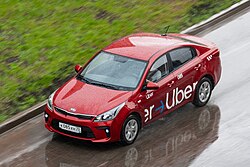
Key Facts
- Founded: March 2009 by Garrett Camp and Travis Kalanick.
- Global Reach: Operates in 10,500 cities across 70 countries.
- 2025 Financials: Reported revenue of US$ 52.017 billion and net income of US$ 10.053 billion.
- Workforce: Employs approximately 34,000 people as of 2025.
- Sustainability Goal: Committed to global carbon neutrality by 2040.
The Journey from Ubercab to Global Leader
Originally known as Ubercab between 2009 and 2011, the company's early leadership saw rapid transitions. Ryan Graves became the first employee in February 2010 and served as CEO until December 2010, when co-founder Travis Kalanick took over the role.

As the company scaled, it experimented with various technologies and acquisitions. In 2016, Uber launched "Uber AI" after acquiring Geometric Intelligence to research machine learning, though this division was eventually shut down in 2020. The company's visual identity also evolved to match its growing scale.

Strategic Acquisitions and Diversification
Uber has aggressively expanded its ecosystem through strategic acquisitions to move beyond ride-hailing:
- Cornershop: A Latin American grocery delivery provider, fully acquired by June 2021.
- Postmates and Uber Eats: Strengthening its presence in the food and package delivery sectors.
- Drizly: An alcohol delivery service acquired in 2021 for $1.1 billion, though it was shut down in early 2024.
- Careem: A Middle-Eastern rival acquired in 2020.
Financial Performance and Market Share
Uber's financial trajectory shows a significant shift from early losses to substantial profitability. By 2025, the company achieved a net income of over US$ 10 billion, a stark contrast to the losses seen between 2014 and 2022.
| Metric | Value |
|---|---|
| Total Revenue | US$ 52.017 Billion |
| Net Income | US$ 10.053 Billion |
| Total Assets | US$ 61.802 Billion |
| Total Equity | US$ 27.041 Billion |
| Operating Income | US$ 5.565 Billion |
Revenue by Segment and Region
The company's income is diversified across three primary business segments. Mobility remains the dominant driver, accounting for 57% of sales (US$ 25.1 billion), followed by Delivery at 31.3% (US$ 13.8 billion) and Freight at 11.7% (US$ 5.1 billion).
Geographically, the United States and Canada represent the largest market share at 53.7%, followed by Europe, the Middle East, and Africa (EMEA) at 28.5%, Asia-Pacific at 11.5%, and Latin America at 6.4%.
Future Outlook: Sustainability and Automation
Uber is pivoting toward a greener and more autonomous future. The company has mandated that in most countries, rides must be offered exclusively in electric vehicles by 2030, aiming for full carbon neutrality by 2040.
Innovation continues with a focus on robotaxis—autonomous vehicles without human drivers. Uber has partnered with companies like Lucid and Nuro for 2026 launches and has invested up to $1.25 billion in EV maker Rivian to deploy 50,000 robotaxis.
Frequently Asked Questions
Who are the current leaders of Uber?
As of the current reporting, Ronald Sugar serves as the Chairman and Dara Khosrowshahi is the Chief Executive Officer (CEO).
What services does Uber provide beyond ride-sharing?
Uber offers a wide array of services including food delivery (Uber Eats), package delivery, and freight transport.
What is Uber's goal regarding environmental impact?
Uber has committed to becoming carbon neutral globally by 2040 and aims to have rides offered exclusively in electric vehicles in most countries by 2030.
Which region generates the most revenue for Uber?
The United States and Canada region is the largest contributor, accounting for 53.7% of the company's total sales.
What is a robotaxi and is Uber implementing them?
A robotaxi is an autonomous vehicle that operates as a taxi without a human driver. Uber is implementing this technology through partnerships with Lucid, Nuro, and Rivian, with launches planned for 2026.