Luis Enrique: The Evolution of a Football Icon from Pitch to Touchline
Few figures in modern football have navigated the transition from elite player to world-class manager as successfully as Luis Enrique Martínez García. Known for his intensity, tactical flexibility, and an unwavering drive for excellence, Enrique has left an indelible mark on the sport's most prestigious clubs and the Spanish national team.
Born on May 8, 1970, in Gijón, Spain, Enrique's journey is a testament to versatility. Whether operating as a midfielder or a forward during his playing days, or orchestrating complex tactical shifts from the dugout, he has consistently remained at the pinnacle of European football.
Key Facts
- Full Name: Luis Enrique Martínez García
- Playing Career: Represented Sporting Gijón, Real Madrid, and Barcelona.
- International Caps: 62 appearances and 12 goals for Spain.
- Managerial Success: Won the UEFA Champions League with Barcelona (2014–15) and multiple Ligue 1 titles with Paris Saint-Germain.
- Individual Honors: Named FIFA World Coach of the Year in 2015 and The Best FIFA Football Coach in 2025.
The Playing Years: A Tale of Two Giants
Luis Enrique began his professional ascent at Sporting Gijón, where his early promise earned him a move to Real Madrid in 1991. Over five seasons in the capital, he made 157 appearances, establishing himself as a reliable presence in the squad and winning La Liga in the 1994–95 season.
In 1996, Enrique made a high-profile move to Barcelona, a club where he would spend the next eight years. His time at the Camp Nou was defined by prolific scoring and leadership, netting 73 league goals and contributing to multiple domestic and European titles, including the UEFA Cup Winners' Cup and the UEFA Super Cup.
On the international stage, Enrique was a staple for the Spanish national team between 1991 and 2002. A highlight of his early international career was winning a gold medal at the 1992 Barcelona Olympic Games with the Spain U23 squad.
Transition to Management
After retiring from play, Enrique transitioned into coaching, starting with Barcelona B (2008–2011). His early managerial steps took him to Roma in Italy and Celta Vigo in Spain, where he refined his philosophy before returning to his spiritual home at Barcelona in 2014.
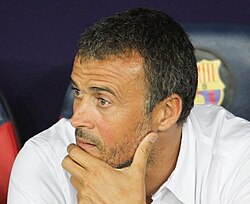
His tenure as Barcelona head coach (2014–2017) was nothing short of legendary. He led the club to a historic treble in the 2014–15 season, capturing La Liga, the Copa del Rey, and the UEFA Champions League. His ability to manage superstar egos and implement a high-tempo attacking style earned him the 2015 FIFA World Coach of the Year award.
Leading the National Team
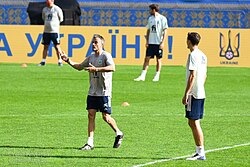
Enrique's managerial journey also included two stints with the Spanish national team. Despite personal tragedies that led to a brief departure in 2019, he returned to lead Spain to a runner-up finish in the 2021 UEFA Nations League, maintaining Spain's reputation for technical dominance.
The PSG Era
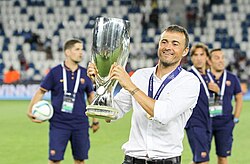
Since joining Paris Saint-Germain (PSG) in 2023, Enrique has overseen a significant transformation of the French giants. His tenure has been marked by domestic dominance in Ligue 1 and a crowning achievement in the UEFA Champions League (2024–25, 2025–26), cementing his status as one of the world's premier tacticians.
Career Statistics and Achievements
The following table summarizes the extensive career of Luis Enrique, spanning both his time as a player and his achievements as a manager.
| Role | Key Teams | Major Honors | Notable Stats |
|---|---|---|---|
| Player | Real Madrid, Barcelona, Spain | La Liga (3), Olympic Gold (1992) | 461 Club Apps / 131 Goals |
| Manager | Barcelona, Spain, PSG | UEFA Champions League (3), Ligue 1 (3) | 608 Games / 61.18% Win Rate |
Frequently Asked Questions
Which clubs did Luis Enrique play for in La Liga?
Luis Enrique played for Sporting Gijón, Real Madrid, and Barcelona during his professional playing career in Spain.
What was Luis Enrique's greatest achievement as a manager at Barcelona?
His greatest achievement was leading Barcelona to the treble in the 2014–15 season, winning La Liga, the Copa del Rey, and the UEFA Champions League.
How many times has Luis Enrique won the UEFA Champions League as a coach?
Luis Enrique has won the UEFA Champions League three times: once with Barcelona (2014–15) and twice with Paris Saint-Germain (2024–25 and 2025–26).
Did Luis Enrique play for the Spanish national team?
Yes, he earned 62 caps for the senior Spain national team between 1991 and 2002, scoring 12 goals.
What individual awards has Luis Enrique received as a manager?
He has been named the FIFA World Coach of the Year (2015), The Best FIFA Football Coach (2025), and the IFFHS World's Best Club Coach (2015, 2025).