Ludueña Stream: Hydrology and Flood Management in Santa Fe
The Ludueña Stream (known in Spanish as Arroyo Ludueña) is a vital waterway in the province of Santa Fe, Argentina. Spanning approximately 19 kilometers (12 mi) including its tributaries, this small river originates near the city of Rosario and flows primarily in an east-southward direction. Its journey concludes as it empties into the Paraná River in the Arroyito neighborhood, situated near the Rosario Central football stadium.
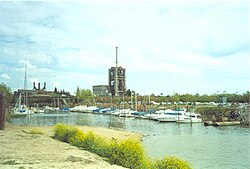
Drainage Basin and Regional Impact
The stream serves as the primary drainage system for an expansive area of 800 square kilometers (310 sq mi). This basin encompasses the city of Rosario as well as several smaller towns, including Pérez, Zavalla, Pujato, Funes, Roldán, San Jerónimo, Luis Palacios, Ricardone, Ibarlucea, and Camilo Aldao.
Due to the geography of the region, parts of the drainage basin are highly susceptible to flooding. A significant event occurred in 1986, which severely impacted the north-east neighborhoods of Rosario. In areas such as Ludueña Norte and Empalme Graneros, floodwaters reached depths of nearly 2 meters. This disaster catalyzed a grassroots movement, prompting citizens to pressure the provincial government to invest in critical preventive infrastructure.
Engineering and Flood Mitigation
To protect densely populated urban areas, engineers implemented a sophisticated piping system. A 1.5 km stretch of the Ludueña Stream was diverted into five underground closed conduits. These pipes feature a combined cross section of 74 meters, allowing the water to pass safely beneath the city before resurfacing into a final open section just a few hundred meters from the Paraná River.
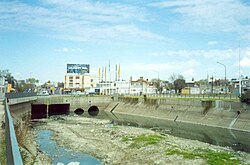
Further upstream, an earth-fill dam was completed in 1995 following two years of construction. This dam acts as a buffer—a structure designed to contain and regulate sudden peaks in waterflow during heavy rains. It is estimated that this regulation system directly or indirectly benefits approximately 200,000 residents in Rosario and the surrounding municipalities.
The March 2007 Flood Events
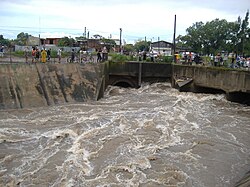
Between late March and early April 2007, the Paraná-Plata basin experienced over a week of intense rainfall. This caused a rise in the water levels of the Paraná River and its various tributaries. During this period, the Ibarlucea Canal—which feeds into the Ludueña Stream—overflowed, forcing the evacuation of several thousand people.
While the Ludueña Stream itself did not overflow, the event caused significant alarm in neighborhoods with a history of flooding. Subsequent analysis revealed that certain unfinished works intended to prevent the Ibarlucea Canal from overflowing were critical; had those works been completed, the excess flow would have been diverted into the main Ludueña channel, potentially pushing the stream over its banks.
Key Facts
- Total Length: Approximately 19 kilometers (12 mi) including tributaries.
- Drainage Area: 800 square kilometers (310 sq mi).
- Termination Point: The Paraná River in the Arroyito neighborhood, Rosario.
- Infrastructure: Includes a 1.5 km underground conduit system and an earth-fill buffer dam.
- Population Protected: Approximately 200,000 people.
| Feature | Detail |
|---|---|
| Location | Santa Fe Province, Argentina |
| Primary Mouth | Paraná River |
| Major Urban Center | Rosario |
| Key Infrastructure | Underground conduits & Buffer dam |
| Notable Flood Years | 1986, 2007 |
Frequently Asked Questions
Where does the Ludueña Stream end?
The stream ends in the Paraná River, specifically in the neighborhood known as Arroyito, near the Rosario Central football stadium in Rosario, Argentina.
What is the purpose of the earth-fill dam?
The dam serves as a buffer to contain and regulate sudden peaks in waterflow, reducing the risk of downstream flooding for about 200,000 people.
How is the stream managed in densely populated areas?
A 1.5 km section of the stream is routed through five underground closed conduits with a total cross section of 74 meters to avoid flooding urban neighborhoods.
What happened during the 2007 floods?
Heavy rainfall caused the Ibarlucea Canal to overflow, leading to the evacuation of thousands of people, although the Ludueña Stream itself remained within its banks.
Which towns are part of the Ludueña drainage basin?
The basin includes Rosario and the towns of Pérez, Zavalla, Pujato, Funes, Roldán, San Jerónimo, Luis Palacios, Ricardone, Ibarlucea, and Camilo Aldao.