Lower Risk Classification in the IUCN Red List
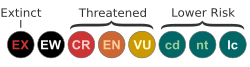
The IUCN Red List is the global standard for evaluating the extinction risk of biological species. While modern assessments use a streamlined set of categories, older records often feature a classification known as Lower Risk. This term served as a broad umbrella for species that were not immediately threatened with extinction but required different levels of monitoring.
In the current system, the Lower Risk designation has been superseded. However, because many species have not been reassessed in decades, this legacy term still appears in various scientific databases and historical records.
Key Facts
- Lower Risk was a former IUCN category for species with population levels high enough to ensure survival.
- It was replaced by the Least Concern and Near Threatened classifications in version 3.1 of the Red List (2001).
- Species still listed as Lower Risk are flagged as "out of date" or "Needs updating" on the official website.
- The IUCN Green Status, introduced in 2020, reintroduced a separate metric for conservation dependence.
The Structure of the Lower Risk Category
When the Lower Risk classification was active, it was not a single designation but was divided into three distinct sub-categories based on the specific needs and stability of the species:
- Conservation Dependent (LR/cd): Species that relied on ongoing conservation efforts to prevent them from moving into a higher risk category.
- Near Threatened (LR/nt): Species that did not yet meet the criteria for being vulnerable but were likely to become so in the near future.
- Least Concern (LR/lc): Species that did not fit into the conservation dependent or near threatened categories.
Transition to Version 3.1 and Modern Standards
Since 2001, the IUCN has utilized version 3.1 of its Categories and Criteria. This update removed the Conservation Dependent (LR/cd) sub-category entirely. Under the current rules, any species that would have previously been labeled as conservation dependent is now classified as Near Threatened (NT).
Despite this change, the Red List maintains historical accuracy. If a species has not undergone a new assessment, it retains its original v2.3 status. Because the IUCN aims for reassessments to occur at least every 10 years, any species still carrying a Lower Risk label is automatically flagged as "Needs updating" to signal that the data is obsolete.
Current IUCN Red List Categories
To provide context, the modern Red List classifies all species into one of nine categories:
- Extinct
- Extinct in the Wild
- Critically Endangered
- Endangered
- Vulnerable
- Near Threatened
- Least Concern
- Data Deficient
- Not Evaluated
Summary of Classification Changes
| Former Sub-category (v2.3) | Modern Category (v3.1) | Description |
|---|---|---|
| Conservation Dependent (LR/cd) | Near Threatened (NT) | Requires active conservation to avoid higher risk. |
| Near Threatened (LR/nt) | Near Threatened (NT) | Likely to become vulnerable soon. |
| Least Concern (LR/lc) | Least Concern (LC) | Low risk of extinction. |
Frequently Asked Questions
What does it mean if a species is listed as Lower Risk today?
If a species is still listed as Lower Risk, it means the assessment is based on the outdated v2.3 criteria and has not been updated in over 10 years. It is considered "out of date" by the IUCN.
Why was the Conservation Dependent category removed?
The IUCN streamlined its categories in version 3.1 to simplify the assessment process, moving species that were conservation dependent into the Near Threatened category.
Is Lower Risk the same as Least Concern?
Not exactly. Lower Risk was a broad category that included Least Concern, but it also included Near Threatened and Conservation Dependent species.
How does the IUCN Green Status differ from the Red List?
While the Red List focuses on extinction risk, the IUCN Green Status (formalized in 2020) focuses on recovery and reintroduced a specific metric to assess conservation dependence separately from the risk category.