Loss of Citizenship: Legal Grounds, Global Challenges, and Prevention
Loss of citizenship, also known as loss of nationality, occurs when an individual ceases to be a citizen of a country under that nation's specific nationality laws. This transition can be a voluntary choice, a punitive measure by a state, or an unintentional result of geopolitical shifts and legal loopholes. While it may seem like a purely administrative process, the loss of citizenship often has profound legal and social consequences, frequently impacting marginalized communities and hindering global sustainability efforts.
Key Facts
- Citizenship can be lost voluntarily through renunciation or involuntarily through denaturalization.
- Marginalized groups, including transgender individuals and ethnic minorities, are disproportionately affected.
- The United Nations aims for "legal identity for all" under Sustainable Development Goal 16.9.
- Statelessness often results from the volatility of aspirant states or poor institutional record-keeping.
- Some countries impose strict age-based requirements for maintaining citizenship, such as Japan and Switzerland.
Grounds for the Loss of Citizenship
The mechanisms for losing citizenship vary widely across the globe. A study by the European Union Democracy Observatory of thirty-three European countries identified nine broad categories where citizenship could be lost through either individual or government action. These grounds generally fall into voluntary and involuntary categories.
Voluntary Renunciation
Renunciation is the act of voluntarily giving up one's citizenship. This is most commonly done when an individual wishes to acquire the citizenship of another country that does not allow dual nationality.
Involuntary Denaturalization
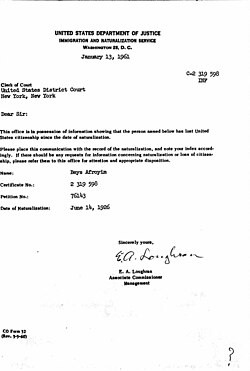
Denaturalization—also referred to as forfeiture or deprivation—is the involuntary revocation of citizenship. Historically, this process has been used to target ethnic minorities, such as Haitians in the Dominican Republic. Common legal grounds for denaturalization include:
- Fraud during the naturalization process, such as sham marriages.
- Failure to renounce a previous citizenship after committing to do so during naturalization.
- Severe legal breaches, including treason.
Vulnerable Populations and Legal Challenges
Certain groups face higher risks of losing their legal identity due to systemic barriers or specific legal frameworks.
Children and Minors
Children may lose their citizenship automatically if their parents do. Additionally, adoption by a foreign national or the annulment of maternity or paternity can lead to loss of nationality. Children of migrants are particularly vulnerable depending on whether a country follows jus soli (citizenship by place of birth) or jus sanguinis (citizenship by bloodline).
Transgender Individuals
Transgender people often face hurdles when updating identification documents during transition. In Europe, many countries lack specific legislation for identity alteration, relying instead on judicial precedent or general anti-discrimination laws. In Poland, for example, legislation prohibits updating citizen identification based on non-domestic sources, meaning those who transition abroad cannot have their identities transcribed. These barriers can limit access to the essential benefits of citizenship.
Citizens of Aspirant States
Aspirant states are entities seeking international recognition as sovereign nations. Because their status is volatile, their citizens often hold insecure documentation. If a state loses international recognition, its people may lose their citizenship on a global scale, frequently leading to statelessness—a condition where no country recognizes the person as a national.
Institutional Failures and Conflict
Even without intentional legal action, poor institutional systems can lead to the loss of citizenship. When countries implement new birth registration or identification systems without adequate resources, citizens can fall through the cracks.
In Indonesia, a bureaucratic numbering system introduced in 2006 left some citizens without identification numbers, making it difficult for them to reclaim their legal status. These issues are exacerbated during armed conflicts—such as those in Ukraine, Syria, and Iraq—where migration, loss of territory, and the depletion of state resources destroy identification records.
Other Grounds for Loss
Some losses of citizenship occur in a "gray area" where a voluntary action triggers an involuntary legal result. Examples include:
- Serving in a foreign military or government.
- Residing abroad on a permanent basis.
- Voluntarily acquiring another citizenship.
- Failure to reaffirm citizenship or revoke other citizenships by a specific age (e.g., age 22 in Japan).
In many cases, these losses occur without the knowledge of either the citizen or the government until an official, such as embassy staff, discovers the discrepancy.
Prevention and International Efforts
To combat statelessness, many countries have legal provisions preventing the loss of citizenship if it would leave a person without any nationality. These are often based on international treaties.
The United Nations promotes "legal identity for all" via Sustainable Development Goal 16.9. Additionally, Article 7 of the Convention on the Reduction of Statelessness stipulates that renunciation should only be permitted if the person already possesses or has acquired another nationality. However, these guidelines are not peremptory norms, meaning they do not legally bind countries that have not signed the Convention.
Country-Specific Provisions
While most nations allow for renunciation and denaturalization, some have unique requirements:
| Country | Condition for Loss of Citizenship |
|---|---|
| Belgium | Citizens residing abroad between ages 18 and 28 may lose citizenship under certain conditions. |
| Japan | Children with dual citizenship must renounce the other nationality by age 22. |
| Switzerland | Citizens who are not registered by age 25 lose their citizenship. |
| Mexico | Naturalized citizens lose citizenship after 5 years of residence abroad. |
Frequently Asked Questions
What is the difference between renunciation and denaturalization?
Renunciation is a voluntary act where a person chooses to give up their citizenship, often to acquire another. Denaturalization is an involuntary process where the government revokes a person's citizenship, typically due to fraud or severe legal breaches.
How does statelessness occur?
Statelessness can occur when a person loses their citizenship without acquiring another, often due to the collapse of an aspirant state, institutional failures in birth registration, or discriminatory laws targeting specific ethnic or social groups.
What are jus soli and jus sanguinis?
Jus soli is the legal principle where citizenship is granted based on the territory where a person is born. Jus sanguinis is the principle where citizenship is determined by the nationality of the parents, regardless of birth location.
What is the UN's goal regarding legal identity?
Under Sustainable Development Goal 16.9, the United Nations calls for the provision of a legal identity for all people, aiming to reduce statelessness and ensure everyone has access to the rights and benefits associated with citizenship.
Can children lose their citizenship?
Yes. Children may lose citizenship if their parents lose theirs, through adoption by a foreign national, or through the annulment of maternity or paternity.