Local Government (Scotland) Act 1973: Reshaping Scottish Administration
The Local Government (Scotland) Act 1973 stands as one of the most significant pieces of legislation in the history of Scottish civic administration. Passed by the Parliament of the United Kingdom, this Act fundamentally altered how Scotland was governed at a local level, replacing centuries-old structures with a modernized administrative framework.
The legislation was primarily the result of the 1969 Wheatley Report, produced by the Royal Commission on Local Government in Scotland. The goal was to sweep away an antiquated system of counties, burghs, and districts—many of which dated back to the Middle Ages—and replace them with a streamlined, uniform system better suited to the needs of a modern state.
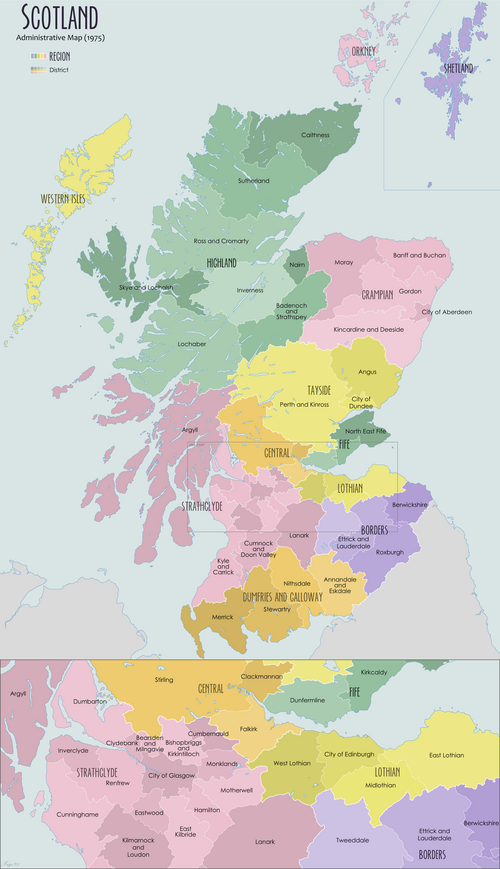
Key Facts
- Royal Assent: Granted on 25 January 1973.
- Implementation: The new system officially took effect on 16 May 1975.
- Core Change: Replaced old counties and burghs with a two-tier system of Regional and District councils.
- Exceptions: Island areas were granted unitary, all-purpose councils rather than the two-tier structure.
- Duration: The system remained in place until 1 April 1996.
The Two-Tier Administrative Structure
The Act established a hierarchy of local government designed to balance large-scale strategic planning with localized service delivery. This was mirrored by the Local Government Act 1972 in England and Wales, though Scotland utilized the specific term region for its upper tier.
Regional Councils
Regions were responsible for wide-area services. The Act created several major regions, including the massive Strathclyde region, as well as Highland, Grampian, Tayside, Fife, Lothian, Borders, Central, and Dumfries and Galloway.
District Councils
Beneath the regions were District councils, which handled more immediate local concerns. For example, the Highland region was further subdivided into districts such as Caithness, Sutherland, and Inverness. In the islands, however, the structure was simplified; Orkney, Shetland, and the Western Isles operated as unitary authorities, meaning a single council handled all local government functions.
| Administrative Level | Scope | Examples |
|---|---|---|
| Regional Council | Upper-tier strategic governance | Strathclyde, Lothian, Highland |
| District Council | Lower-tier local governance | Clydebank, Inverness, Roxburgh |
| Island Council | Unitary (All-purpose) | Orkney, Shetland, Western Isles |
Reaction and Long-term Impact
The transition was not without challenges. The sheer scale of some regions proved cumbersome. For instance, by 1977, the Strathclyde Regional Council had to establish unelected sub-regional councils to manage its vast territory, effectively recreating the county-style councils the Act had intended to replace.
Interestingly, because the Act used the term "region" rather than "county" for the new upper tier, the traditional Scottish counties maintained a strong cultural identity. While they lost their direct governing power, they continued to be used by the Royal Mail as postal counties and remained relevant for lieutenancy areas and registration.
The era of the two-tier system eventually came to an end on 1 April 1996. Under the Local Government etc. (Scotland) Act 1994, the regions and districts were abolished and replaced by 32 unitary authorities—single-tier councils that manage all local services.
Legislative Evolution and Amendments
Since its inception, the 1973 Act has been amended by a vast array of subsequent legislation to keep pace with changing social and legal needs. These range from the Control of Pollution Act 1974 and the Housing (Scotland) Act 1987 to more recent updates like the Scottish Local Government Elections (Candidacy Rights of Foreign Nationals) Act 2022.
Frequently Asked Questions
What was the primary purpose of the Local Government (Scotland) Act 1973?
The Act aimed to modernize Scottish local government by replacing an obsolete system of burghs and counties with a uniform two-tier system of regional and district councils, based on the recommendations of the 1969 Wheatley Report.
When did the changes introduced by the Act actually begin?
Although the Act received Royal Assent on 25 January 1973, the new local government structure officially came into effect on 16 May 1975.
How did the island areas differ from the mainland?
Unlike the mainland, which used a two-tier system (Region and District), the island areas of Orkney, Shetland, and the Western Isles were given unitary, all-purpose councils.
Why did the two-tier system eventually fail?
The system became cumbersome due to the immense size of certain regions, such as Strathclyde, which made region-wide administration difficult and led to the creation of sub-regional councils.
What replaced the 1973 system in 1996?
The Local Government etc. (Scotland) Act 1994 abolished the regions and districts, replacing them with 32 unitary authorities on 1 April 1996.