Inverness District: A History of Local Government in the Scottish Highlands
The Inverness District was a pivotal administrative division in Scotland, serving as a local government district from the mid-1970s through the mid-1990s. Established as one of eight districts within the broader Highland region, it balanced the urban needs of its primary settlement, Inverness, with the management of vast rural landscapes, including the world-famous Loch Ness.
Key Facts
- Established: 16 May 1975
- Abolished: 31 March 1996
- Successor: Highland Council (single-tier authority)
- Headquarters: Inverness Town House
- Geographic Scope: Included Inverness burgh and rural areas of former Inverness-shire
The Formation of the District
The district was created under the Local Government (Scotland) Act 1973. This legislation fundamentally restructured Scottish administration by abolishing traditional counties, burghs (self-governing towns), and landward districts, replacing them with a two-tier system consisting of regions and districts.
The Inverness District consolidated three previous administrative areas, all of which had originally been part of Inverness-shire:
- Inverness burgh: The central urban hub.
- Aird district: Rural territories generally located to the west of Loch Ness.
- Inverness district: Rural territories generally located to the east of Loch Ness.
Under this two-tier structure, the Inverness District Council managed local-level functions, while the Highland Regional Council—also based in Inverness—handled regional-level responsibilities.
Administration and Political Control
Before the district formally began operations on 16 May 1975, the first council election was held in 1974 to establish a shadow authority. This allowed for a smooth transition from the outgoing local governments.
Political leadership of the council shifted over its two-decade existence. From 1975 to 1988, the council was under Independent control. From 1988 until its abolition in 1996, the council operated under no overall control, meaning no single political party held an absolute majority.
The Council Headquarters
The administrative heart of the district was the Inverness Town House. Located on the High Street in the center of Inverness, this building had been completed in 1882 to serve the original Inverness Town Council before becoming the main offices for the District Council.
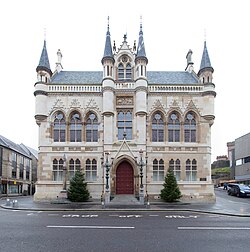
Transition to Single-Tier Governance
The administrative landscape changed again with the Local Government etc. (Scotland) Act 1994. On 31 March 1996, the two-tier system of regions and districts was abolished in favor of single-tier council areas. Consequently, the Highland region became a unitary authority known as the Highland Council.
Although the district no longer exists as a legal entity, its legacy continues through the City of Inverness Area Committee. This committee consists of councillors representing wards that broadly align with the boundaries of the pre-1996 Inverness District. Notably, Inverness was granted official city status in 2000, four years after the district's abolition.
| Feature | Details |
|---|---|
| Active Period | 1975–1996 |
| Parent Region | Highland Region |
| Constituent Areas | Inverness burgh, Aird district, and Inverness district |
| Political Control (1975-1988) | Independent |
| Political Control (1988-1996) | No overall control |
| Current Equivalent | City of Inverness Area Committee |
Frequently Asked Questions
When was the Inverness District created and abolished?
The Inverness District was created on 16 May 1975 and was abolished on 31 March 1996.
What happened to the district after 1996?
It was succeeded by the Highland Council, which became a single-tier council area replacing the previous two-tier system of regions and districts.
Which areas were merged to form the Inverness District?
The district merged the Inverness burgh, the Aird district (west of Loch Ness), and the original Inverness district (east of Loch Ness), all of which were part of Inverness-shire.
Where were the council's main offices located?
The council met and operated out of the Inverness Town House on the High Street, a building completed in 1882.
Does any part of the old district structure still exist today?
While the district is gone, the Highland Council maintains the City of Inverness Area Committee, which covers a geographical area broadly corresponding to the former district.