Lobsters: Biology, History, and the Evolution of the Global Trade
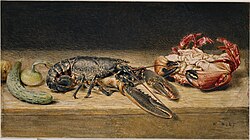
Lobsters are fascinating marine crustaceans belonging to the family Nephropidae. Known for their imposing claws and deep-sea habitats, these creatures have evolved over millions of years, with a temporal range extending from the Valanginian period to the present day. From their complex biological adaptations to their role as a global culinary delicacy, lobsters represent a unique intersection of marine science and economic history.
These animals are classified under the order Decapoda (meaning ten-footed) and the class Malacostraca. While many people associate them primarily with the Atlantic coast, the family includes a diverse array of genera, including Homarus, Nephrops, and Metanephrops, spanning various oceanic regions and depths.
Key Facts
- Physical Size: Typically range from 25 to 50 cm (10 to 20 inches) in length.
- Escape Mechanism: Use a "caridoid escape reaction," curling and uncurling their abdomens to swim backward at speeds up to 5 m/s (11 mph).
- Habitat Depth: Generally found between 2 and 900 meters, though some species reside as deep as 3,700 meters.
- Sentience: Legally recognized as sentient beings in the UK under the Animal Welfare (Sentience) Act 2022.
- Mercury Levels: The FDA reported a mean mercury level of 0.107 ppm in American lobsters between 2005 and 2007.
Biological Characteristics and Ecology
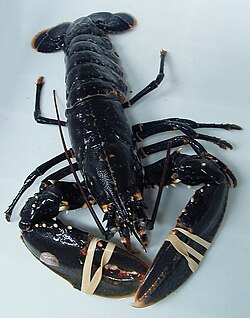
Lobsters are primarily benthic organisms, meaning they live on the sea floor, where they move by walking slowly. Their most distinctive feature is their powerful claws, used for defense and capturing prey. To survive in diverse marine environments, they have developed specialized physiological traits, including a complex exoskeleton.
The diversity of the Nephropidae family is vast. The most well-known species include the American lobster (Homarus americanus) and the European lobster (Homarus gammarus). Other notable species include the Norway lobster (Nephrops norvegicus), also known as the langoustine or Dublin Bay prawn, and various scampi species within the Metanephrops genus.
The History of the Lobster Industry
The commercialization of lobster has undergone a massive transformation, shifting from preservation-based methods to the high-speed transport of live animals.
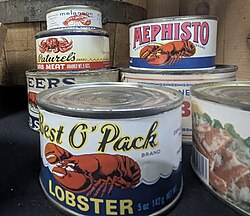
The Era of Canning
In the 1840s, the first US lobster cannery opened in Eastport, Maine. By 1880, Maine hosted 23 canneries, with approximately two-thirds of the 14.2 million pound catch being canned. During the 1870s, the industry shifted toward the Canadian Maritime Provinces. Because these regions were too distant from major markets to support a live trade, canning became the primary method of export. For example, in 1879, Prince Edward Island operated 35 canneries, shipping 2.3 million pounds of lobster primarily to Great Britain.
The Shift to Live Shipping
By 1895, the canning industry in Maine had vanished due to overfishing and the introduction of ice, which made shipping live lobsters practical. In Canada, the decline of canneries continued through the 1950s as refrigerated rail, truck, and air freight emerged. The deregulation of airlines in 1977 further accelerated this trend, allowing live lobsters to reach markets across North America with unprecedented efficiency.
Fishery and Aquaculture
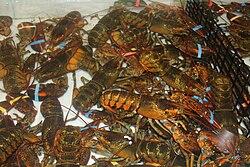
Lobsters are harvested using baited one-way traps made of wood or plastic-coated galvanized steel. These traps are marked with color-coded buoys to identify ownership. A single fisher may manage as many as 2,000 traps across their fishing grounds.
Animal Welfare and Sentience
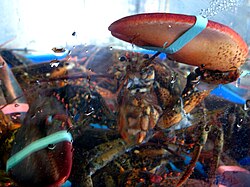
The method of preparing lobsters has become a subject of significant scientific and legal debate. A 2021 study by the London School of Economics provided strong scientific evidence that decapod crustaceans and cephalopod molluscs are sentient—meaning they have the capacity to experience feelings and sensations.
While boiling lobsters alive remains a common practice in the UK as of 2025, the Animal Welfare (Sentience) Act 2022 has legally recognized them as sentient beings. This has led to ongoing legal arguments regarding whether boiling them alive violates animal welfare legislation.

Summary of Lobster Classification and Species
| Genus | Notable Species | Common Names |
|---|---|---|
| Homarus | H. americanus, H. gammarus | American lobster, European lobster |
| Nephrops | N. norvegicus | Norway lobster, Langoustine |
| Metanephrops | M. australiensis, M. sinensis | Australian scampi, China lobster |
| Nephropsis | N. aculeata | Florida lobsterette |
Frequently Asked Questions
How do lobsters move quickly to escape predators?
Lobsters utilize the caridoid escape reaction, which involves rapidly curling and uncurling their abdomens to propel themselves backward. They can reach recorded speeds of up to 5 m/s (11 mph).
Are lobsters considered sentient?
Yes, scientific evidence suggests they are sentient. In the United Kingdom, this was legally formalized through the Animal Welfare (Sentience) Act 2022.
What is the typical depth at which lobsters are found?
Most lobsters are fished in waters between 2 and 900 meters, although some specialized species have been found at depths of up to 3,700 meters.
Why did the lobster canning industry decline?
The industry declined due to the development of refrigeration and faster transportation methods (rail, truck, and air freight), which made it more profitable and practical to ship live lobsters to market.
Is there a risk of mercury in lobster meat?
According to FDA data from 2005-2007, the mean mercury level in American lobster was 0.107 ppm, which is well below the FDA's maximum permissible level of 1 ppm for seafood.