Littoral Combat Ship (LCS): A History of Design Struggles and Strategic Shifts
The Littoral Combat Ship (LCS) program was conceived as a flexible, high-speed solution for the U.S. Navy to operate in shallow coastal waters. Designed to be modular and agile, the LCS was intended to replace aging frigates and minesweepers. However, the program's journey from conception to deployment has been marked by significant budget overruns, design disputes, and a fundamental re-evaluation of what a modern surface combatant should be.
Key Facts
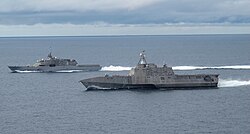
- Two Primary Designs: The program utilized two distinct hulls: the semi-deep draft Freedom class and the trimaran Independence class.
- Cost Challenges: Early lead ships saw costs rise to $637 million (Freedom) and $704 million (Independence).
- Performance Gaps: The GAO reported that the LCS had a "near-zero chance" of meeting the requirement for 30 consecutive days underway without critical failure.
- Strategic Pivot: The Navy eventually abandoned plans to rebrand LCS as "Fast Frigates," opting instead for the Constellation class (FFG-62).
- Current Status: As of 2026, the Navy plans to maintain a fleet of 28 ships, focusing on mine clearing and robotic platform support.
Budgetary Turmoil and Procurement Hurdles
The LCS program faced immediate financial scrutiny. In 2007, the Navy canceled contracts for LCS-3 and LCS-4 due to a failure to control cost overruns. This led to a contentious bidding process and public criticism, including mentions in the 2008 U.S. presidential debates regarding botched contracting.
By 2009, the Navy attempted to stabilize costs by exploring fixed-price contracts and considering a reduction in top speed requirements from 40 knots to 30 knots to stay under price caps. Despite these efforts, the Government Accountability Office (GAO) later found that operating an LCS cost approximately $79 million annually, significantly higher than the $54 million required for a larger traditional frigate.
The Dual-Design Strategy
Rather than selecting a single winning design, the Navy requested permission in 2010 to order ten of each variant. This decision was based on the complementary nature of the two designs: the Freedom class was deemed better for the enclosed waters of the Middle East, while the Independence class was suited for the open waters of the Pacific.
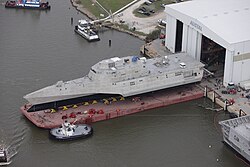
However, this dual-track approach introduced complexity. The transition of management for the Independence class from General Dynamics to Austal USA resulted in a 13-month schedule slip. By 2011, the unit cost for the program reached $1.8 billion, with a total program cost of $3.7 billion.
Operational Challenges and Vulnerabilities
As the ships entered service, critical operational gaps emerged. In 2013, Navy requirements officers identified a significant vulnerability to tactical aircraft armed with standoff anti-ship missiles. Critics argued that the 57 mm main gun was more appropriate for a patrol boat than a frigate.
Survivability became a central point of contention. The LCS was built to Level I+ survivability standards—higher than patrol craft but lower than the Level II standards of the Oliver Hazard Perry-class frigates they replaced. This meant the ships were designed to withdraw from combat upon sustaining damage rather than fighting through it.
Performance and Theater Suitability
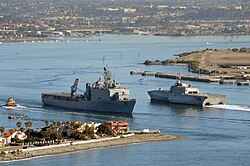
Reports from the U.S. 7th Fleet suggested that while the LCS was useful in the Persian Gulf, it lacked the speed, range, and electronic warfare capabilities necessary for the Pacific theater. Furthermore, the first two vessels from each manufacturer were found to be overweight and unable to consistently maintain sprint speeds over 40 knots.
The Evolution Toward the "Fast Frigate" and Beyond
In response to these shortcomings, Secretary of Defense Chuck Hagel directed the Navy to seek a more versatile surface combatant. This led to a proposal to upgrade the LCS into a "Fast Frigate" (FF). These proposed upgrades included improved 3D air defense radar, better electronic warfare systems, and enhanced armor.
The Navy planned to categorize the first 24 ships as "Block 0" and the subsequent ships as "Block 1" (the Fast Frigates). However, this rebranding effort was eventually abandoned. In April 2020, the Navy selected a design based on the Italian/French FREMM multi-purpose frigate, creating the Constellation class (FFG-62) to fulfill the need for a capable guided-missile frigate.
| Feature | Original LCS (Flight 0) | Proposed Fast Frigate (FF) | Constellation Class (FFG-62) |
|---|---|---|---|
| Primary Role | Modular Littoral Ops | Anti-Sub/Surface Warfare | Multi-mission Guided-Missile |
| Survivability | Level I+ | Enhanced Armor/Defenses | High-end Frigate Standard |
| Key Armament | 57mm Gun / Modules | Improved Radar / Decoys | Advanced Missile Systems |
| Status | Active / Partial Retirement | Abandoned/Rebranded | Selected/In Development |
Procurement Cuts and Future Outlook
In 2015, the planned procurement was reduced from 52 to 40 ships to reallocate funds toward F-35C fighters, SM-6 missiles, and Virginia-class submarines. By 2022, the Navy proposed decommissioning several ships due to structural failures and ineffective anti-submarine warfare systems.
However, the geopolitical climate has shifted the strategy once more. Due to the expansion of the Chinese fleet, the Navy canceled plans to retire seven hulls. As of January 2026, the U.S. Navy intends to keep 28 LCS vessels, repurposing them for mine-clearing missions and as support platforms for robotic aircraft and unmanned ships.
Frequently Asked Questions
Why were there two different designs for the LCS?
The Navy determined that the two designs offered complementary features: the Freedom class was better suited for the enclosed waters of the Middle East, while the Independence class was more effective for the open waters of the Pacific.
What caused the significant cost overruns in the LCS program?
Costs rose due to initial bidding based on commercial standards rather than Navy survivability standards, the experimental nature of the first two ships, and challenges during the management handoff between shipbuilders.
Why was the "Fast Frigate" plan abandoned?
The plan to upgrade and reclassify the LCS as a frigate was eventually viewed as a rebranding effort that did not sufficiently address the need for a highly capable guided-missile frigate, leading to the selection of the Constellation class.
What is the current role of the remaining LCS fleet?
The Navy envisions using the remaining 28 ships primarily for mine-clearing missions (replacing the Avenger class) and as experimental platforms for robotic and unmanned systems.
How does LCS survivability compare to older frigates?
The LCS is built to Level I+ survivability standards, which is lower than the Level II standards of the Oliver Hazard Perry-class frigates. Consequently, the LCS is designed to withdraw from combat after taking damage rather than sustain prolonged operations.