Lisa Su: A Legacy of Innovation in Semiconductor Leadership
From pioneering the materials that power modern chips to leading one of the world's most influential semiconductor companies, Lisa Su has left an indelible mark on the technology landscape. Her career is defined by a rare combination of deep technical expertise in device physics—the study of how electrons move through semiconductor materials—and a strategic vision for business diversification.
Key Facts
- Current Role: Chair and CEO of AMD.
- Major Technical Achievement: Developed the copper interconnect "recipe" at IBM, increasing chip speeds by up to 20%.
- Strategic Pivot: Shifted AMD's revenue from 10% non-PC sales in 2012 to roughly 40% by 2015.
- Key Product Launches: Oversaw the development of the Zen architecture and Ryzen CPU line.
- Major Acquisition: Led the $49 billion acquisition of Xilinx in February 2022.
Early Career: Foundations at Texas Instruments and IBM
Lisa Su began her professional journey in 1994 as a member of the technical staff at Texas Instruments within the Semiconductor Process and Device Center (SPDC). By February 1995, she transitioned to IBM, where she served as a research staff member and vice president of the semiconductor research and development center.
At IBM, Su played a critical role in a fundamental shift in chip manufacturing. She helped develop the process to replace aluminum connections with copper, solving the complex problem of preventing copper impurities from contaminating devices during production. Launched in 1998, this copper technology established new industry standards and produced chips that were up to 20% faster than conventional versions.
Driving Emerging Products and Global Collaborations
In 2000, Su served as the technical assistant to IBM CEO Lou Gerstner before founding and leading the Emerging Products division. Operating as an internal startup, her team focused on biochips and low-power, broadband semiconductors. Their first success was a microprocessor designed to extend battery life in handheld devices, earning Su a spot as a "Top Innovator Under 35" by MIT Technology Review in 2001.
Su also spearheaded a high-profile collaboration between IBM, Sony, and Toshiba. Tasked with increasing game processor performance by a factor of 1,000, her team conceptualized a nine-processor chip. This innovation eventually became the Cell microprocessor, the engine powering the PlayStation 3.
Executive Leadership at Freescale and AMD
Su joined Freescale Semiconductor in June 2007 as Chief Technology Officer (CTO). She later became the senior vice president and general manager of the networking and multimedia group, where she managed global strategy and engineering for embedded communications. Her leadership is credited with stabilizing the company's networking-chip business, leading to an initial public offering (IPO) in 2011.
In January 2012, Su joined AMD as senior vice president and general manager. She focused on diversifying the company's portfolio beyond the PC market, securing partnerships with Microsoft and Sony to integrate AMD chips into the Xbox One and PlayStation 4.
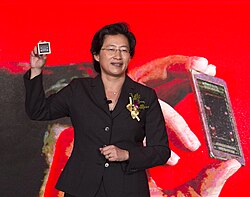
On October 8, 2014, Su was appointed President and CEO. She implemented a strategy of streamlining product lines and making targeted technology investments to accelerate development.
The Ryzen Era and Market Transformation
Under Su's leadership, AMD underwent a massive financial and technical transformation. By February 2015, non-PC markets—including embedded devices and consoles—accounted for approximately 40% of sales, up from just 10% when she joined in 2012. In 2016, she announced the move toward FinFET-based chips (a 3D transistor design that reduces leakage and improves performance) for a new line of microprocessors and Accelerated Processing Units (APUs), which combine a CPU and GPU on a single die.
The launch of Zen-based chips in early 2017 marked a turning point, pushing AMD's CPU market share to nearly 11%. The Ryzen line, particularly the Threadripper workstation processors, gained acclaim for offering high thread counts at more competitive prices than Intel's offerings.
In February 2022, Su expanded AMD's capabilities further by becoming Chair following the $49 billion acquisition of Xilinx, a leader in FPGA (Field Programmable Gate Array) and programmable systems on chip.
| Period | Organization | Key Contribution/Role |
|---|---|---|
| 1994–1995 | Texas Instruments | Technical staff at SPDC |
| 1995–2007 | IBM | Copper interconnects; Cell microprocessor; Emerging Products |
| 2007–2011 | Freescale | CTO; Networking and Multimedia GM |
| 2012–Present | AMD | CEO; Zen/Ryzen architecture; Xilinx acquisition |
Frequently Asked Questions
What was Lisa Su's major technical contribution at IBM?
She played a critical role in developing the "recipe" for using copper connections instead of aluminum in semiconductor chips, which prevented contamination and increased chip speeds by up to 20%.
How did Lisa Su change AMD's business model?
Su diversified AMD's revenue streams, moving the company from a heavy reliance on the PC market (90% of sales in 2012) to a more balanced portfolio including gaming consoles, datacenters, and embedded devices (40% non-PC sales by 2015).
What is the significance of the Ryzen processor line?
The Ryzen CPUs, based on the Zen architecture, allowed AMD to regain significant CPU market share by offering high thread counts and high performance at lower price points than competitors.
What was the result of the Xilinx acquisition?
Completed in February 2022 for $49 billion, the acquisition of Xilinx integrated FPGA and programmable systems on chip capabilities into AMD's portfolio.
Which gaming consoles used technology developed under Lisa Su's leadership?
Her work contributed to the Cell microprocessor in the PlayStation 3, and later, she helped secure AMD chips for the PlayStation 4 and Xbox One.