Lev Landau: The Architect of Modern Theoretical Physics
Lev Davidovich Landau was a titan of 20th-century science, widely regarded as one of the last physicists to possess a universal mastery of all branches of theoretical physics. A Soviet physicist of immense influence, Landau laid the essential foundations for condensed matter physics—the study of the physical properties of solid and liquid matter—and left an indelible mark on quantum mechanics, plasma physics, and thermodynamics.
His career was defined by a relentless pursuit of mathematical rigor and a capacity to synthesize complex phenomena into elegant theories. From the discovery of the density matrix to his Nobel Prize-winning work on superfluidity, Landau's contributions continue to shape how scientists understand the universe at its most fundamental levels.
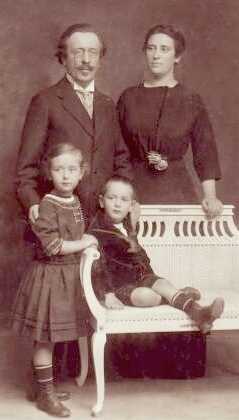
Key Facts
- Nobel Prize: Awarded the 1962 Nobel Prize in Physics for his theory of superfluidity.
- Universalist: One of the few scientists to make seminal contributions to nearly every field of theoretical physics.
- Educational Legacy: Co-authored the definitive Course of Theoretical Physics.
- The Theoretical Minimum: Created a rigorous qualifying exam that only 43 candidates passed between 1934 and 1961.
- Major Theories: Developed Fermi liquid theory, Ginzburg–Landau theory of superconductivity, and the theory of second-order phase transitions.
Early Life and Prodigious Beginnings
Born on January 22, 1908, in Baku (then part of the Russian Empire, now Azerbaijan) to Jewish parents, Landau displayed an extraordinary aptitude for mathematics from a young age. He mastered differential calculus at 12 and integral calculus at 13. By the age of 13, he had already graduated from gymnasium.
Because his parents felt he was too young for university, he spent a year at the Baku Economical Technical School before matriculating at Baku State University at age 14. There, he simultaneously studied physics, mathematics, and chemistry, though he eventually focused his academic path on the former two.
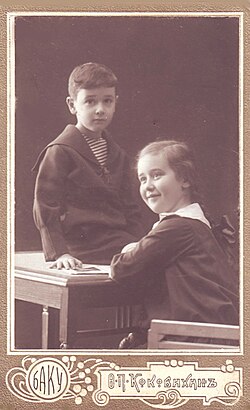
Academic Journey and European Influence
In 1924, Landau moved to Leningrad State University, the epicenter of Soviet physics at the time, graduating in 1927. He continued his studies at the Leningrad Physico-Technical Institute, earning his doctorate in 1934. Between 1929 and 1931, Landau traveled extensively across Europe, supported by fellowships from the Soviet government and the Rockefeller Foundation.
During this period, he worked with some of the most influential minds of the era. He spent significant time at the Niels Bohr Institute in Copenhagen, where he developed a lifelong intellectual bond with Niels Bohr. He also collaborated with Paul Dirac in Cambridge and Wolfgang Pauli in Zürich. These experiences solidified his approach to physics, blending deep theoretical insight with a rigorous mathematical framework.
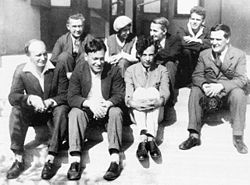
The Kharkov Era and the "Theoretical Minimum"
While working at the Ukrainian Physics and Technology Institute in Kharkov, Landau established a legendary pedagogical standard known as the Theoretical Minimum. This was a comprehensive series of examinations covering all essential aspects of theoretical physics. It served as a gateway for students wishing to study under him; the exam was so demanding that only a small fraction of candidates ever passed, though those who did often became world-class physicists in their own right.
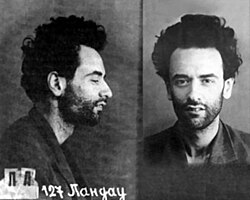
Contributions to Soviet Science and the Atomic Project
Later in his career, Landau moved to Moscow, where he led a team of mathematicians supporting the development of the Soviet atomic and hydrogen bombs. He was specifically responsible for calculating the dynamics and predicting the yield of the first Soviet thermonuclear bomb. For these contributions, he was awarded the Stalin Prize in 1949 and 1953, and named a Hero of Socialist Labour in 1954.
Scientific Achievements and the Nobel Prize
Landau's scientific output was vast, spanning multiple disciplines. He independently co-discovered the density matrix method in quantum mechanics and developed the theory of Fermi liquids. He also pioneered the order parameter technique and the Ginzburg–Landau theory of superconductivity.
His most celebrated achievement was the mathematical theory of superfluidity—a state of matter in which a fluid flows without viscosity. Specifically, his work explained the properties of liquid helium II at temperatures below 2.17 K (−270.98 °C), for which he received the Nobel Prize in Physics in 1962.
| Field | Key Contribution / Theory | Significance |
|---|---|---|
| Low-Temperature Physics | Theory of Superfluidity | Explained zero-viscosity flow in liquid helium II. |
| Quantum Mechanics | Density Matrix | Fundamental tool for describing statistical quantum states. |
| Condensed Matter | Fermi Liquid Theory | Describes the behavior of interacting fermions. |
| Thermodynamics | Phase Transition Theory | Introduced the order parameter for second-order transitions. |
| Plasma Physics | Landau Damping | Explains the decay of plasma waves without collisions. |
Legacy and Final Years
Beyond his research, Landau's legacy lives on through the Course of Theoretical Physics, a multi-volume series co-authored with Evgeny Lifshitz that remains a standard reference for physicists worldwide. His influence is further commemorated by the Landau Gold Medal, the highest prize in theoretical physics awarded by the Russian Academy of Sciences, and several celestial objects named in his honor.
Landau's later years were marked by a tragic car accident in 1962, which left him severely injured. Despite the efforts of the scientific community to sustain him, he passed away on April 1, 1968, at the age of 60. He is buried at the Novodevichy Cemetery in Moscow.
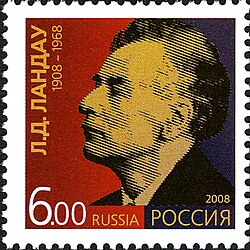
![Landau in 1962[19] on a 2010 Ukrainian stamp](/images/43/81/4381ce9c3d0dc3878ef6e93ff97116a41c8d5130ea9b6be893efe04a3c8a4540.jpg)
Frequently Asked Questions
What was the "Theoretical Minimum"?
The Theoretical Minimum was a rigorous set of examinations created by Lev Landau. It covered the entirety of theoretical physics and was required for any student who wished to join his research school. Only 43 people passed it between 1934 and 1961.
Why did Lev Landau win the Nobel Prize?
Landau was awarded the 1962 Nobel Prize in Physics for his development of a mathematical theory of superfluidity, which successfully accounted for the unique properties of liquid helium II at temperatures below 2.17 K.
What is the Course of Theoretical Physics?
It is a comprehensive series of textbooks co-authored by Landau and Evgeny Lifshitz. The series covers a vast range of topics, including mechanics, quantum mechanics, and fluid mechanics, and is renowned for its depth and clarity.
What is Landau damping?
Landau damping is a phenomenon in plasma physics where plasma waves are damped (decay) without the need for collisions between particles, a discovery that is fundamental to understanding plasma stability.
Who were Landau's primary intellectual influences?
Landau was most heavily influenced by Niels Bohr, whom he considered his teacher. He also worked closely with other pioneers of quantum mechanics, including Paul Dirac and Wolfgang Pauli.