League of Nations: The Rise and Fall of the First Global Peacekeeping Body
The League of Nations was the first ambitious attempt in history to create a permanent intergovernmental organization dedicated to maintaining world peace. Established in the wake of the devastation of World War I, it sought to replace the old system of secret alliances and balance-of-power politics with a framework of collective security—the principle that an attack on one member is an attack on all.
Operating from 1920 to 1946, the League represented a pivotal shift toward international law and diplomacy, laying the structural and conceptual groundwork for the modern United Nations.
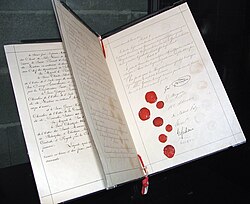
Key Facts
- Founded: January 10, 1920, following the Treaty of Versailles.
- Headquarters: Geneva, Switzerland (Palais Wilson and later the Palace of Nations).
- Primary Goal: To prevent future global conflicts through disarmament and diplomacy.
- Official Languages: English, French, and Spanish.
- Successor: The United Nations (established 1945).
- Key Figure: U.S. President Woodrow Wilson, credited as the founder.
Origins and Establishment
The concept of a League of Nations grew from a desire to ensure that the horrors of the Great War would never be repeated. While early advocates like Lord Bryce had championed the idea, it was Woodrow Wilson who integrated the League into the peace process. During his 1918 trip to Europe, Wilson reaffirmed that creating the League was a single, essential objective for lasting peace.
![The League to Enforce Peace published this full-page promotion in The New York Times on Christmas Day 1918.[30] It resolved that the League "should ensure peace by eliminating causes of dissension, by deciding controversies by peaceable means, and by uniting the potential force of all the members as a standing menace against any nation that seeks to upset the peace of the world".[30]](/images/e6/89/e689b11c2f56d8785ef7eae868dd6f6226ef247f4f482cbcb37a0f1f7b788b9a.jpg)
![On his December 1918 trip to Europe, Woodrow Wilson gave speeches that "reaffirmed that the making of peace and the creation of a League of Nations must be accomplished as one single objective".[38]](/images/e3/24/e3245185ffa0eb5e2b1a1639b64a3a613b0079b885b5d2f4dada746df3a94fa9.jpg)
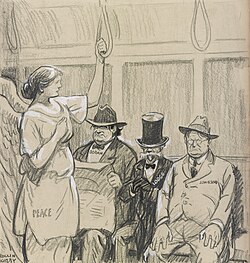
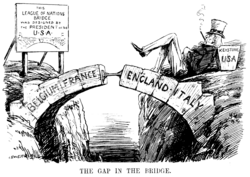
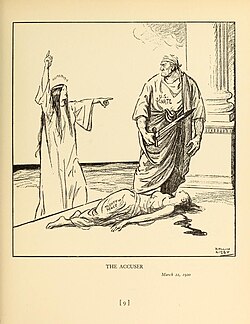
Despite Wilson's efforts, the League faced a critical blow from the start: the United States Senate refused to ratify the Treaty of Versailles. This left a significant "gap in the bridge," as the world's emerging superpower remained outside the organization it had helped conceive.
Structure and Governance
The League was headquartered in Geneva, Switzerland. It initially operated out of the Palais Wilson before moving to the purpose-built Palace of Nations in 1936.
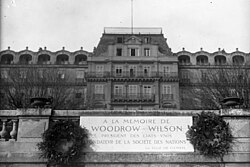
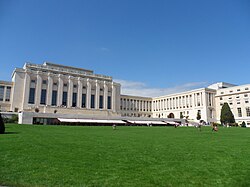
The organization was governed by several permanent organs, including the Assembly and the Council. Its administration was led by a Secretary-General, with Sir Eric Drummond serving as the first in this role from 1920 to 1933.
![League of Nations Organisation chart[75]](/images/dd/d3/ddd3b218511db4b11e40409d60c8466351ea065687ce1e28695b9af48c9bc402.png)
![A session of the Assembly (1923), meeting in Geneva at the Salle de la Réformation (in a building at the corner of Boulevard Helvétique and Rue du Rhône) from 1920 to 1929, and at the Bâtiment électoral or Palais Électoral (Rue du Général- Dufour 24) from 1930 to 1936 as well as for special sessions at the Palais du désarmement adjacent to the Palais Wilson,[82] before moving into the Assembly Hall of the Palace of Nations.](/images/98/eb/98eb87365e8a97a3005948938e5fc7a5fcee37ce62729f5e5dd16f8bfcb7a0d7.jpg)
Global Representation and Inclusion
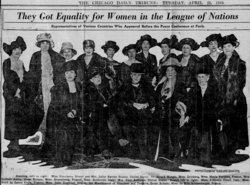
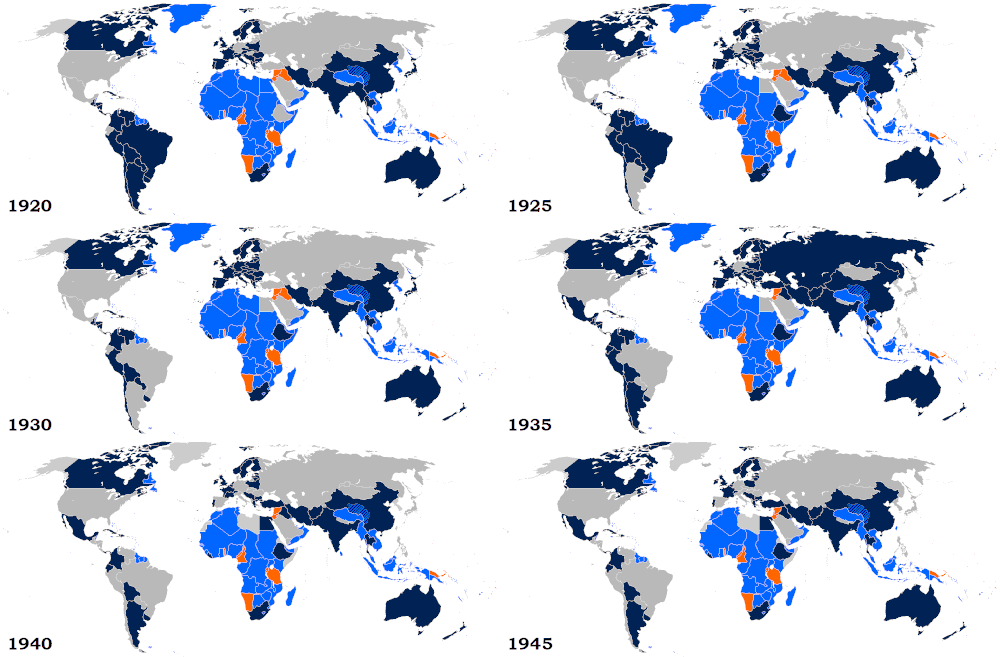
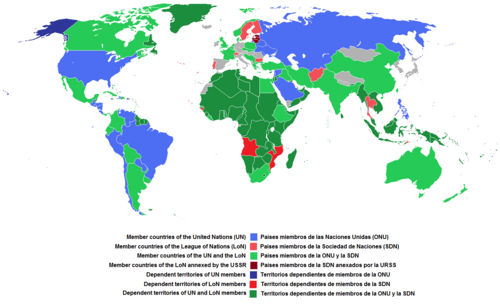
The League aimed for broad membership, though its effectiveness was often hampered by the shifting political tides of the interwar period. Notably, the 1919 Inter-Allied Women's Conference played a role in securing equality for women within the League's framework.
The Mandates System and Social Work
One of the League's most complex functions was the Mandates system. Under Article 22 of the Covenant, certain territories—primarily from the former Ottoman Empire—were designated as mandates. These were communities deemed not yet able to stand alone, placed under the administration of "mandatory powers" to be guided toward independence.
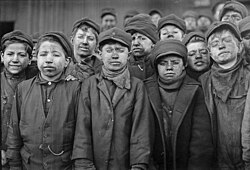
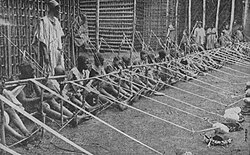
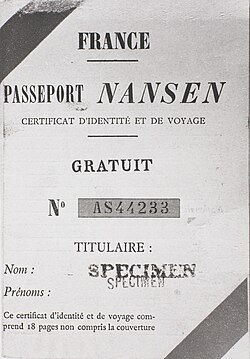
Beyond territorial management, the League tackled humanitarian crises. It fought against child labour in regions like the United States and Kamerun and issued Nansen passports to provide legal identity to stateless refugees.
Successes and Failures in Conflict Resolution
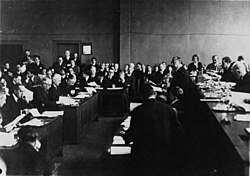
The League experienced early successes in resolving territorial disputes in areas such as the Åland Islands and Upper Silesia. However, as the 1930s approached, its inability to enforce collective security became evident.
Major Failures
- The Manchurian Crisis (1932): The League failed to stop Japanese aggression in China.
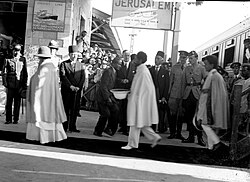
- The Abyssinian Crisis: The Italian invasion of Abyssinia (Ethiopia) exposed the League's impotence, leading Emperor Haile Selassie I into exile.
- Disarmament: The organization failed to achieve meaningful global disarmament, as nations continued to arm themselves in preparation for another war.
Demise and Legacy
The outbreak of World War II in 1939 served as the final proof that the League could not prevent large-scale aggression. The organization was officially dissolved on April 18, 1946, and its assets and archives were transferred to the newly formed United Nations.
![League of Nations archives, Geneva[252]](/images/55/27/5527d082e4f8c4b02132f1a85db33ca5c7fbfdc9090f52ddc4fa957900a750d8.jpg)
| Feature | Details |
|---|---|
| Founding Document | Treaty of Versailles / The Covenant |
| Key Headquarters | Palais Wilson & Palace of Nations (Geneva) |
| Major Successes | Refugee aid (Nansen passports), early territorial disputes |
| Major Failures | Manchurian Crisis, Italian invasion of Abyssinia, Disarmament |
| Reason for Dissolution | Inability to prevent World War II |
Frequently Asked Questions
Why did the United States not join the League of Nations?
Despite President Woodrow Wilson being a primary architect of the League, the U.S. Senate refused to ratify the Treaty of Versailles, fearing that the League's collective security obligations would strip the U.S. of its sovereignty and pull it into foreign conflicts.
What were Nansen passports?
Nansen passports were travel documents issued by the League of Nations to stateless refugees, named after Fridtjof Nansen, allowing them to cross borders legally when they had no national citizenship.
What was the purpose of the Mandates system?
The Mandates system was designed to manage territories previously controlled by the German and Ottoman Empires, placing them under the administration of League members to prepare them for eventual self-governance.
Did the League of Nations achieve anything positive?
Yes. While it failed to prevent WWII, it succeeded in resolving several smaller territorial disputes, pioneered international cooperation in public health, and fought against child labour and human trafficking.
How does the League of Nations differ from the United Nations?
The United Nations was designed to correct the League's weaknesses, notably by ensuring the participation of all major world powers and creating a more robust security council with the ability to authorize military action.