LB&SCR Class A1 and A1X Steam Locomotives: The Legacy of the Terriers
The LB&SCR Class A1, and its later rebuilt variant the A1X, represent one of the most enduring designs in British railway history. These small but powerful 0-6-0 tank engines—affectionately known as "Terriers"—were the workhorse of the London, Brighton and South Coast Railway (LB&SCR) and later the Southern Railway. Designed for versatility, they served a wide array of roles, from passenger services to departmental duties.
The fleet was characterized by names that typically denoted locations served by the LB&SCR, creating a geographical map of the railway's reach through its rolling stock. Over the decades, these locomotives proved so robust that many found second lives with industrial firms, the Admiralty, and light railways across the UK and even abroad.
Key Facts
- Operator: Originally the London, Brighton and South Coast Railway (LB&SCR), later the Southern Railway.
- Designations: Class A1 (original) and Class A1X (rebuilt).
- Configuration: 0-6-0 tank engines (though some were briefly converted to 2-4-0 for auto-train trials).
- Service Span: Locomotives entered service as early as 1872, with some remaining in active use until the 1960s.
- Global Reach: While primarily UK-based, some units were exported as far as Argentina.
- Preservation: Several units survive today in museums and on heritage lines, including the Bluebell Railway and the Canada National Railway Museum.
Fleet Evolution and Technical Transitions
The transition from the A1 to the A1X class involved rebuilding processes that extended the operational life of the fleet. For example, locomotive No. 40 (Brighton) was rebuilt to A1X specifications in August 1918, while No. 61 (Sutton) was rebuilt in January 1912. These modifications ensured the engines could meet the evolving demands of the network.
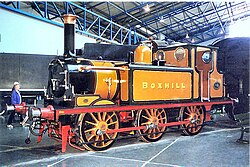
Beyond standard service, some Terriers were adapted for specialized roles. The auto-train—a system allowing the driver to control the engine from a leading carriage—led to experimental conversions. No. 81 (Beulah) and No. 82 (Boxhill) were both converted to 2-4-0 configurations to facilitate these trials, though Boxhill was eventually restored to its original 0-6-0T form in 1913.
Diverse Career Paths and Disposals
The disposal of the A1/A1X fleet reveals the immense utility of the design. Many were sold to the Admiralty for military use, such as No. 37 (Southdown) and No. 79 (Minories). Others were purchased by private contractors like Pauling & Co., where they were used in the construction of the Great Central Railway's Chiltern Line extension between Northolt and High Wycombe.
A significant number of Terriers migrated to the Isle of Wight, serving the Isle of Wight Central Railway. This migration preserved several engines long after they would have been scrapped on the mainland. Notably, No. 40 (Brighton) and No. 46 (Newington) both spent significant time on the island before entering preservation.
Summary of Notable Locomotives
| Original No. | Name | Service Entry | Final Status / Fate |
|---|---|---|---|
| 40 | Brighton | 10 March 1878 | Preserved |
| 46 | Newington | 10 January 1877 | Preserved |
| 54 | Waddon | 16 February 1876 | Preserved (Canada) |
| 55 | Stepney | 21 December 1875 | Preserved (Bluebell Railway) |
| 61 | Sutton | 27 October 1875 | Scrapped 1963 (Last BR Terrier) |
| 70 | Poplar | 4 December 1872 | Preserved |
| 72 | Fenchurch | 9 September 1872 | Preserved (Bluebell Railway) |
| 82 | Boxhill | 20 August 1880 | Preserved |
Frequently Asked Questions
What is the difference between the A1 and A1X classes?
The A1 was the original design of the locomotive, while the A1X represents the rebuilt version of these engines, modified to improve performance and longevity.
Which Terrier was the last to be scrapped by British Railways?
No. 61 (Sutton) was the last Terrier to be scrapped by British Railways, with its disposal occurring in September 1963 at Eastleigh.
Did any LB&SCR Terriers leave the United Kingdom?
Yes. No. 52 (Surrey) and No. 57 (Thames) were sold to La Plata Tramways in Argentina in 1909. Additionally, No. 54 (Waddon) was presented to the Canada Railway Historical Association and is now on display at the Canada National Railway Museum in Quebec.
How many Terriers are currently preserved?
Several units have been preserved, including No. 40 (Brighton), No. 46 (Newington), No. 50 (Whitechapel), No. 54 (Waddon), No. 55 (Stepney), No. 62 (Martello), No. 70 (Poplar), No. 72 (Fenchurch), No. 78 (Knowle), and No. 82 (Boxhill).
What were the "auto-train" trials?
Auto-train trials involved modifying locomotives to allow them to be operated from a driving trailer at the front of the train, eliminating the need for the engine to run around its carriages at termini. This led to the temporary conversion of some Terriers from 0-6-0T to 2-4-0 configurations.