LB&SCR A1 and A1X Class Terriers
The London, Brighton and South Coast Railway (LB&SCR) A1 class represents one of the most enduring legacies of British steam engineering. Designed by the renowned William Stroudley, these 0-6-0T (tank) locomotives were built at the Brighton Works between 1872 and 1880. While initially dubbed "Rooters" by crews in south London, they earned the far more famous nickname "Terriers" due to the sharp, distinctive bark of their exhaust beat.
These compact engines were designed for versatility and efficiency, making them ideal for light branch line duties. Their longevity is a testament to Stroudley's design, as they remained in service through three different eras of British rail ownership, adapting to the changing needs of the network.
Key Facts
- Designer: William Stroudley, built at Brighton Works.
- Production: 50 locomotives produced between 1872 and 1880.
- Configuration: 0-6-0T (three powered axles, no leading or trailing wheels).
- Nicknames: "Terriers" (for their exhaust sound) and "Hayling Billy" (for their work on the Hayling Island branch).
- Preservation: Ten locomotives have been preserved, a remarkably high survival rate for the era.
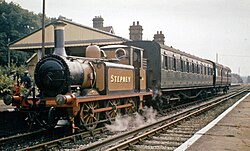
- Legacy: No. 55 Stepney was the first standard gauge locomotive to arrive at the Bluebell Railway.
Technical Specifications
The A1 class was engineered for reliability on lines with severe weight restrictions. Over time, 17 of the original 50 engines were rebuilt to the A1X specification, which offered improved performance.
| Feature | A1 Specification | A1X Specification |
|---|---|---|
| Wheel Configuration | 0-6-0T | 0-6-0T |
| Locomotive Weight | 27.5 long tons | 28 long tons |
| Boiler Pressure | 140 or 150 psi | 140 or 150 psi |
| Tractive Effort | 7,650 lbf | 7,650 to 10,695 lbf |
| Fuel Capacity | 1 long ton (Coal) | 1 long ton (Coal) |
| Water Capacity | 500 imp gal | 500 imp gal |
Operational History
London, Brighton & South Coast Railway (1872–1923)
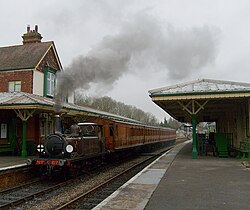
The A1s were the backbone of many LB&SCR branch lines. By the turn of the century, the railway adopted push-pull (or "motor-train") working, where the locomotive could be controlled from a driving trailer at the other end of the train. The A1 class was found to be ideally suited for this operation, which extended their useful lives.
Southern Railway (1923–1948)
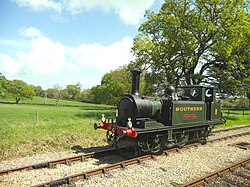
Following the 1923 grouping, the Southern Railway inherited 24 Terriers. Because many light railways—including those on the Isle of Wight and the Hayling Island branch—had strict weight limits, the small Terriers remained indispensable. Some were even used as departmental shunters, such as the former No. 82 Boxhill, which was painted in Stroudley's original yellow ochre livery.
British Railways (1948–1963)
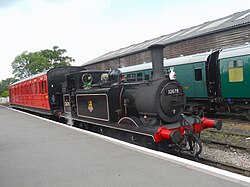
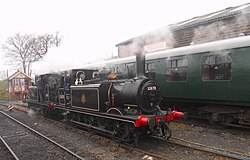
Under British Railways, the Terriers continued to serve rural branch lines. The Hayling Island line remained profitable due to summer traffic, but the deterioration of the Langstone Harbour bridge eventually led to the line's closure on November 4, 1963. This event signaled the end of the class in commercial service. Notably, No. 32636 (formerly No. 72 Fenchurch) was the oldest working steam engine in BR ownership at the time of its withdrawal.
Preservation and Cultural Impact
The preservation of the Terrier class is a cornerstone of the UK heritage railway movement. No. 55 Stepney became a symbol of this movement when it arrived at the Bluebell Railway in 1960, the world's first preserved standard gauge steam-operated passenger railway.
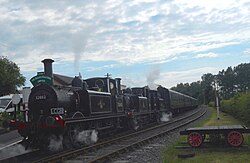
The class has also found its way into popular culture. No. 55 Stepney was featured in the Railway Series books by the Reverend Wilbert Awdry. Additionally, No. 72 Fenchurch appeared in Ken Russell's 1975 film Lisztomania, in a scene where it appears to smash a grand piano on the tracks.
Current Status of Preserved Locomotives
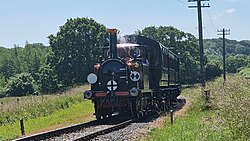
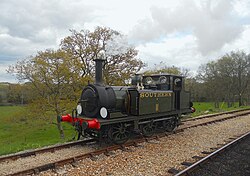
Today, Terriers can be found across several heritage lines, including the Kent and East Sussex Railway and the Isle of Wight Steam Railway. Some, like No. 54 Waddon, have even traveled overseas to the Canadian Railway Museum.
Frequently Asked Questions
Why were these locomotives called "Terriers"?
They earned the nickname because of the distinctive, sharp "barking" sound produced by their exhaust beat while running.
What is the difference between the A1 and A1X classes?
The A1X is a rebuilt version of the original A1. The primary differences include a slight increase in locomotive weight and a significant increase in maximum tractive effort, improving their pulling power.
Which Terrier is the most famous in literature?
No. 55 Stepney is the most famous, appearing as Stepney the "Bluebell" Engine in the Railway Series by the Reverend Wilbert Awdry.
Where can I see these locomotives today?
Preserved Terriers are located at the Bluebell Railway, the Isle of Wight Steam Railway, the Kent and East Sussex Railway, the Bressingham Steam Museum, and the National Railway Museum in the UK, as well as the Canadian Railway Museum.
How did the numbering system change over time?
They began with two-digit numbers, were later prefixed with a '6' by the LB&SCR, received a 'B' or 'W' prefix under the Southern Railway, had 2000 added to their numbers in 1930, and finally had 30000 added under British Railways.