László Kubala: The Legendary Forward and Barcelona Icon
László Kubala was more than just a professional footballer; he was a transformative figure in the history of Spanish sport. A master striker known for his technical brilliance, Kubala is widely regarded as one of the greatest players to ever grace the pitch. While his career spanned multiple countries and clubs, he is most revered as a hero of FC Barcelona, where his influence helped shape the club's golden era in the 1950s.
Renowned for his quick, skillful dribbling, powerful finishing, and deadly accuracy from free kicks, Kubala brought a level of sophistication to the game that captivated fans. His legacy is so enduring that during Barcelona's 1999 centenary celebrations, a fan poll named him the best player in the club's entire history.
Key Facts
- Born: June 10, 1927, in Budapest, Hungary.
- Positions: Striker / Forward.
- Barcelona Legacy: Scored 280 goals in 345 appearances (including unofficial matches).
- International Versatility: Played for the national teams of Czechoslovakia, Hungary, and Spain.
- La Liga Record: Holds the record for most goals scored in a single match (7 goals against Sporting de Gijón).
- Managerial Success: Guided the Spanish national team to the 1978 World Cup.
Early Life and the Journey of a Refugee
Born in Budapest to parents of Slovak and Polish roots, Kubala described himself as a "cosmopolitan." He began his football journey with Ganz TE in the Hungarian third division, showing early promise by playing against opponents several years his senior. By age 18, he had signed for Ferencváros, where he played alongside Sándor Kocsis.
Kubala's early career was marked by political instability. He moved to Czechoslovakia in 1946 to join Slovan Bratislava, allegedly to avoid military service. After a brief return to Hungary with Vasas, the Soviet occupation of Hungary in 1949 forced him to flee the country in the back of a truck. This journey led him through Austria and Italy, where he played briefly for Pro Patria.
During this period, Kubala narrowly avoided tragedy. He had agreed to play for Torino in a testimonial match against Benfica but withdrew due to his son's illness. The plane carrying the Torino team subsequently crashed into the Superga hills, killing everyone on board.
The Rise of a Barcelona Legend
Kubala's path to Spain was paved by a mix of sporting talent and political convenience. After forming a refugee team called Hungaria, he was spotted by Barcelona's chief scout, José Samitier. The government of Francisco Franco, seeking to use Kubala's status as a refugee from a communist state for propaganda, helped him obtain Spanish citizenship quickly.
Although he signed for Barcelona on June 15, 1950, a FIFA ban delayed his La Liga debut until 1951. However, his impact was immediate. In the 1951–52 season, he scored 26 goals in 19 games, including a historic seven-goal haul against Sporting de Gijón.
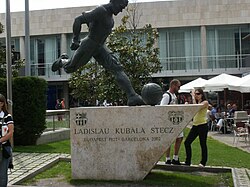
Despite a life-threatening bout of tuberculosis during the 1952–53 season, Kubala made a miraculous recovery. He went on to lead Barcelona to multiple La Liga and Copa del Generalísimo titles. In 1958, he further strengthened the squad by persuading fellow Hungarian refugees Sándor Kocsis and Zoltán Czibor to join the club.
Kubala's playing days at Barcelona culminated in the 1961 European Cup, where Barcelona became the first club to defeat Real Madrid in the competition, eventually reaching the final against Benfica.
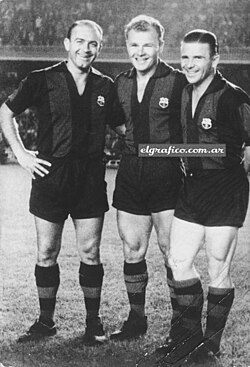
International Career and Global Reach
Kubala's international career is unique for its breadth, having represented three different nations. He earned six caps for Czechoslovakia (4 goals) and three for Hungary. After gaining Spanish nationality, he played 19 times for Spain, scoring 11 goals, with a highlight being a hat-trick against Turkey in 1957.
Beyond national teams, he was a frequent selection for the Europe XI and the Catalan XI. In 1953, he scored twice for the Europe XI in a famous 4–4 draw against England at Wembley Stadium.
Transition to Coaching
After retiring as a primary player, Kubala transitioned into management. He served as a player-coach for Espanyol and Zürich, and spent time in Canada with the Toronto Falcons. His managerial career reached its peak when he took charge of the Spanish national team, ending their eleven-year absence from the World Cup by leading them to the 1978 tournament in Argentina.
He also managed Al-Hilal in Saudi Arabia and several La Liga clubs, including Málaga, whom he led to the Segunda División title in 1988. His final coaching role was with the Paraguay national team in 1995.
Career Summary
| Category | Details / Achievements |
|---|---|
| Primary Position | Striker |
| Major Club | FC Barcelona (186 League Apps, 131 League Goals) |
| National Teams | Czechoslovakia, Hungary, Spain |
| Major Honours (Player) | 4x La Liga, 5x Copa del Generalísimo, 2x Inter-Cities Fairs Cup |
| Major Honours (Manager) | Segunda División title with Málaga (1987–88) |
| Total Career Goals | 235 (League appearances only) |
Frequently Asked Questions
How many national teams did László Kubala play for?
László Kubala played for three national teams: Czechoslovakia, Hungary, and Spain.
What is Kubala's most famous record in La Liga?
He holds the record for the most goals scored by a single player in a single La Liga match, scoring seven goals against Sporting de Gijón in the 1951–52 season.
Why was Kubala's move to Barcelona politically significant?
Because he was a refugee fleeing a Soviet satellite state, the government of Francisco Franco used his arrival as propaganda to validate the regime's political stance during the Cold War.
Did Kubala ever manage the Spanish national team?
Yes, Kubala managed the Spain national team and successfully guided them to the 1978 World Cup, ending an eleven-year drought of qualification.
Which other legendary players did Kubala play with or against?
He was teammates with Sándor Kocsis and Zoltán Czibor at Barcelona and played in high-profile matches alongside and against icons like Alfredo Di Stéfano and Ferenc Puskás.