Larks: The Melodious Songbirds of the Alaudidae Family
Larks are small- to medium-sized passerine birds (perching birds) belonging to the family Alaudidae. Known for their striking songs and ability to thrive in diverse environments, these birds have a cosmopolitan distribution. While they are found across the globe, the highest concentration of species resides in Africa. In contrast, North America is home to only a single species, the horned lark, and Australia hosts only Horsfield's bush lark.
When the term "lark" is used generally, it typically refers to the Eurasian skylark (Alauda arvensis). While their habitats vary, many species are specially adapted to drier regions.
Key Facts
- Family: Alaudidae, containing 98 extant species across 24 genera.
- Size: Typically 12 to 24 cm in length and 15 to 75 g in mass.
- Distribution: Global, with the greatest diversity in Africa.
- Distinctive Feature: Multiple scutes on the hind side of the tarsi (leg scales).
- Sister Group: Molecular studies link them closely to the Panuridae family (bearded reedling).
Taxonomy and Systematics
The family Alaudidae was first introduced in 1825 by Irish zoologist Nicholas Aylward Vigors. Larks are biologically distinct from many other songbirds due to the shape of their tarsus (the lower part of the leg). Unlike most songbirds that have a single plate, larks possess multiple scutes on the hind side of their tarsi. Additionally, they lack a pessulus, which is the bony central structure found in the syrinx (vocal organ) of other songbirds.
Classification has evolved over time. While some authorities place them at the beginning of the oscines (true songbirds), others follow the Sibley-Ahlquist taxonomy, placing them in the larger Passerida subgroup. Recent molecular phylogenetic studies suggest larks belong to the superfamily Sylvioidea, forming a sister clade to the bearded reedling (Panurus biarmicus).
A 2023 study by Per Alström and collaborators refined the genus-level classification, proposing that the genus Mirafra be split into four distinct genera: Mirafra, Plocealauda, Amirafra, and Corypha.
Physical Characteristics and Diversity
Larks range in size from the tiny Spizocorys species, such as the pink-billed and Obbia larks (weighing approximately 14 g), to the larger Tibetan lark. Their physical build is optimized for ground-dwelling life in open landscapes.
Below is a summary of the diversity within the Alaudidae family:
| Category | Details |
|---|---|
| Total Extant Species | 98 |
| Number of Genera | 24 |
| Length Range | 12 cm to 24 cm |
| Mass Range | 15 g to 75 g |
| Primary Distribution | Africa (highest diversity), Eurasia, North America, Australia |
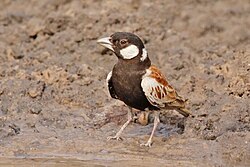
Among the various genera, the Eremopterix group includes several sparrow-larks, known for their compact size and distinct coloring.
Behavior and Breeding
Calls and Song
Larks are renowned for their elaborate calls and extravagant songs, which are often performed during display flights. This musicality has made them staples of human literature and music, particularly the Eurasian skylark in Northern Europe and the crested and calandra larks in Southern Europe.
Breeding Habits
Male larks utilize song flights to attract mates and defend their territories. Most species are ground-nesters, constructing cup-shaped nests from dead grass, though some build more complex domed structures. In desert environments, some species nest low in bushes to utilize circulating air for cooling.
Incubation typically lasts between 11 and 16 days. Clutch sizes vary significantly by species; for example, Sclater's lark may lay a single egg, while the black lark and calandra lark can lay between 6 and 8 speckled eggs.
Larks in Human Culture
Symbolism and Literature
In mythology and poetry, the lark is a symbol of daybreak. This is evident in the works of Chaucer, who called the lark the "messager of day," and Shakespeare, who described the bird singing "hymns at heaven's gate." In Renaissance art, such as the works of Domenico Ghirlandaio, the lark has been used to symbolize Christ.
Famous literary tributes include Percy Bysshe Shelley's 1820 poem "To a Skylark," George Meredith's "The Lark Ascending," and Gerard Manley Hopkins' "The Sea and the Skylark." Even the Canadian poet John McCrae referenced larks in "In Flanders Fields."
Music and Traditions
The influence of larks extends to classical music, most notably in Ralph Vaughan Williams' 1914 composition The Lark Ascending. In folk traditions, the Welsh song Marwnad yr Ehedydd (The Lark's Elegy) may use the bird as a coded reference to leader Owain Glyndŵr, while the French-Canadian song Alouette describes plucking a lark's feathers.
In China, particularly in Beijing, larks are traditionally kept as pets and trained to mimic other animals. A highly valued skill is the ability to sing "the 13 songs of a lark" in a specific, strict order.
The "Early Bird" Connection
Because larks often sing before dawn, the phrase "up with the lark" has entered the English language to describe someone who wakes up very early. Consequently, a "lark" is a term used for a person who habitually rises at dawn.
Frequently Asked Questions
What makes larks biologically different from other songbirds?
Larks are distinguished by having multiple scutes on the hind side of their tarsi and the absence of a pessulus, a bony structure in the syrinx that is common in most other songbirds.
Where are larks most commonly found?
While they have a cosmopolitan distribution, the largest number of lark species are found in Africa. They are also prevalent in Eurasia, with only one species in North America and one in Australia.
How do larks build their nests?
Most larks build cup-shaped nests on the ground using dead grass. Some species create domed nests, and certain desert species nest in low bushes to keep the eggs cool.
Why is the Eurasian skylark significant?
The Eurasian skylark (Alauda arvensis) is the species most commonly referred to when the word "lark" is used without specification, and it has a deep history in European literature and music.
What is the size range of larks?
Larks generally range from 12 to 24 cm in length and weigh between 15 and 75 g, with the Spizocorys species being among the smallest and the Tibetan lark being among the largest.