The Eurasian Skylark: A Guide to the Song of the Fields
Commonly referred to simply as the lark in Europe, the Eurasian skylark (*Alauda arvensis*) is a beloved passerine bird known for its spectacular aerial displays. Whether it is a tiny dot in the sky or a bubbling melody rising from the farmland, this species has captured the human imagination for centuries, inspiring poets and musicians alike.
Belonging to the family Alaudidae, the Eurasian skylark is a widespread species found across Europe and the Palearctic. It has also established introduced populations in distant lands, including Australia, New Zealand, Canada, and the Hawaiian Islands.
Key Facts
- Scientific Name: Alauda arvensis
- Conservation Status: Least Concern (IUCN 3.1)
- Habitat: Open farmland and heath
- Diet: Insects, seeds, and young leaves
- Distinguishing Feature: Males perform a hovering song at heights of 50 to 100 metres
- Collective Noun: An "exaltation" of skylarks
Physical Description and Identification
The Eurasian skylark is a relatively modest-looking bird, measuring between 18 and 19 cm in length. Its plumage is designed for camouflage in open environments, featuring streaked greyish-brown feathers on its upperparts and breast, with a paler, buff-white belly.
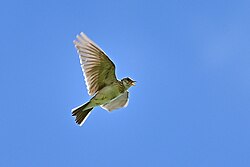
One of its most notable physical features is a short, blunt crest on the head that can be raised or lowered. While the sexes appear similar, males possess broader wings—an evolutionary adaptation that allows for more efficient hovering during their famous singing flights. This ability to hover for extended periods is believed to be a sign of high physical fitness, which females prefer when selecting mates.
In flight, observers can spot white edging on the tail and the rear edges of the wings. These white markings are particularly visible when the bird is flying away from the observer.
The Famous Song and Behavior
The most iconic aspect of the skylark is the male's song. Delivered during a hovering flight at altitudes of 50 to 100 metres, the song is a clear, bubbling warble. While a typical song lasts two to three minutes, it can extend to 20 minutes or more during the height of the mating season.
Interestingly, skylarks exhibit local microdialects. Neighboring birds often share distinctive song patterns that act as group signatures, helping them distinguish local individuals from outsiders. Recent studies have also noted that males at wind farm sites may sing at higher frequencies to compete with the noise generated by wind turbines.
Breeding and Life Cycle
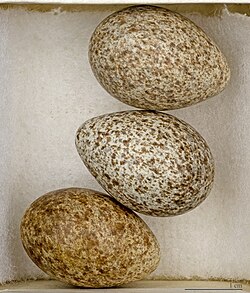
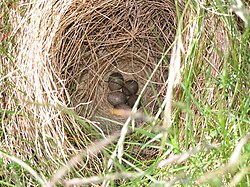
Skylarks typically begin breeding at one year of age, with nesting often starting in late March or early April. The female is responsible for building the nest, which is a simple, shallow depression in the ground lined with grass, located well away from trees or hedges to avoid detection.
The breeding process follows a specific cycle:
- Clutch Size: The female lays between three and five eggs.
- Incubation: The female incubates the eggs for approximately 11 days.
- Fledging: Chicks are altricial (helpless at birth) and are fed by both parents. They usually leave the nest after 8 to 10 days but do not fully fly until they are 18 to 20 days old.
- Broods: Parents are prolific and can raise up to four broods in a single season.
Despite their efforts, nests face high predation rates from small mammals and larger birds. Once the young reach approximately 25 days of age, they become independent of their parents.
Habitat, Distribution, and Global Presence
The species is primarily found in open habitats such as heathlands and farmland. While many populations in the west are resident (staying in one area year-round), eastern populations are more migratory, moving south during the winter. Some subspecies, such as A. a. pekinensis, have even been recorded as vagrants in Alaska.
Introduced Populations
The Eurasian skylark has been introduced to several parts of the world, with varying degrees of success:
- New Zealand: Introduced in the 1860s, the population spread rapidly across both islands by the 1920s.
- Australia: Introduced starting in 1850, they are now widespread in the southeast, including Victoria, Tasmania, and parts of South Australia.
- Hawaii: Introduced in 1865, populations have declined; they are now primarily found on Hawaii and Maui.
- Canada: Introduced to Vancouver Island in the early 1900s, numbers have declined significantly due to habitat loss, with only about 100 individuals estimated in 2007.
Conservation Challenges
In the United Kingdom, skylark numbers have seen a significant decline since the 1970s. Research by the RSPB suggests that changes in farming practices are a primary driver. The shift from planting spring cereals to winter cereals means that by summer, fields are often too dense with wheat stems for the birds to walk through and forage effectively.
To combat this, conservation schemes like Natural England’s Environmental Stewardship Scheme encourage farmers to grow spring cereals and leave stubble untreated with pesticides. These untreated fields act as "giant bird tables," providing essential grain and weed seeds for the birds.
| Feature | Details |
|---|---|
| Scientific Name | Alauda arvensis |
| Primary Diet | Insects and plant material (seeds/leaves) |
| Nesting Site | Shallow ground depression |
| Typical Clutch | 3–5 eggs |
| Key Threat | Changes in agricultural practices |
Frequently Asked Questions
What is a collective noun for skylarks?
A group of skylarks is known as an exaltation.
How do skylarks find their food?
Skylarks walk across the ground, searching the soil surface for insects, seeds, and young leaves. Unlike finches, they swallow seeds whole without removing the husk.
Why are skylark numbers declining in the UK?
The decline is largely attributed to changes in farming. Modern winter-grown crops create dense vegetation that prevents the birds from walking through fields to find food.
Are male and female skylarks different?
They look very similar, but males generally have broader wings, which helps them perform the hovering flight required for their singing displays.