Lakefront Airport: New Orleans' Art Deco Aviation Landmark
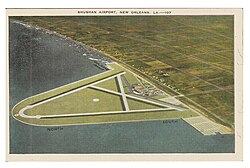
Located five miles northeast of downtown New Orleans in Orleans Parish, Lakefront Airport (IATA: NEW, ICAO: KNEW) serves as a vital hub for general aviation in Louisiana. Situated on a man-made peninsula jutting into Lake Pontchartrain, this public airport blends a rich military and commercial history with a striking architectural legacy.
While it once served as the primary airline gateway for the region, the airport transitioned its role in 1946 when commercial services moved to the larger Moisant International Airport (now Louis Armstrong New Orleans International Airport). Today, it is categorized as a general aviation reliever airport, supporting private flights, charters, and occasional military operations, while still offering select airline services to the Gulf South Region.
Key Facts
- Location: Orleans Parish, Louisiana, 5 miles northeast of downtown New Orleans.
- Designation: General aviation reliever airport.
- Architecture: Features a restored 1930s Art Deco terminal.
- Ownership: Owned by the Orleans Levee District and operated by the Lakefront Management Authority.
- Notable Events: Annual host of the WWII Air, Sea & Land Festival.
A Legacy of Architecture and Politics
The story of Lakefront Airport began in 1929 under the direction of Huey Long. The site was created via dredging by the Orleans Levee Board to form a peninsula in Lake Pontchartrain. Designed by the firm Weiss, Dreyfous, and Seiferth—the same architects responsible for the Louisiana State Capitol—the facility opened on February 10, 1934.
Originally named Shushan Airport after Levee Board president Abraham Shushan, the facility was known for its lavish details, with Shushan's name or initials appearing on nearly every fixture. Following Shushan's involvement in the Louisiana Scandals of the late 1930s, the facility was renamed New Orleans Airport in 1939, though it retained the airport code "NEW" to this day.
Military Use and Cold War Adaptations
During World War II, the airfield served the United States Army Air Forces and hosted the Tropical Weather School in 1945. As geopolitical tensions rose during the Cold War, the main terminal underwent a drastic transformation in the early 1960s; thick concrete panels were installed to convert the building into a bomb shelter, obscuring its original Art Deco beauty for decades.
Resilience and Restoration
Lakefront Airport has faced significant challenges from nature, most notably during Hurricane Katrina in 2005 and Hurricane Isaac in 2012. The storm surge from Katrina destroyed several hangars and outlying buildings. While the airport resumed operations quickly, the full restoration of the terminal was a gradual process.
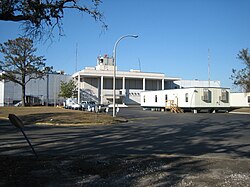
The restoration effort successfully removed the "bomb-proof" facade, returning the terminal to its original 1930s Art Deco appearance. The interior remains lavish, housing the popular Walnut Room restaurant. Outside, the Fountain of the Four Winds sculpture by Enrique Alferez stands as a local landmark.
Airport Facilities and Operations
Covering 473 acres at an elevation of 7 feet above mean sea level (AMSL), the airport is equipped with three asphalt runways to accommodate various aircraft types.
| Runway | Length (ft) | Length (m) | Surface |
|---|---|---|---|
| 18R/36L | 6,879 | 2,097 | Asphalt |
| 18L/36R | 3,697 | 1,127 | Asphalt |
| 9/27 | 3,114 | 949 | Asphalt |
According to 2022 data, the airport handled 78,080 aircraft operations annually, averaging 214 per day. The traffic is predominantly general aviation (88%), followed by air taxi (9%) and military (3%) operations. The airport hosts 125 based aircraft, the majority of which are single-engine planes.
Cultural Impact and Popularity
Beyond aviation, the airport is a significant cultural site. Since 2014, it has hosted the WWII Air, Sea & Land Festival, a three-day event organized by the National WWII Museum, Commemorative Air Force, and the Greater New Orleans Sports Foundation.
The airport's unique aesthetic has also made it a favorite for filmmakers. It has appeared in the James Bond film Live and Let Die (1973) and served as the headquarters for the fictional Ferris Aircraft in Green Lantern (2011). Other productions filmed on-site include Reminiscence, Project Power, Tall Girl, Capone, Ray, Daisy Jones & The Six, Leverage: Redemption, and Cloak & Dagger.
Frequently Asked Questions
Why is the airport code still "NEW" if the name changed?
The airport code "NEW" was assigned when the facility was known as New Orleans Airport and has been retained for consistency despite the subsequent change to Lakefront Airport.
What is a general aviation reliever airport?
A general aviation reliever airport is a facility designed to provide an alternative to larger commercial airports, reducing congestion by handling private, charter, and corporate aircraft.
Who designed the original terminal building?
The terminal was designed by New Orleans architect Leon C. Weiss and his firm, Weiss, Dreyfous, and Seiferth, who are also known for designing the Louisiana State Capitol.
How did Hurricane Katrina affect the airport?
Hurricane Katrina caused severe damage via hurricane-force winds and storm surges, destroying several outlying buildings and hangars. This led to a long-term restoration process for the terminal and other facilities.
What is the Walnut Room?
The Walnut Room is a restaurant located inside the main terminal building that is frequently visited by local residents.