Lake Maracaibo: Venezuela's Ancient Basin of Oil and Lightning
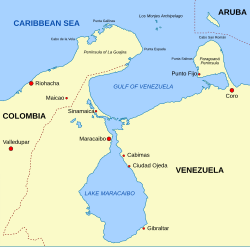
Located in northwestern Venezuela, Lake Maracaibo is a geographical marvel that defies a simple definition. While commonly called a lake, its connection to the Gulf of Venezuela via a narrow strait means it functions hydrologically as an estuary or a semi-enclosed bay. Spanning a surface area of 13,512 square kilometers, it is one of the oldest lakes on Earth, having formed approximately 36 million years ago during the uplift of the Andes Mountains.
The region is a vital hub for Venezuela, housing a quarter of the nation's population and serving as the heart of the country's oil industry. From its unique brackish waters to the world-famous electrical storms that illuminate its skies, Lake Maracaibo is as ecologically complex as it is economically significant.
Key Facts
- Age: Formed 36 million years ago in the late Eocene.
- Classification: An ancient lake, estuary, and semi-enclosed bay.
- Dimensions: 210 km long, 121 km wide, with a maximum depth of 35 m.
- Primary Inflow: The Catatumbo River, providing 57% of the lake's water.
- Global Record: The site of the most frequent lightning on Earth (Catatumbo lightning).
- Economy: Venezuela's primary oil-producing region and a major fishing/agricultural center.
Geology and Hydrology
Lake Maracaibo sits within a faulted basin between the Perija Mountains and the Merida Mountains. Its geological history is marked by alternating periods of freshwater and seawater flooding. During the last glacial period, rising sea levels connected the basin to the Atlantic Ocean. This created a stratified environment where lighter freshwater floated atop heavier saltwater, leading to a sediment deposit over five kilometers thick on the bedrock.
The lake's shape resembles a vase, with a deep southern section and a shallower northern "bottleneck" that extends 55 kilometers. The water is brackish—a mixture of salt and fresh water. While the southern delta, fed by the Catatumbo, Escalante, and Santa Ana rivers, has very low salinity (0.13%), the northern area is more saline due to tidal influence from the Gulf of Venezuela.
Climate and the Catatumbo Lightning
The region maintains an average annual temperature of 28°C. A unique meteorological interaction occurs here: cold mountain winds from the Andes meet the warm, humid air over the lake, triggering frequent precipitation and electrical activity.
This results in the Catatumbo lightning, a phenomenon characterized by nearly silent, continuous lightning strikes. On average, the area sees 233 strikes per square kilometer annually, with thunderstorms occurring roughly 297 days a year. At its peak in September, the lake can experience up to 280 strikes per hour, providing enough light to assist in nighttime navigation.
History and Human Settlement
Long before European arrival, the lake was home to the Añú people, who called the region Coquivacoa, as well as the Wayuu, Caquetíos, and Quiriquires tribes. In 1499, Amerigo Vespucci and Alonso de Ojeda encountered the stilt houses of the Añú; the resemblance to Venice led Vespucci to name the region Veneziola ("Little Venice"), the origin of the name Venezuela.
The city of Maracaibo was successfully established in 1574. Over the centuries, the lake played a strategic role in conflict, including raids by the privateer Henry Morgan in 1669 and the decisive Battle of Lake Maracaibo on July 24, 1823, during the Venezuelan War of Independence.
Modern Infrastructure
In the 20th century, the lake's accessibility was transformed. Dredging in the 1930s and the completion of a stone breakwater in 1957 allowed ocean-going tankers to enter. In 1962, the General Rafael Urdaneta Bridge was completed. At 8,678 meters long, it was the world's longest cable-stayed concrete bridge at the time of its opening, connecting Maracaibo and Santa Rita.
Industry and Economy
Known as the "oil lake," the basin is rich in hydrocarbons. Large-scale exploitation began in 1922, with oil fields concentrated in Tertiary sandstone and Cretaceous limestone layers. Maracaibo serves as a global oil export port and a transshipment center for coffee from the Andes.
Beyond oil, the lake supports over 20,000 fishermen and a robust agricultural sector. The south bank produces cocoa, coffee, sugar cane, coconut, peanuts, and bananas, while the western shore is known for its dairy industry.
Nature and Environmental Challenges
The lake's highly oxygenated waters support immense biodiversity, including 145 fish species. Many are endemic (found nowhere else), such as the Maracaibo half-hooked catfish and the Maracaibo wolf anchovy. The waters also provide habitat for the endangered Amazon river dolphin and the West Indian manatee.
Pollution and Contamination
Despite its beauty, the lake faces severe environmental crises. Eutrophication—the over-enrichment of water with nutrients—caused by agricultural sewage and industrial waste has led to massive blooms of duckweed and green algae. These blooms block sunlight and deplete oxygen, disrupting biological cycles.
Oil pollution is another critical issue. With approximately 14,000 drill sites and 24,000 kilometers of aging pipelines on the lake floor, leaks are frequent. Additionally, cañadas (random drainage courses) carry urban plastic waste and garbage from human settlements directly into the basin.
Summary of Lake Maracaibo Characteristics
| Feature | Detail |
|---|---|
| Surface Area | 13,512 km² (5,217 sq mi) |
| Maximum Length | 210 km (130 mi) |
| Maximum Width | 121 km (75 mi) |
| Maximum Depth | 35 m (115 ft) |
| Water Volume | 280 km³ |
| Primary Inflow | Catatumbo River |
| Key Cities | Maracaibo, Cabimas, Ciudad Ojeda |
Frequently Asked Questions
Is Lake Maracaibo actually a lake?
While called a lake, it is hydrologically more like an estuary or a semi-enclosed bay because it is connected to the Gulf of Venezuela and the Atlantic Ocean via a narrow strait.
What is the Catatumbo lightning?
It is a meteorological phenomenon in the southern part of the lake where warm, humid air meets cold Andean winds, creating the most frequent lightning strikes on Earth.
Why is the lake called the "oil lake"?
The basin is exceptionally rich in oil and gas resources, with large-scale exploitation beginning in 1922, making it Venezuela's primary oil-producing area.
What are the main environmental threats to the lake?
The primary threats include oil spills from aging pipelines, eutrophication caused by agricultural and industrial sewage, and the accumulation of plastic waste.
Which animals are endemic to Lake Maracaibo?
The lake is home to several endemic fish species, including the Maracaibo half-hooked catfish, the Maracaibo hairy catfish, and the Maracaibo wolf anchovy.