Lady's Slipper Orchids: The Fascinating World of Cypripedioideae
In the diverse family of orchids, few groups capture the imagination quite like the Cypripedioideae. Commonly known as lady's slipper orchids, these perennial, herbaceous plants are instantly recognizable by their unique, sac-like flowers. This specialized structure, known as a modified labellum (or lip), serves a critical biological purpose: it acts as a sophisticated trap to ensure successful pollination.
With approximately 165 species distributed across the globe, these orchids represent a complex and highly evolved lineage within the Orchidaceae family. From the temperate forests of North America to the tropical jungles of Southeast Asia, they have adapted to a wide variety of environments through specialized morphology and clever reproductive strategies.
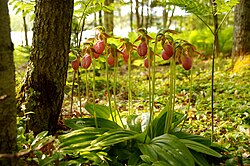
Pink lady's slippers in Nova Scotia, Canada
Key Facts
- Subfamily: Cypripedioideae, containing approximately 165 species.
- Defining Feature: Slipper-shaped pouches (modified labella) used for insect pollination.
- Pollination Method: A trap-lip mechanism involving mimicry and deception of bees and hoverflies.
- Taxonomic Uniqueness: They are "diandrous," meaning they possess two fertile anthers.
- Global Presence: Found in North and South America, Europe, Africa (Algeria), and Asia, but notably absent from Australia and Africa (as a continent).
Biological Characteristics and Morphology
All members of the Cypripedioideae subfamily are perennial herbaceous plants. Their physical structure is characterized by fleshy roots and leaves that are arranged either spirally or in two distinct rows. The shoots can be slender or compressed, and in the budding stage, the leaves often appear folded or leathery.
The flowers themselves are a marvel of botanical engineering. They are typically arranged in a terminal, mostly unbranched inflorescence. A key feature of these flowers is that they are resupinate, meaning they undergo a twist during development to orient themselves correctly. The petals are organized in two threefold circles, often with two petals of the outer circle being completely fused. The most striking element is the labellum, which forms the characteristic sac-like pouch.
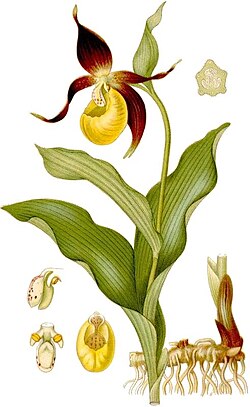
Lady's slipper orchid (Cypripedium calceolus)
The Pollination Trap
The survival of these orchids relies on a specialized trap-lip pollination mechanism. The flowers use mimicry and deception to attract pollinators such as bees and hoverflies. The insect is lured into the sac-like lip through a dorsal opening. Once inside, the insect finds itself trapped and must navigate a specific path to escape through small lateral openings.
As the insect climbs out, it is forced to squeeze past the stigma (the female reproductive part) and the stamens (the male reproductive parts). During this process, the insect deposits pollen collected from a previous flower onto the stigma and simultaneously picks up new pollen from the anther, ensuring the fertilization of the plant.
Taxonomy and Classification
The classification of lady's slipper orchids has been a subject of scientific debate. Unlike most other orchids, these plants are diandrous, possessing only two fertile anthers. This unique trait led some experts to propose a separate family, Cypripediaceae. However, modern molecular phylogenetics—the study of evolutionary relationships using DNA sampling—has confirmed that they belong firmly within the Orchidaceae family.
The subfamily is monophyletic, meaning all its members share a single common ancestor, and is divided into five distinct genera:
- Cypripedium: Found across North America, parts of Asia, and Europe. Notably, the pink lady's slipper is the official flower of Prince Edward Island, and the showy lady's slipper is the state flower of Minnesota.
- Mexipedium: A monotypic genus, meaning it contains only one single species found in Oaxaca, Mexico.
- Paphiopedilum: Native to the tropical forests of Southeast Asia. While popular among enthusiasts due to their ease of cultivation, many species face threats from over-collection.
- Phragmipedium: Located in northern South and Central America. These are also popular in cultivation as they tolerate lower temperatures.
- Selenipedium: Found throughout Central and South America.
Summary of Genera and Hybrids
| Genus/Hybrid | Type | Primary Distribution |
|---|---|---|
| Cypripedium | Genus | North America, Europe, Asia, Algeria |
| Mexipedium | Genus | Mexico (Oaxaca) |
| Paphiopedilum | Genus | Southeast Asia, Southern China |
| Phragmipedium | Genus | North/Central & South America |
| Selenipedium | Genus | Central & South America |
| × Cyphiopedilum | Hybrid (Nothogenus) | Cypripedium × Paphiopedilum |
| × Cyphragmipedium | Hybrid (Nothogenus) | Cypripedium × Phragmipedium |
| × Phragmipaphium | Hybrid (Nothogenus) | Paphiopedilum × Phragmipedium |
Frequently Asked Questions
Why are they called "slipper" orchids?
They are named for their unique labellum, which is a modified petal that forms a pouch resembling a slipper or shoe.
How do these orchids ensure pollination?
They use a trap mechanism. Insects enter the pouch and are forced to exit through a narrow path that requires them to brush against both the stigma and the anthers, facilitating pollen transfer.
Are all lady's slipper orchids the same?
No. There are approximately 165 species divided into five different genera, each with different geographic distributions and growth requirements.
What makes their anatomy different from other orchids?
The most significant difference is that they are diandrous, meaning they have two fertile anthers, whereas most other orchids have different arrangements of reproductive structures.
Which genera are easiest to grow at home?
Both Paphiopedilum and Phragmipedium are noted for being relatively easy to cultivate. Phragmipedium is particularly well-suited for areas that do not require a greenhouse, as they prefer lower temperatures.