La Nación: Argentina's Historic Newspaper of Record
La Nación (translated as "The Nation") stands as one of Argentina's most influential daily newspapers. Recognized as a newspaper of record—a publication regarded as a definitive and reliable source of historical documentation—it serves as the country's leading conservative voice. While it faces stiff competition from the more liberal Clarín, La Nación maintains a prestigious position in both print and digital media.
Guided by its founding motto, "La Nación will be a tribune of doctrine," the publication has evolved from a partisan platform into a multifaceted media organization. Today, it is the second most-read print newspaper in Argentina and the third most-visited digital news platform, trailing only Infobae and Clarín. To meet modern consumption habits, the outlet provides dedicated applications for both Android and iOS devices.

Key Facts
- Founded: January 4, 1870, by former President Bartolomé Mitre.
- Political Alignment: Liberal conservatism.
- Format: Tabloid on weekdays; broadsheet on weekends.
- Headquarters: Vicente López, Buenos Aires Province.
- Digital Presence: One of the top news websites in Argentina with millions of monthly visitors.
- Multimedia: Operates the television channel LN+.
Historical Evolution and Growth
The newspaper was established in 1870 to replace the publication Nación Argentina. In its early decades, it achieved massive success, boasting the largest readership in Latin America until the 1930s, with an average daily circulation of 350,000. Its dominance was eventually challenged by the 1945 launch of Clarín and the subsequent closure of other major tabloids like Crítica and Crónica.
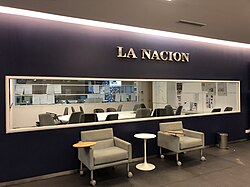
The physical home of the newspaper has shifted alongside its growth. Originally published in Bartolomé Mitre's private residence (now the Museo Mitre), the paper moved to a Plateresque building on Florida Street in 1929. By the early 21st century, the group expanded into the Bouchard Plaza Tower, a 26-storey Post-modern office building. Currently, the newsroom is located in Vicente López, which also serves as the studio for its TV channel, LN+.
Expansion and Modernization
In 2012, La Nación expanded its reach by acquiring ImpreMedia, the publisher of several US-based Spanish-language newspapers, including El Diario-La Prensa and La Opinión. To adapt to changing reader preferences, the paper transitioned its weekday editions to a tabloid format on October 30, 2016, while maintaining the traditional broadsheet style for weekends.
Editorial Stance and Philosophy
From its inception, La Nación was designed as a "platform of doctrine" to propagate liberal ideology. Over time, it has become a primary voice for the landowning upper-middle class and the agricultural sector, which it views as the most efficient part of the national economy.
The paper's editorial history is marked by a commitment to republican institutions and a complex relationship with Argentine politics. During the World Wars, it strongly supported the Allied cause and criticized Argentine neutrality. While it has historically supported liberal values—such as secularization of cemeteries and compulsory education—it remains conservative in its defense of traditional social values and order.
Cultural Impact and Contributors
Beyond politics, La Nación has been a vital hub for Latin American literature and intellectual thought. It has hosted contributions from world-renowned writers, including Jorge Luis Borges, Mario Vargas Llosa, and Rubén Darío. This commitment to design and culture was recognized in 2019 when the Society for News Design named it the World's Best Designed Newspaper, sharing the honor with The New York Times and The Sunday Times.
Operational Summary
| Category | Details |
|---|---|
| Owners | MNMS Holding / Mitre Family |
| Key Leadership | Fernán Saguier (Publisher), Pablo Sirvén (Editor-in-chief) |
| Circulation (2024) | 35,000 |
| ISSN | 0325-0946 |
| Language | Spanish |
Frequently Asked Questions
Who founded La Nación?
The newspaper was founded on January 4, 1870, by Bartolomé Mitre, a former President of Argentina, and his associates.
What is the political orientation of the newspaper?
La Nación is aligned with liberal conservatism, often serving as a voice for republican institutions and the interests of the agricultural sector.
How does the printing format differ between weekdays and weekends?
Since 2016, the newspaper has used a tabloid format for its weekday editions and a traditional broadsheet format for its weekend editions.
Does La Nación have a television presence?
Yes, the newspaper operates a television channel called LN+, with studios located within the newspaper's newsroom in Vicente López.
What major award did the newspaper win recently?
In 2019, La Nación was named the World's Best Designed Newspaper by the Society for News Design.