The History and Influence of Kronen Zeitung: Austria's Most Powerful Tabloid
In the landscape of European media, few publications command as much attention—or spark as much debate—as the Kronen Zeitung. As Austria's leading tabloid, it has transitioned from a small daily in the early 20th century to a massive media force with millions of readers. Known for its distinctive style and significant political impact, the newspaper has shaped public opinion and influenced national policy for decades.
Key Facts
- Founded: 2 January 1900 by Gustav Davis.
- Format: Daily tabloid newspaper.
- Headquarters: Vienna, Austria.
- Circulation: Approximately 828,000 (as of 2013).
- Political Alignment: Populism, right-wing populism, and conservatism.
- Ownership: Owned by Mediaprint (the Dichand family).
A Century of Evolution
The story of the Kronen Zeitung began on 2 January 1900. Its founder, former army officer Gustav Davis, chose the name to reflect the monthly subscription price of one crown—a price made possible by the abolition of newspaper stamp duties (Zeitungsstempelgebühr) in late 1899. While the paper initially struggled, its popularity surged following its extensive reporting on the 1903 regicide of King Aleksandar Obrenović in the neighboring Kingdom of Serbia.
By 1906, the paper had reached a milestone of 100,000 copies. However, the 20th century brought significant challenges. Following the Anschluß (the annexation of Austria by Nazi Germany) in 1938, the paper lost its editorial independence through Gleichschaltung—a process of forced coordination with Nazi ideology. The publication eventually ceased operations entirely on 31 August 1944 due to the pressures of the war.
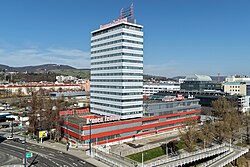
The Rebirth and the Dichand Era
The modern era of the newspaper began in 1959 when journalist Hans Dichand purchased the rights to the name. He refounded the publication as the Illustrierte Kronen Zeitung. Over the following decades, the name evolved through several variations before settling on Kronen Zeitung in 2000.
Under the leadership of the Dichand family, the paper grew into Austria's most influential, yet controversial, tabloid. The ownership structure saw various shifts, including a period of involvement by the German WAZ media group. However, by 2025, the Dichand family successfully acquired the remaining 50% of the shares from Funke Mediengruppe, regaining full control.
Media Methods and Controversies
The Kronen Zeitung has frequently been noted for its aggressive and unorthodox competitive tactics. Throughout its history, the paper has engaged in high-stakes maneuvers to maintain its market dominance:
- Format Competition: In 1963, after a mutual agreement with a competitor to switch to broadsheet format, the Krone maintained its small tabloid format, successfully capturing 40,000 new readers.
- Acquisitions: In 1970, the paper purchased the tabloid Express, subsequently shutting it down.
- Infrastructure Control: In 1972, the paper successfully pressured the BAWAG bank into selling the Pressehaus (a major printing house) to the Krone.
- Legal Battles: In 1995, the paper filed a multi-million Schillings lawsuit against the newspaper Falter, a move critics described as an attack on press freedom.
Beyond business tactics, the paper has faced criticism regarding journalistic ethics. In 2012, it was accused of manipulating imagery by superimposing a photo of a Muslim family onto a war-torn background to create a false narrative regarding Middle Eastern politics.
Political Muscle and Public Influence
The "power of the Krone" is perhaps its most defining characteristic. With a readership that has historically reached nearly three million people, it often holds nearly double the readership of its closest competitor. This massive reach has allowed the paper to exert significant influence on Austrian politics.
Direct and Indirect Political Impact
While much of its influence was historically indirect, the paper has been credited by intellectuals with contributing to the rise of the far-right Freedom Party (FPÖ). In more recent years, its impact has become more overt. In 2008, the paper orchestrated a successful campaign that helped facilitate the leadership change within the SPÖ (Social Democratic Party of Austria), supporting Werner Faymann's rise to Chancellor.
The paper also utilizes campaigns and referendums to drive public discourse. Notable examples include its successful opposition to a hydro-electric power plant at Hainburg an der Donau in the 1980s and its support for various social and political causes.
Publication Profile
Today, the Kronen Zeitung is a daily, color publication consisting of approximately 80 pages in a tabloid format. While it maintains a dominant presence in eastern Austrian states—where it has held market shares as high as 60%—it faces more competition in western regions like Tyrol and Vorarlberg.
| Feature | Details |
|---|---|
| Format | Daily Tabloid (approx. 80 pages) |
| Primary Market | Austria (Strongest in Eastern states) |
| Key Content | Short articles (max 1,600 characters) and extensive commentary |
| Ownership | Mediaprint (Dichand family) |
| Political Leanings | Conservative / Populist |
Frequently Asked Questions
What does the name "Kronen Zeitung" mean?
The name refers to the monthly subscription price of one crown (the currency at the time), rather than a monarchic crown. This pricing model was established after the removal of newspaper taxes in 1899.
How does the newspaper's layout differ from traditional papers?
The Kronen Zeitung uses a tabloid format, which is smaller than a traditional broadsheet (similar to A4 size). It is characterized by shorter article lengths, often capped at 1,600 characters, and a high volume of commentary columns.
Is the Kronen Zeitung a monopoly?
While not a legal monopoly, many observers have noted that the founding of Mediaprint—a joint venture between the Krone and Kurier—created a situation where a single company manages the print, marketing, and sales for a majority of Austria's printed media.
How influential is the paper in Austrian elections?
The paper is considered highly influential. For example, in the 2009 European Parliament elections, a poll indicated that 70% of voters for Hans-Peter Martin's List were readers of the Kronen Zeitung.
Does the paper have regional variations?
Yes. Most editions vary from state to state to cater to local interests, with the exception of Vorarlberg, which does not have its own specific version.