Korea Aerospace University: Leading Aviation and Space Education in South Korea
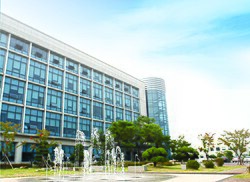
Korea Aerospace University (KAU) is a premier private institution located in Goyang, South Korea, dedicated to the advancement of aviation and aerospace studies. Since its inception, KAU has served as a critical hub for developing the technical expertise required to sustain and grow the civil aviation industry. By blending rigorous academic theory with practical, industry-aligned training, the university prepares students for high-stakes careers in aircraft systems, space engineering, and airport management.
The university is widely recognized for its deep integration with the aerospace sector, offering students unparalleled access to internships and collaborative research through partnerships with global industry leaders.
Key Facts
- Established: June 16, 1952
- Location: Goyang, South Korea (Main Campus), with training centers in Jeju and Uljin
- Student Population: 5,907 (as of 2025)
- Specialization: Aviation, Aerospace, and Air Transportation Logistics
- Accreditation: AABI (Aviation Accreditation Board International) certified
- Key Achievements: First Korean university to launch a CubeSat microsatellite
Institutional History
Foundations and Early Years (1950s–1960s)
KAU was founded on June 16, 1952, during the Korean War. It began as a national school under the Charter for Transport School, granted by the Ministry of Transportation to foster a domestic civil aviation industry. Initially, the institution operated as a two-year college focusing on three core areas: Flight Operation, Aircraft Power, and Telecommunication Engineering.
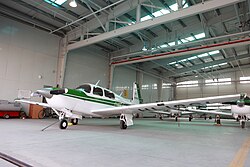
Following the war, the university relocated to Seoul in 1962 before moving to its current home in Goyang City in 1963. This move saw the construction of essential infrastructure, including the Hangar and the Flight Training Center.
Transition and Expansion (1970s–1990s)
A pivotal shift occurred in 1979 when the Jungseok Foundation, established by the Hanjin Group, took over the institution, transitioning it into a private university. This era was marked by significant growth in academic offerings and physical infrastructure. Throughout the 1970s and 1990s, the campus expanded to include the Liberal Arts Building, the Science Building, and specialized facilities for Mechanical and Electronic Engineering.
Modern Development and Global Reach (2000s–Present)
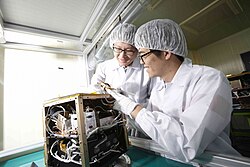
In the 21st century, KAU pivoted toward internal stability and cutting-edge research. In 2006, the university made history as the first in South Korea to develop and launch a CubeSat (a miniaturized satellite). The institution also pioneered breakthroughs in unmanned aerial vehicles (UAV), achieving the nation's first autonomous formation flight and the first solar-powered UAV flight lasting 12 continuous hours.
In 2007, the institution rebranded from Hankuk Aviation University to Korea Aerospace University. To solidify its global standing, KAU secured AABI certification and established strategic partnerships with prestigious institutions such as Embry-Riddle Aeronautical University, the University of Southern California, and General Electric (GE).
Academic Structure and Research
KAU provides a comprehensive educational pathway from undergraduate degrees to doctoral research, ensuring a pipeline of experts for the aerospace industry.
Undergraduate Colleges
- College of Engineering: Focuses on Aerospace and Mechanical Engineering, as well as Electronics, Telecommunication, and Computer Engineering.
- College of Aviation and Management: Specializes in Air Transportation and Logistics, Aeronautical Science and Flight Operations, and Air and Space Law.
- School of Business: Offers degrees in Business Administration and Global Aviation Management.
- School of Liberal Arts and Sciences: Provides foundational studies in General Studies and English.
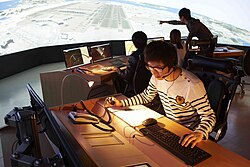
Graduate and Doctoral Studies
The Graduate School offers advanced degrees in technical fields like Space Technology and Materials Engineering, as well as professional degrees in Aviation Management and Air & Space Law. Additionally, the Graduate School of Aviation & Management provides specialized Master's programs in Techno-Management and Airline Management.
Research and Laboratories
The university maintains a vast network of specialized laboratories, including the Rocket Propulsion Laboratory and the Spacecraft Control Laboratory. Its research activities are supported by numerous national projects, such as the Global Surveillance Research Center (GSRC) and the Haneul Project for developing global aviation experts.
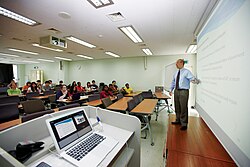
University Overview
The following table summarizes the core administrative and academic details of Korea Aerospace University.
| Category | Details |
|---|---|
| President | Dr. Kangwoong Lee |
| Faculty & Staff | 165 Faculty / 224 Administrative Staff |
| Campus Locations | Goyang (Main), Jeju, and Uljin (Flight Training) |
| Official Colors | Navy cobalt blue |
| Mascots | Peregrine falcon, pine tree, lilac |
| Website | www.kau.ac.kr |
Frequently Asked Questions
When was Korea Aerospace University established?
The university was established on June 16, 1952, originally as a national school to support the development of the civil aviation industry during the Korean War.
What are the primary areas of study at KAU?
KAU specializes in aerospace and aviation, offering programs in aircraft systems, avionics, space engineering, air transportation, logistics, and air and space law.
What is a CubeSat and why is it significant to KAU?
A CubeSat is a miniaturized satellite. KAU distinguished itself in 2006 by becoming the first Korean university to develop and launch one, marking a major milestone in the country's academic space research.
Does KAU have international accreditation?
Yes, the university has received AABI (Aviation Accreditation Board International) certification in several key areas, including flight education, air traffic management, and aviation management.
Where are the university's flight training facilities located?
While the main campus is in Goyang, KAU operates specialized Flight Training Centers in Jeju and Uljin.